What Would Texas Chips Change for Starlink?
By Dalton Skach · 2 min read
Samsung plans to make a chip used in Starlink’s satellite laser links at its Austin factory, Seoul Economic Daily reported on November 15. Samsung declined to confirm individual customer contracts, the newspaper said.1
My read: the potential gain for SpaceX is a more dependable supply of a proven component. But that depends on whether Austin adds usable production alongside France. Moving output closer to home alone would not establish that Starlink can build more satellites.
The chip already has a job
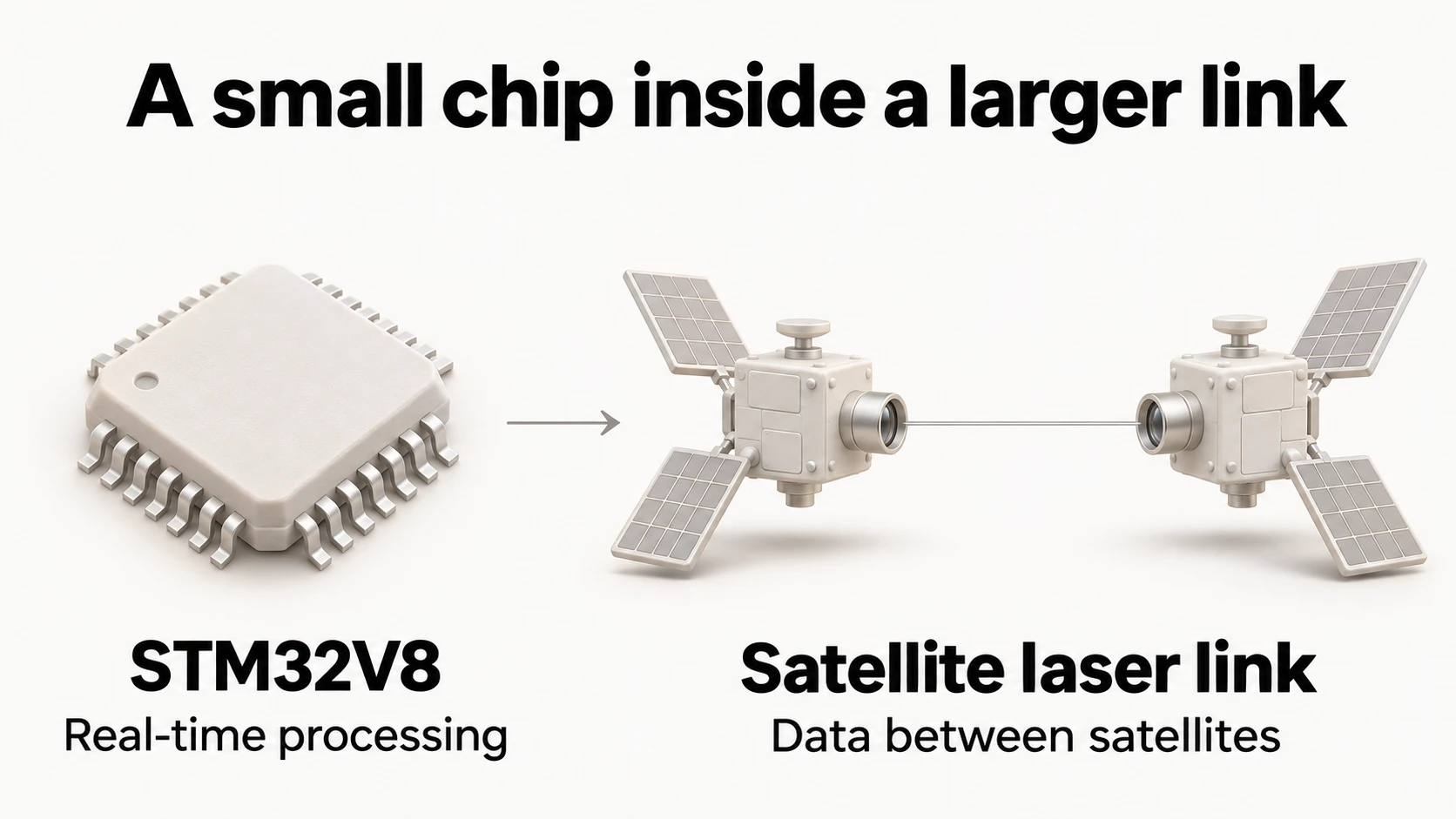
The STM32V8 is a microcontroller, a small computer embedded inside a larger system. STMicroelectronics’ November 18, 2025 launch announcement quoted Michael Nicolls, SpaceX’s vice president of Starlink engineering, confirming its use in Starlink’s deployed mini laser system. The chip handles demanding real-time processing in the system that connects satellites to one another.2
ST identified manufacturing in Crolles, France, and collaboration with Samsung Foundry. Its technical account says the underlying 18nm process was developed with Samsung.3 The new claim is therefore about where production would happen, rather than Starlink adopting a new chip.
A factory budget is not a customer order
The public records support the industrial logic. NIST describes an Austin expansion for FD-SOI chips serving aerospace, defense and automotive customers, with the broader Texas facilities expected to operate by 2030. It does not name Starlink or the STM32V8.4
And the spending is not newly disclosed. A City of Austin document prepared for its November 20, 2025 meeting describes more than $1.9 billion in planned factory retrofits and equipment purchases. That is a facility investment, not a disclosed SpaceX order or a budget dedicated to this chip.5
The business question is what remains available in France once Austin begins. Two qualified locations could give ST and SpaceX more room to work around a disruption. A transfer of the same output could change geography without adding capacity. Neither outcome is established by the records reviewed.

I would watch for ST or Samsung to identify the Austin product, confirm customer qualification and explain the capacity split with Crolles. Until then, this is a plausible supply-chain improvement with an unconfirmed customer link. Evidence of an additional qualified source would make it materially more useful to Starlink than a Texas address alone.
This article reflects Dalton Skach’s views as of November 15, 2026. It provides general research and does not offer personalized investment advice or recommend buying, selling, or holding a security. As of November 8, 2026, Dalton owns shares in Tesla and SpaceX. As of November 15, 2026, Dalton has no financial interests in Samsung or STMicroelectronics. Editorial Standards & Disclosures · Terms of Use
Sources and calculations
- Seoul Economic Daily, November 15, 2026, 구경우. Original Korean report, paragraphs 2–6. Published 18:11:47 KST, or 4:11:47 a.m. Eastern. Reports planned Austin STM32V8 production; its unnamed industry source describes increased likelihood. Samsung’s refusal to confirm customer contracts is reported by the newspaper. The text says Austin would also manufacture the product; it does not quantify a transfer, added capacity, order size or qualification milestone. No separate contract-announcement date is established. ↩
- STMicroelectronics, press release P4733S, November 18, 2025, page 1, opening paragraph and Michael Nicolls quotation. Confirms STM32V8, Crolles manufacturing, Samsung Foundry collaboration and deployment in the Starlink mini laser system. This precedes the December 2025 date in the supplied update. ST identifies itself as NYSE: STM; this is a product release, not a securities filing, so no filing accession applies. ↩
- ST technical blog, November 18, 2025, “18-nm” and “Proven track record” sections. Describes process collaboration with Samsung and the processing, memory and environmental requirements of SpaceX’s application. It does not identify Austin as the manufacturing site. ↩
- NIST, Samsung Electronics (Texas), “Economic and National Security Impact,” Austin paragraph, and “Facility Summary.” Describes FD-SOI expansion and a project-wide operational expectation by 2030. Reviewed November 15, 2026; the page is a project disclosure, not a November 15 customer announcement. No Starlink-specific delivery date is supplied. ↩
- City of Austin, File 25-2214, agenda item 10, page 1, “Additional Backup Information.” Printed November 7, 2025 for the November 20 meeting. Records a planned investment exceeding $1.9 billion in retrofits and equipment. A recommendation for enterprise-zone nomination is not proof of completed spending or a customer contract. ↩
Research cutoff: November 15, 2026. The production-allocation and resilience discussion is BTF analysis. No revenue, wafer-volume or satellite-output estimate is calculated. The sources reviewed do not establish a direct Samsung–SpaceX contract for Austin. Original AI-generated photography and sculpted illustrations are conceptual, not documentary evidence. Prompts and provenance are preserved with the draft. Editorial standards.
Go deeper: 51 Percent
How could more dependable chip supply support a larger Starlink network?