51 Percent
Why one launch changes how big Starlink can get
View contents
Prologue: The Arms Close
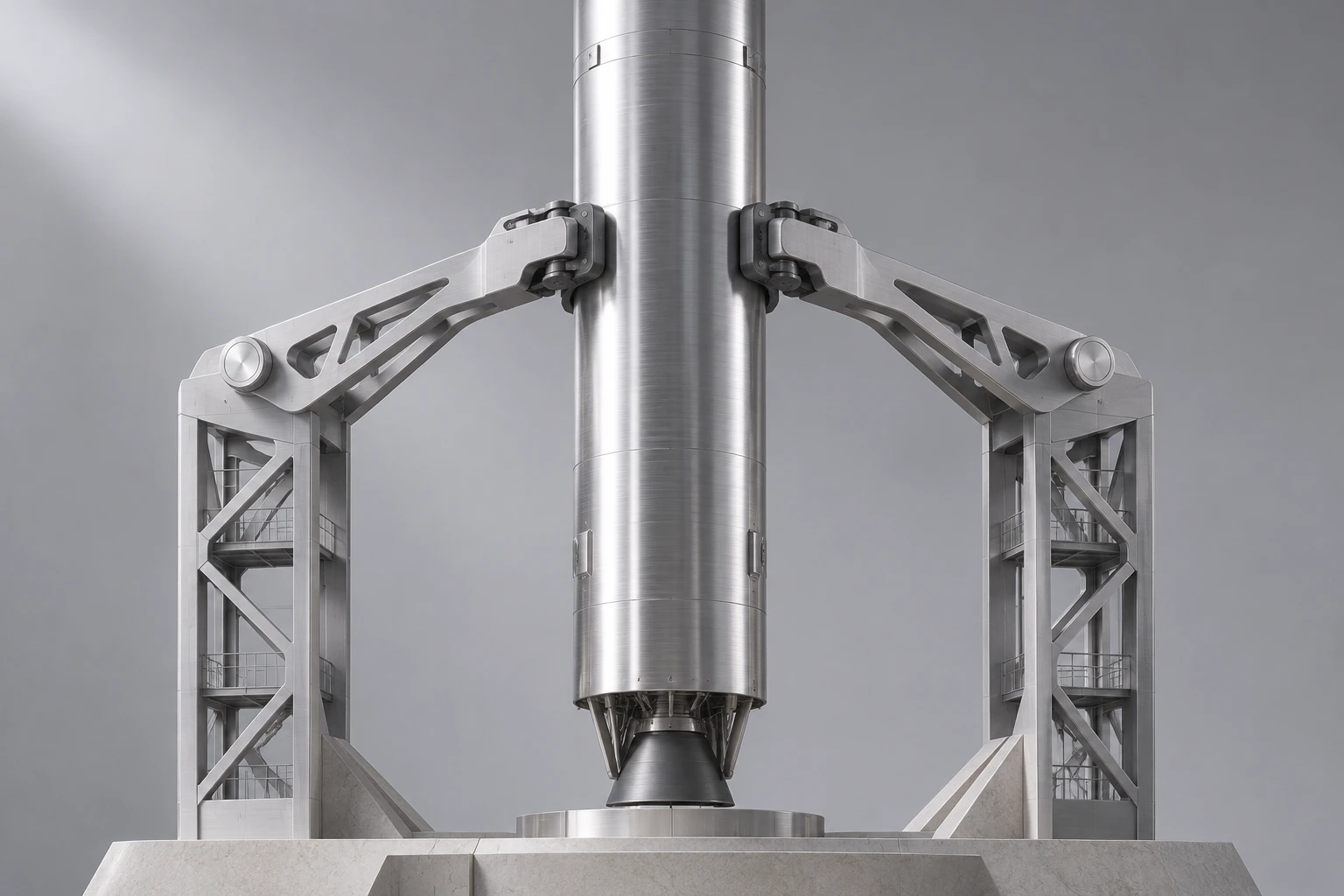
A little after three o’clock on the afternoon of Saturday, November 14, 2026, a stainless-steel spacecraft returned from orbit to the South Texas coastline it had left twenty-two and a half hours earlier. In between, it had circled the Earth, opened a door in its side, and let go of twenty-six satellites. Now it was coming back to the tower.
The tower at SpaceX’s Starbase launch site has two enormous mechanical arms. Engineers call them the chopsticks; the company’s fans call the whole structure Mechazilla. They had caught returning boosters, the rocket’s lower stage. They had never caught the upper stage, the part that actually goes to orbit and has to survive the fire of reentry. This time the ship came home. At 3:21 p.m. Central time, SpaceX opened a post with three words and an exclamation point: “Mechazilla catches Starship!”
For a program that had spent years losing prototypes in public, the sight of the ship held in the tower’s arms was a moment of something like vindication. But a recovered ship and a reusable ship are not quite the same thing. The next test would happen after the cameras moved on.
Later that afternoon, the company posted a summary that would have sounded like marketing from anyone else: on Saturday, Starship “returned to Starbase, Texas, and changed everything.”
Most of the coverage that weekend was about the catch, and it deserved to be. A rocket that can land and fly again changes the economics of everything that goes to space. But the clue that matters most for this story came the day before, about ten minutes before liftoff, in a short post on SpaceX’s account on X. It did not mention the catch at all.
Today’s flight will deploy 26 @Starlink V3 satellites, furthering our goal of Starlink becoming 51% of the internet.
SpaceX, post on X, November 13, 2026
Read it twice. Not a slice of the satellite-internet market. Not rural America. Not the places the cables never reached. Fifty-one percent of the internet: an ambition to carry a majority of the traffic on the network that now carries the world’s banking, shopping, war reporting, love letters and, increasingly, the conversations between machines.
In my series on the future of wireless, I argued that Elon Musk’s push to become your phone company was one piece of something bigger. This series is about the bigger thing. Its question is simple to ask and hard to answer: what happens to the world when one private company becomes part of the internet itself? Before we can ask what Starlink means for farms and ships, for governments and wars, for competitors and regulators, we need to understand the machine and the ambition. Where did “51 percent” come from? What does it actually mean? And why does a satellite launch, not a rocket landing, explain how SpaceX thinks it can get there?
I. Twenty-Six Terabits
Flight 15 lifted off from Starbase’s second launch pad at 4:47 p.m. Central time on Friday, November 13. On paper, it was the most ambitious flight in the Starship program’s history: the first attempt to bring back both halves of an orbital rocket and catch them on the tower.
Half of that plan failed within minutes. The Super Heavy booster, the 33-engine first stage, separated cleanly and began its trip home. Then something went wrong. Viewers saw a green tinge in the engine plume. The booster never came back to the tower. SpaceX diverted it to a splashdown offshore, and it exploded just above the water, its remaining fuel burning on the surface of the Gulf. The next morning Musk explained on X that the green flame was copper burning inside the engines, a sign they were running short of fuel. The engines had slightly underperformed, he wrote, and a booster designed to land with almost nothing left in its tanks had too little for the trip home. The fix, he said, was better engine performance and shutting the main engines down about one second earlier. “This booster loss does not change our timeline,” he added.
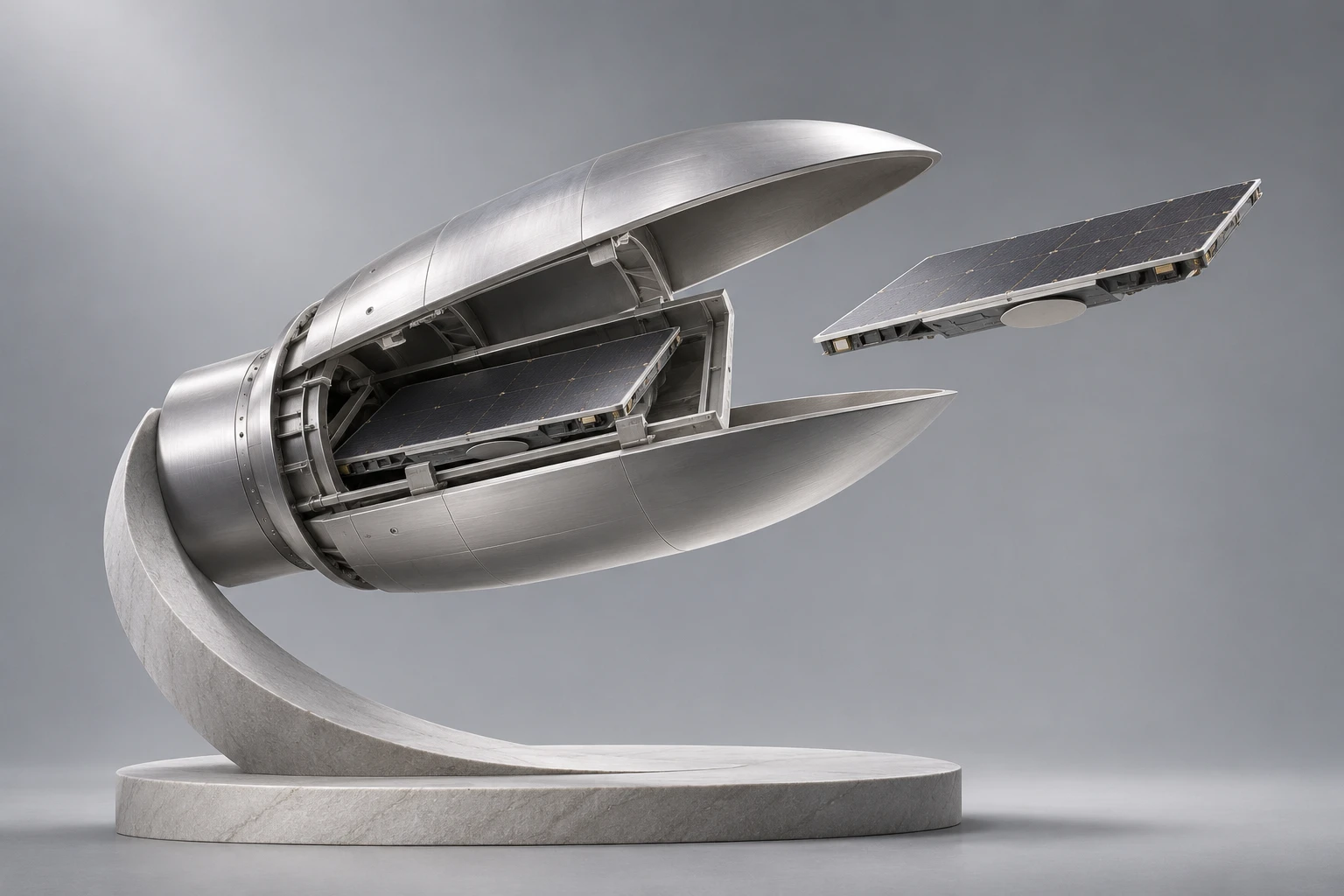
The upper stage, Ship 42, kept going. It reached orbit, opened a slot in its side that works like a candy dispenser, and deployed twenty-six satellites. The payload had reached its destination even though the booster had not made it home.
Those twenty-six satellites are the real news. They are Starlink’s third generation, called V3, and they are not small upgrades. SpaceX says each one can send about one terabit per second of data down to Earth. A terabit is a trillion bits. A terabit per second is a rate of transmission, roughly enough to stream tens of thousands of high-definition movies at the same moment. The company’s Starlink account put it more simply during the flight: this payload would “add up to 26 Terabits of capacity to the constellation.” That night, Musk added a forecast. “Future Starship flights will carry over 50 Tb/s of Starlink bandwidth to orbit,” he wrote.
This was not the first time Starship had carried V3s. On July 24, Flight 13 tested their deployment on a suborbital path. On September 28, Flight 14 became the first Starship to reach orbit and deployed twenty-six V3 satellites. SpaceX reported making contact with all twenty-six; checkouts and orbit raising would come before service. Engine issues prompted a shorter coast and a controlled return to the Pacific. On SpaceX’s earnings call three weeks later, Musk said that single flight, which he described as “maybe half loaded,” had put up as much Starlink capacity as ten launches of SpaceX’s workhorse Falcon 9 rocket.
Then came the long wait. For most of a day, Ship 42 coasted around the planet. SpaceX’s flight plan included successive checks before committing to the return, with opportunities to bring the ship down at sea instead. On Saturday afternoon, the company announced that controllers had polled go to return it to Starbase. A deorbit burn set up reentry, and the ship came back to the tower.
So Flight 15 was the second flight in a row to deploy a substantial new payload for Starlink’s next generation. And it ended with the upper stage recovered. Whether that ship could be inspected, prepared and flown again was still to be demonstrated.
That combination, a much bigger satellite and a rocket that may soon be reusable from top to bottom, is why the weekend was bigger than it looked. Each piece alone is impressive. Together, they change the math of how large Starlink can become. SpaceX reported roughly 9,600 Starlink satellites as of March 31, 2026, and has continued launching since. The company now talks about a hundred thousand. To understand why it wants that many, and why it believes it can afford them, you have to go back to a winter night in Seattle, more than a decade ago, when Musk first described what he was building and why.
II. Rebuilding the Internet in Space

On Friday evening, January 16, 2015, Musk stood alone on a stage at Fisher Pavilion, at Seattle Center, wearing a black insulated jacket over a white shirt. It was a private recruiting event, about four hundred engineers, no press. Someone in the audience filmed it anyway, and the GeekWire reporter Todd Bishop later transcribed the talk. Reading it now is a strange experience. Much of the ambition driving SpaceX this month is already visible in it.
Musk was there to open SpaceX Seattle, a new office that would design satellites. The rockets were in Los Angeles. This would be something different.
The focus is going to be on creating a global communication system. This is quite an ambitious effort. In the long term, it will be like rebuilding the Internet, in space. The goal will be to have a majority of long-distance Internet traffic go over this network, and about 10 percent of local consumer and business traffic.
Elon Musk, SpaceX Seattle opening, Seattle Center, January 16, 2015 (GeekWire transcript)
There it is, eleven years before the post on X: a majority. The argument he made for it was about physics. Light travels faster through a vacuum than through glass fiber, he said, somewhere around forty to fifty percent faster. He contrasted a terrestrial route through many routers and repeaters with a handful of hops through space. “From a physics standpoint,” he said, “it’s inherently better to do long-distance Internet traffic through space.” The physical advantage is real, though the delay a customer experiences also depends on the route, the ground links and the equipment along the way. Space was also good, he added, for “sparse connectivity”: places with lots of land and not many people.
He knew he was walking onto a graveyard. Seattle had been home to Teledesic, a 1990s plan for a global satellite internet backed by Bill Gates and the wireless pioneer Craig McCaw, which collapsed before it launched a real network. Iridium, the satellite phone system, had gone bankrupt in 1999 after building a constellation of about seventy satellites. Musk’s answer was manufacturing. Traditional satellites were built like Battlestar Galactica, he said, one giant, precious machine at a time. His would be built more like cars or consumer electronics. If one failed, you would steer it out of the sky and launch another. It was, he said, the difference between a mainframe and a warehouse full of cheap PCs.
The money was already starting to arrive. Within days of the Seattle talk, reports surfaced that Google was close to investing in SpaceX, and on January 20, 2015, the company announced that Google and the investment firm Fidelity had put in about a billion dollars. Satellites were the obvious attraction. Musk estimated that night that the full system would cost ten to fifteen billion dollars to build, “maybe more.”
Then he explained what the money was for.
This is intended to generate a significant amount of revenue, and help fund a city on Mars. So in looking in the long term, and saying what’s needed to create a city on Mars, well one thing’s for sure: a lot of money. So we need things that will generate a lot of money.
Elon Musk, Seattle, January 16, 2015
Two other lines from that night are worth holding onto. Asked about the schedule, Musk said he had been “a little optimistic” in the past, then predicted a useful first version in about five years and full capability in twelve to fifteen. Starlink opened its public beta in October 2020, about five years and nine months later. The third-generation satellites began reaching orbit this fall. The first step arrived reasonably close to his estimate. The full ambition is a different test, and one it has not yet passed.
The other line is the one this series will keep returning to. Near the end of his prepared remarks, Musk said: “I think this is a fundamentally good thing to do. I can’t think of any major downsides.”
In 2015, that sounded reasonable. A few thousand satellites, about four thousand by his estimate, giving people in poor countries and in Comcast territory a new option. He imagined a system that would carry ten percent of local traffic, while “90 percent of people’s local access will still come from fiber.” The network he described was a complement to the internet: a faster express lane for long distances and a lifeline for places the wires didn’t reach.
It is also worth remembering how hard Musk pushed to get there. In 2018, with the first test satellites barely in orbit, Reuters reported that he had fired at least seven senior managers on the Starlink program in Redmond because they were moving too slowly. The first batch of sixty satellites went up in May 2019. The pattern would repeat for years: a public vision, a private impatience, and a schedule that seemed impossible until, often a little late, it wasn’t.
That is not quite the network SpaceX described in its post this week. Somewhere between Seattle and Starbase, the goal changed shape. To see how, you have to read “51 percent” carefully.
III. What Fifty-One Percent Means

The SpaceX post does not define its terms. “Starlink becoming 51% of the internet” could mean several different things. It could mean half the world’s internet users. It could mean half the world’s network capacity. It could mean half of the money people spend on connectivity. Those are not the same, and the gap between them is where most of the confusion lives.
The company’s founder has been clearer. Over the past six months, Musk has repeated a version of the same claim on X, and each time the unit is traffic, the actual data flowing over the network. In May, replying to a post about the V3 satellite, he wrote that “if growth continues, Starlink will one day carry the majority of Internet traffic.” On August 8, responding to the investor David Friedberg’s argument that Starlink alone could be worth a trillion dollars, he went further.
It’s not out of the question that Starlink carries more than 50% of Internet traffic long-term, which would probably be over a trillion/year. There is no obvious impediment to that outcome so far.
Elon Musk, post on X, August 8, 2026
On September 27, the day before Flight 14, he made the sharpest version of the argument, in a sentence that could serve as this series’ epigraph.
It is increasingly probable that Starlink will carry a majority of Earth’s IP traffic long-term. At that point, Starlink would de facto become the Internet and everything else would connect to Starlink.
Elon Musk, post on X, September 27, 2026
So “51 percent” is shorthand for a majority of traffic. It is a goal, not a measurement, and the company has not published a date for it. SpaceX has not provided a public measure of its share of global internet traffic or a consistent denominator against which to test the ambition. Fiber still carries the overwhelming majority of data between continents. Cloudflare observed about 2.3 times as many requests from Starlink’s network in 2025 as at the start of the year. That is evidence of fast growth within Cloudflare’s view of the web, not a census of all the world’s data.
It helps to see why the unit matters. SpaceX reported 13.6 million consumer subscriptions at the end of September. The United Nations’ telecommunications agency estimates 6.3 billion people online worldwide in 2026. Those are different counts: one subscription can serve a household, a school or a ship. Capacity is different again. It measures how much data a network can carry, while traffic measures how much actually travels over it. A bigger pipe makes the ambition possible. It does not, by itself, fill the pipe.
Compare the 2026 claim with the 2015 one and two changes stand out.
The ambition broadened. In Seattle, the majority was of long-distance traffic, the express lane between cities and continents, plus about ten percent of local connections. Now the majority is of everything.
The rationale changed. In 2015, the argument was physics: light is faster in a vacuum. In 2026, the argument is demand. On the October earnings call, Musk said he expected the world to want perhaps a thousand times more bandwidth within three to five years, because AI agents and robots “will, even up on a per-agent basis, use far more bandwidth than a person, and there will be far more agents than there are people.” If the pie grows a thousandfold and most of the growth comes from machines, the argument goes, then whoever builds new capacity fastest ends up with most of the pie.
There are good reasons to be skeptical, and some come from Musk himself. The day after the launch, when a fan marveled at how much capacity a single Starship could add, he pushed back. “This is not as good as it sounds,” he wrote, “because Starlink required many satellites in low Earth orbit to achieve this bandwidth improvement globally.” He is pointing at a basic fact about satellites in low orbit: they are always moving, and most of the time most of them are over oceans, deserts and polar ice, where almost nobody lives. A terabit in orbit is not a terabit over Manhattan. In the same post, he added, “Good chance that this system carries about half of global traffic.” Note the hedge: a good chance, not a plan.
His own president offered another wrinkle. On the earnings call, Gwynne Shotwell estimated that most mobile connectivity travels over Wi-Fi, and noted that Starlink dishes can feed Wi-Fi networks. A single connection can pass through several networks on its way to a destination. Counting it as Wi-Fi traffic does not stop it from also being satellite traffic. Before anyone can establish a majority, they have to say what they are counting, over what period, and where.
Still, the direction of the claim is what matters for this series. A network that carries ten percent of local traffic is an alternative. A network that carries most of the world’s traffic, and that “everything else would connect to,” is infrastructure in the way roads and power lines are infrastructure. That is a different kind of thing, with a different kind of responsibility, and it raises the question every other part of this series will ask: who answers for it?
Before we get there, there is a more practical question. A goal like that is enormously expensive. Who pays for it?
IV. The Machine That Pays
For most of its life, SpaceX did not have to show the public its books. That changed on June 12, 2026, when the company began trading on the Nasdaq under the ticker SPCX after one of the largest stock offerings in history. Its prospectus, and the quarterly reports since, answer a question people have argued about for years: does Starlink actually make money, or is it a science project kept alive by government contracts?
The answer is clear. Starlink makes money, a lot of it. Its Connectivity segment was SpaceX’s largest contributor to operating profit in the third quarter of 2026. In 2025, what the company calls its Connectivity segment, essentially Starlink, brought in about $11.4 billion in revenue and earned about $4.4 billion in operating profit. The rocket business, the part most people think of when they hear “SpaceX,” lost money on an operating basis that year, as the company poured billions into Starship. In the third quarter of 2026, Starlink’s revenue rose to about $5.2 billion for the quarter, up sixty-nine percent from a year earlier, with operating profit of about $2.4 billion. The company ended September with 13.6 million consumer subscribers in 174 countries and markets, alongside its enterprise and government business.
One detail matters for anyone who suspects the profits are an accounting trick. Starlink’s costs include the launches that put its satellites in orbit. SpaceX treats those launches and the satellites themselves as long-lived assets and spreads their cost over their working lives, and the prospectus shows that depreciation as a large and growing line in Starlink’s cost of revenue. The network is not getting free rides on its parent’s rockets in the books.
What about the government? Here the honest answer has two parts. Federal agencies are important customers of SpaceX, buying launches, crew and cargo services, and connectivity. Within Starlink, sales to businesses and governments are reported together. In 2025, most of the growth in that category came from enterprise customers, especially mobile connectivity, while government connectivity added a smaller amount. In its third-quarter results, the company highlighted Starshield, its secure government network, as a contributor to growth.
That last point is the complication. Starshield’s revenue is not broken out. The segment results show that Connectivity as a whole is profitable. They do not tell us whether the consumer and commercial operations would produce the same result without government business. Nor is operating profit cash in the bank: new satellites and launches require spending now, while their cost reaches the income statement over time. The network is a strong earnings engine. Its separate cash contribution to every other SpaceX project is not disclosed.
Where the money goes is the more revealing story. In 2015, Musk said Starlink would fund a city on Mars. It still might. SpaceX’s board has tied a large block of Musk’s shares to two conditions: hitting a series of market-value targets, and establishing a permanent human colony on Mars with at least a million people. But in February 2026, SpaceX acquired xAI, Musk’s artificial-intelligence company, and with it Grok and X. Today the company reports a third segment, which it calls Super Intelligence. In the third quarter, that segment spent about $16 billion on capital projects, mostly computer chips and data centers, compared with about $1.5 billion for Starlink. Starlink is now the steady earner in a company that is spending at a pace few businesses have ever attempted.
The turnaround in SpaceX’s overall results shows how quickly the mix is changing. In the second quarter of 2026, the company lost about $541 million. In the third, it reported net income of about $4.4 billion on revenue of $14.6 billion, more than two and a half times what it had brought in a year earlier. The AI segment became the largest source of revenue for the first time. Starlink remained the largest contributor to segment operating profit, though the AI segment also reported positive operating income. Enterprise and government revenue grew faster than consumer revenue. SpaceX said Starlink was now under contract for roughly twelve thousand airplanes, a contracted figure rather than a count of installations, and that it had quadrupled production of its aviation equipment since the start of the year. Shotwell told analysts that business and government revenue were each on track to eventually exceed consumer revenue.
The distinction matters because SpaceX is doing several expensive things at once. A strong subscription business gives it an earnings base that a launch-only company would not have. How much cash can be moved from that business into rockets, chips or data centers depends on the network’s own investment needs as well as the rest of the company’s finances.
That is the economic logic behind “51 percent.” More paying demand could support more investment, and more investment could support a larger network. But traffic alone does not pay the bills. What matters is what customers will pay for it, and what it costs to deliver. Musk said on the October call that he saw “a clear path to several hundred billion dollars a year in connectivity revenue.” That is his forecast. The question is whether the network can grow efficiently enough to earn it.
V. Users at the Edge

The first public version of Starlink, in the fall of 2020, was called the “Better Than Nothing Beta.” That name was a kind of honesty. Early users paid $499 for a dish and $99 a month for service that could suffer interruptions as the early constellation provided incomplete coverage. Musk had predicted in Seattle that user terminals would cost between $100 and $300. Like many of his forecasts, the direction was right and the price came later.
For the people it reached, though, “better than nothing” was transformative. For a farm family limited to a slow cellular hotspot, a fast satellite connection could make video calls, streaming and running a business possible. Part Two of this series will spend time in those places. What matters here is a quieter consequence of Starlink’s success: in the places where it became popular, it started to fill up.
A satellite network has a hard limit on how much data it can deliver to any one area. Every satellite has a fixed amount of capacity, and it has to share that capacity among everyone under it. In crowded rural regions, especially parts of the United States, that meant slower speeds at peak hours, and eventually Starlink stopped selling new home service in some places. It showed “sold out” on its maps. In others it charged a one-time “demand surcharge” to new customers. In some areas, according to reporting by PCMag, that surcharge reached as much as $1,500.
That is an unusual problem for a technology company. It is not a software bug you can patch overnight. A major part of the answer is more capacity overhead: more satellites, better satellites, or both. Spectrum, ground infrastructure and the way the network allocates capacity matter too. And for most of Starlink’s life, the satellites were limited by the rocket. The Falcon 9 can only fit so much in its nose. Starlink’s current workhorse, a satellite SpaceX calls the V2 Mini, is literally a shrunken version of the satellite engineers wanted to build, sized to fit the rocket they had.
The capacity problem is not only on farms. SpaceX reported more than 3,800 aircraft equipped with Starlink as of September 30. On the October call, Shotwell said customers on Starlink-equipped flights fill planes more fully, and that full connectivity is “quickly becoming table stakes for passengers.” Ships, oil platforms and remote mines use it too. After disasters, Starlink dishes have become a standard part of the emergency kit; in the third quarter alone, SpaceX said, it supported the response to twenty-five crises, including donating more than 1,400 kits after an earthquake in Venezuela. Every one of those uses needs capacity in the right place at the right time. Capacity over the Atlantic cannot simply be treated as capacity available to a family in rural Montana.
There is a second constraint that shows up in the numbers. As Starlink expanded into poorer countries and offered cheaper plans, the average amount each subscriber pays dropped. In 2025, the company’s number of subscribers roughly doubled while revenue per subscriber fell by about eleven percent. In the third quarter of 2026, consumers paid an average of $69 a month, down from $83 a year earlier. The latest figure was up from $66 in the previous quarter, so the decline was not continuous. Still, adding customers at lower prices puts pressure on the cost of delivering each connection.
On the October call, a shareholder asked the obvious question. When will the new satellites actually make things faster? Shotwell’s answer was refreshingly concrete.
I think we’ll need a few hundred V3 satellites for people to really feel the impact, because right now with very few satellites, you’ll get an impact and then 10 minutes later it won’t be there. So a few hundred satellites, and I think we can achieve that by mid-next year.
Gwynne Shotwell, SpaceX president, third-quarter earnings call, October 20, 2026
That is the user’s version of the story. Flights 14 and 15 have deployed fifty-two V3 satellites between them. A few hundred are needed before the difference shows up reliably on the ground. Getting from one number to the other depends on two machines: the satellite, and the rocket that carries it.
VI. The Bigger Satellite
A Starlink satellite is, at heart, a very fast router with solar panels. It listens for signals from dishes on the ground, passes the data along, and sends replies back down. Older satellites relayed traffic through ground stations. Newer ones also pass it to each other with lasers, so data can cross an ocean entirely in space before coming down near its destination, which is exactly the shortcut Musk described in Seattle.
Inside, the important parts are antennas called phased arrays. Instead of a dish that physically turns to point at you, a phased array is a flat panel made of many small antenna elements. By adjusting the timing of each one, the satellite can steer its signal electronically, aiming many narrow beams at different spots on the ground at once and moving them as it flies overhead. Think of the difference between a single flashlight and a stadium full of spotlights, each tracking a different person.
The V3 is a much bigger version of that idea. SpaceX describes a design with about one terabit per second of downlink capacity and about 160 gigabits per second of uplink capacity. Those are company capacity claims, not measured speeds for an individual customer. Upload matters more than it used to. Cameras, video calls and machines sending sensor data can place heavy demands on the path back to the network, though they do not all send and receive equal amounts.
The new satellites do not start work the moment they leave the rocket. They have to complete checkouts and use their electric thrusters to reach their operating orbits. Low deployment orbits also help satellites that fail come down sooner. That is why a successful launch, a healthy satellite and reliable service on the ground are three different milestones.
There is one catch. The V3 is too big for the Falcon 9. That is not a side detail. It is the reason the satellite and the rocket arrive together. SpaceX’s prospectus says a single Starship launch will be able to deploy up to sixty V3 satellites, “representing a potential twenty-fold” increase over what a Falcon 9 Starlink launch adds. Flights 14 and 15 each carried twenty-six. Musk’s post after Flight 15, promising more than fifty terabits per flight, implies loads closer to the full sixty.
On the October call, Musk laid out the arithmetic he is aiming for.
What I expect over time is, not in the distant future, probably within three years, is that we will have about 100 times the bandwidth of the current Starlink constellation. Because we will have launched satellites with an order of magnitude more bandwidth, and we will place into orbit an order of magnitude more Starlink satellites. Probably something on the order of 100,000 satellites.
Elon Musk, third-quarter earnings call, October 20, 2026
That hundred thousand is not just talk. On September 18, 2026, the Federal Communications Commission accepted for review a SpaceX application for a third-generation Starlink system of up to a hundred thousand satellites. Accepting an application is not approving it. The notice opened the filing to regulatory consideration. It was not permission to launch the proposed fleet. The eventual authorization, if granted, could differ from the application.
It is worth pausing on the scale. When Musk spoke in Seattle, there were fewer than two thousand working satellites of any kind in orbit. As of March 31, 2026, SpaceX said, its roughly 9,600 Starlink satellites made up about three-quarters of all the active satellites in orbit that can maneuver. A hundred thousand would be roughly ten times that March count.
Is it plausible? The satellite part looks increasingly real. Two orbital flights have deployed fifty-two V3 satellites between them. Whether they deliver their promised performance in daily service is something only months of operation will show. The harder part is the other machine, the one that has to carry them up, and come back, and go up again. Which brings us back to the tower.
VII. The Hinge
SpaceX’s first great trick was making the bottom half of a rocket reusable. In December 2015, a Falcon 9 booster landed upright for the first time. In 2017, SpaceX first reflew an orbital-class booster, then built reuse into a routine operation. Reuse helped lower the cost of supplying Starlink with launches. SpaceX could build a network around its own flight schedule, using rockets it did not have to replace after every mission.
But the Falcon 9 still throws away its upper stage on every flight. Starship is designed to throw away nothing. The booster comes back to the tower. The ship comes back to the tower. Both are refueled and flown again, ideally within hours, the way an airliner is. SpaceX argues that this could eventually cut the cost per kilogram of reaching orbit by ninety-nine percent or more compared with a historical average cited in its prospectus. That is a forecast against a historical benchmark, not a saving already demonstrated by Starship. If that is even half right, the cost of putting a satellite in orbit becomes a much smaller constraint on how big a constellation can get.
That is why the catch matters so much to Starlink, even though the satellites were already deployed when it happened. Saturday was the first recovery of a Starship upper stage from orbit at the launch site. A rocket that carries sixty V3s but is thrown away each time is an expensive way to build a network. A rocket that carries sixty V3s and flies again next week is a factory conveyor belt.
SpaceX’s own filings are candid about what happens if that doesn’t work. In the risk section of its prospectus, the company says that without full reusability and rapid turnaround, Starship “would still be capable of enabling progress on our next-generation Starlink,” but “at a slower pace and higher cost.” In other words: V3 can happen with a disposable Starship. A hundred thousand satellites, and fifty-one percent, probably cannot.
The schedule is the main risk, and it should be named plainly. On the October call, Musk said he expected Starship to fly weekly at some point in the first half of 2027, and twice weekly or more by the end of that year. Shotwell said the company aims to refly a caught ship by early next year. These are Musk timelines, and Musk’s own 2015 self-assessment applies: “in the past I’ve been a little optimistic on schedule.” Flight 15 itself was a reminder that this is still a test program. One half of the rocket came home. The other exploded over the Gulf. A caught ship is not yet a reused ship, and the real test of the weekend will come when Ship 42, or one like it, flies again.
SpaceX is building as if the schedule will hold. In October, it announced a new Starship launch site in Louisiana, which Musk said could eventually have twenty or more launch towers and “enable the transport of millions of tons per year to orbit and beyond.” Its internal goal for a first launch from Louisiana is 2028; Musk called 2029 “highly likely.” Multiple pads are under construction at Starbase and at Cape Canaveral in Florida. Those are not the investments of a company that expects Starship to fly a handful of times a year.
There is a second reason the catch matters, and it has nothing to do with the internet. A specialized Starship variant is the lander NASA has hired SpaceX to develop for astronauts on the Moon. To get there, Starship has to be refueled in orbit by a series of tanker flights, whose economics depend heavily on the cost and cadence of those launches. NASA now plans to test docking with both SpaceX’s and Blue Origin’s landers in Earth orbit in 2027, and to land astronauts in 2028 with whichever lander is ready first. SpaceX says it will attempt its first ship-to-ship refueling early next year. That race deserves its own series. For now, it is enough to notice that the arms that closed on Saturday were catching more than a satellite truck.
Inside SpaceX, the rocket and the satellite are not two businesses. They are one loop. Starlink gives Starship a customer that never stops ordering launches. Starship gives Starlink a way to grow without hitting the ceiling of the Falcon 9. Starlink’s earnings strengthen the company behind both, though the filings do not trace a separate stream of cash to each project. That loop has been running for years. What changed this fall is that both halves got much bigger at once, and a third piece has been added to the loop: the machines that will use the network.
VIII. A Network for Machines

In my series on the future of wireless, I traced how SpaceX moved from using T-Mobile’s airwaves toward acquiring its own: an initial spectrum deal of about $17 billion with EchoStar, followed by further spectrum agreements. The FCC approved the EchoStar transactions in May 2026. In October, SpaceX agreed to acquire nationwide 800 MHz licenses, with closing expected in the first half of 2027, subject to approvals. I argued in “The Last Piece of the Puzzle” that direct-to-cell service, satellites talking straight to the phone in your pocket, was one piece of a bigger network. Seen from Starbase this week, that piece fits into a much larger picture.
On the October call, Musk described the connectivity business as a stack. At the top are the broadband satellites carrying traffic to dishes. Alongside them, a new generation of satellites built to talk directly to phones, which SpaceX plans to start launching in 2027. On the ground, small radios mounted on the homes and businesses that already have Starlink dishes, turning millions of existing customers into tiny cell sites. And underneath all of it, spectrum the company has acquired or agreed to acquire. “We will be building out our terrestrial network such that there is broad-based connectivity anywhere that SpaceX and Starlink are allowed to operate,” he said.
That phone piece began modestly. In August 2022, Musk stood on a stage at Starbase with T-Mobile’s chief executive under a banner reading “Coverage Above and Beyond” and promised that ordinary phones would one day connect to Starlink in places with no cell towers. T-Mobile’s satellite texting service launched commercially in July 2025. It was useful in a canyon or after a hurricane, and it was limited, because SpaceX was borrowing a thin slice of T-Mobile’s airwaves. SpaceX is now building around its own spectrum strategy, including purchases that have been approved and one that has yet to close. On the October call, Shotwell explained that the higher-frequency spectrum from EchoStar would carry most of the traffic, while the planned low-frequency layer would help coverage reach inside buildings. Readers of the wireless series will remember the carriers’ response. From this vantage point, the phone business is no longer the destination. It is one more on-ramp to the same network.
Then there is the part of the stack that doesn’t serve people at all. On January 30, 2026, SpaceX asked the FCC for permission to launch up to one million satellites for what it called an “Orbital Data Center” system: solar-powered computers in orbits between 500 and 2,000 kilometers up, linked to each other and to Starlink by lasers. The filing said the system would be a first step toward a civilization “that can harness the Sun’s full power.” It did not include a timeline. The FCC accepted it for filing on February 4. SpaceX had completed its acquisition of xAI on February 2. Acceptance was not authorization for the fleet. In July, a trade publication reported that SpaceX planned to carry “Starmind” AI satellites on Starship. In its third-quarter call, the company said it would begin flying them in 2027.
Put those pieces next to one another and the shape of the ambition becomes clearer. SpaceX wants to make the rockets, the satellites that carry the internet, the phones’ connection to those satellites, the AI that generates much of the new traffic, and possibly the computers in orbit that run that AI. The proposed loop is easy to see. AI could generate more demand for connections; paying demand could support more investment in rockets, satellites and chips. Whether those connections need to pass through Starlink, and what customers would pay for them, is the business question.
This is where “51 percent” stops sounding like a boast and starts sounding like a business plan. If, as Musk argues, most of the world’s future data will be generated by machines, and if SpaceX owns many of the machines and much of the network they talk over, then a majority of traffic is not a matter of winning customers one household at a time. It could become part of a much larger system. But owning the machines does not guarantee that their traffic will travel through space.
This is also the place to apply the most skepticism. Orbital data centers are unproven. Experts quoted by the BBC when the filing was made pointed out that launching, cooling and protecting computers in space is hard and expensive, and that crowding low orbit with more hardware increases the risk of collisions. A million satellites is a filing, not a fleet. The idea that AI agents will soon consume a thousand times more bandwidth than humans is a forecast from someone who sells bandwidth. Bot requests, AI-agent activity and total internet data volume are different measures. None of them by itself tells us how much traffic needs a satellite rather than a fiber line between two data centers.
Still, the pattern is consistent with everything SpaceX has done. In the wireless series, I described Musk’s habit of building around gatekeepers rather than negotiating with them: the spectrum acquisitions gave SpaceX another path alongside its carrier partnerships. The same instinct is visible here. Rather than renting capacity on someone else’s network, or relying on someone else’s data centers, SpaceX is trying to own every layer between its machines and the world. Which raises the question most readers will ask first: isn’t this really just a race against Amazon?
IX. Is This About Beating Amazon?
As SpaceX brought its ship home, Amazon was preparing a different milestone. Its November 14 mission update targeted November 15 for the first Vulcan flight carrying Amazon Leo satellites, the constellation formerly known as Project Kuiper. The planned payload was forty satellites, the first delivery in a thirty-eight-launch Vulcan contract. It was a reminder that a satellite network grows one launch at a time.
The comparison writes itself, and it is a little misleading. Amazon’s deployment log listed fourteen production missions since April 2025, delivering roughly four hundred satellites before the planned Vulcan flight. Its first constellation is planned at more than 3,200 satellites, and it has targeted an initial service rollout later in 2026. SpaceX’s network is already much larger. One of Amazon’s launch providers is SpaceX itself, using the Falcon 9. Amazon describes the mix of providers as a way to obtain diversity and scale.
The launch supply is still a constraint. Blue Origin’s New Glenn holds a large block of Amazon launches, but its May ground hot-fire anomaly interrupted the program. In a November 10 update, Blue Origin said a modified engine oxygen valve had been qualified and investigations were expected to conclude later that month. The issue was a ground-test failure, not a launch failure. For Amazon, the practical consequence of a delay is the same: satellites ready on the ground still need a ride.
China is building large constellations known in English as Guowang and Qianfan. Europe, Canada and others have their own plans. All of them need launches, and SpaceX has a substantial advantage in the supply of them. On the October call, Musk put the company’s share of mass sent to orbit at almost ninety percent. That is his estimate, not a measure of internet traffic. Europe’s IRIS² plan has a different purpose. The European Commission’s August update described 348 satellites and first launches in 2029, with early services to follow. Secure communications and reduced dependence on foreign providers matter alongside commercial demand. That motive, sovereignty rather than market share, is one this series will meet again.
That is the real reason the Starship catch matters to competitors. If Starship works as designed, SpaceX will not just have more satellites than everyone else. It will be able to add capacity at a rate and cost that competitors may struggle to match, using a rocket they do not control. Amazon’s own launch director said this week that “larger rockets and more frequent launches are critical to scaling our constellation.” She was describing Amazon’s plan. She was also describing the problem.
But reading this weekend as Musk versus Bezos misses what “51 percent” is aimed at. You cannot get to a majority of the world’s internet traffic by beating Amazon. Amazon is a rounding error in that calculation. You get there only by taking traffic that today flows over fiber, cell towers and undersea cables, which is to say from the telephone companies, cable companies and cable consortiums that built the internet we have. The competitor is not another constellation. It is the ground.
And the ground has a power that space does not. Every country decides whether Starlink can sell service within its borders, which frequencies it can use, and whether its traffic must pass through local gateways where it can be monitored. Musk’s own formulation on the October call carried that limit inside it: connectivity “anywhere in the world that we are allowed to operate.” His August post said Starlink might reach a quarter of the market “outside of China.” The biggest constraint on fifty-one percent may not be rockets at all, but permission.
Part Four of this series will look closely at Amazon Leo, China’s constellations and the carriers, and at whether anyone can still compete. For now, the point is narrower. The race that matters is not between two billionaires’ satellite networks. It is between a single private network and the idea of an internet that no one owns.
X. What Would Have to Be True
So what would have to be true for Starlink to become fifty-one percent of the internet? Laying out the conditions is the clearest way to see both how far SpaceX has come and how far it still has to go.
Starship has to become what it is designed to be: fully and quickly reusable, flying often. One caught ship is a milestone. Weekly flights with caught and reflown ships, by the company’s own admission, are what the larger plan requires.
The V3 satellites have to perform in daily service as promised, and SpaceX has to put up hundreds of them over the next year and thousands after that.
Regulators have to let it. The September 18 notice accepted the hundred-thousand-satellite application for filing; it did not approve the fleet. Spectrum fights, from the wireless series, have not gone away.
Demand has to arrive in the shape Musk predicts. If machine traffic grows by orders of magnitude and much of it needs to move between places that fiber does not serve well, Starlink’s share could grow fast. If most of that traffic stays inside data centers connected by fiber, the satellite network becomes a large, profitable complement to the internet, without necessarily carrying a majority of its traffic.
Governments have to keep saying yes. Every new country Starlink enters is a negotiation, and every one can change its mind.
Space itself has to stay usable. Low Earth orbit is not infinite. Astronomers have complained for years that Starlink’s satellites and radio signals interfere with their telescopes. Larger fleets increase the demands on collision avoidance and debris management, though the risk depends on orbit design, reliability and mitigation. A network of a hundred thousand satellites, plus a proposed million more for computing, would require a level of traffic management in orbit that no one has attempted. Musk waved away concerns about space junk in Seattle in 2015. The scale he is talking about now makes that harder.
People and governments have to trust the network. The last condition is the one the rest of this series is about. A network that carries most of the world’s traffic would need to be trusted by people and governments who did not choose it. SpaceX is now a public company, but it is a controlled one: according to its prospectus, Musk held roughly eighty-two percent of the voting power after the offering. On November 12, Ukraine’s president said that speed limits had again been imposed on Starshield-connected drones over Russian-occupied territory. SpaceX told Ars Technica, “This is false. There has been no change.” Musk had said in October that any such limits on Starshield were decided by the U.S. military and, ultimately, the president. Whoever is right, the episode shows what is at stake when a single network becomes essential: decisions about who stays connected get made somewhere, by someone, and the people affected may not know who.
Each of those conditions has a history worth remembering. SpaceX has repeatedly done things experts said it could not, from landing boosters to building the largest satellite network in history in about five years. It has also repeatedly missed its own dates, sometimes by years. Starship was once supposed to be carrying cargo to Mars by now. Past successes make the ambition worth taking seriously. They do not guarantee that every new target will be reached, and the conditions above are the places where the schedule could slip.
None of this means SpaceX is acting in bad faith, or that a single network is necessarily worse than many. Starlink has repeatedly kept people connected when governments, cables and towers failed. The point is that the larger the share of the world’s connection that runs through one system, the more every decision inside that system matters to people outside it: which countries get service, at what price, under whose rules, and what happens in a war. In 2015, those were questions for a niche satellite service. If SpaceX gets anywhere near fifty-one percent, they become questions about the internet itself.
| What would have to be true | Where it stands | What to watch |
|---|---|---|
| Starship flies often and is fully reused | First upper-stage catch; booster lost on Flight 15 | A caught ship flying again; turnaround time and repeated flights |
| V3 satellites perform at scale | 52 deployed across Flights 14 and 15; deployment is not service | A few hundred by mid-2027, a target stated by Shotwell |
| Regulators authorize expansion | 100,000-satellite application accepted for filing on September 18 | A grant and its conditions, not just filing acceptance |
| Machine traffic needs satellites | Demand forecast by Musk; satellite share unproven | Whether new traffic needs space or stays on fiber |
| Governments keep saying yes | SpaceX reported service in 174 markets at September 30 | Market access, local gateways and national rules |
| Orbit stays safe and usable | About 9,600 Starlinks at March 31, roughly 75% of active maneuverable satellites, per SpaceX | Collision avoidance, debris mitigation and astronomy impacts |
| The world trusts one controlled company | Musk held about 82% of voting power at the IPO | Who controls access and how disputed decisions are explained |
Epilogue: Fifty-One Is Not Fifty
By Saturday afternoon, Ship 42 had returned to the tower’s arms at Starbase. Twenty-six new satellites had been deployed from its payload bay, following twenty-six on September’s orbital flight. Across the Gulf, Amazon was preparing its first Vulcan mission. Each network would get bigger by getting more hardware off the ground. SpaceX had added another piece of the machinery it hopes will make that process cheaper.
Go back to Seattle for a moment. In 2015, Musk described a network that would carry a majority of long-distance traffic and a tenth of local traffic, help people in poorly served places, and make enough money to build a city on Mars. The service and the substantial business are now real. The traffic shares and the Mars city are not. That distinction makes the story more interesting, not less: a company that has built something consequential is now asking the world to imagine something much larger.
Look again at the money, and the picture sharpens. The subscription business Musk described in Seattle as a way to fund Mars has become SpaceX’s largest contributor to segment operating profit. Its accounts include the cost of satellites and launches spread over their working lives. They do not prove that billions of dollars in spare cash flow out of Starlink every quarter to pay for everything else. But they do show an earnings base behind a company investing heavily in rockets, lunar transport and AI. The internet business is no longer just a way to pay for the dream. It has become part of it.
The clue in the post on Friday was the number. Fifty-one is not fifty. It crosses the threshold from a large share to a majority. SpaceX wants to build infrastructure that much of the internet depends on. This weekend strengthened one part of the case: larger satellites can reach orbit, and their carrier’s upper stage can come home. The next question is whether that becomes cheap, repeated deployment, and whether the new capacity wins enough paying traffic. Carrying more of the internet could give SpaceX enormous influence. It would not make the company the owner of the internet.
“I can’t think of any major downsides,” Musk told that room in Seattle. Eleven years later, Starlink has brought a useful connection to people around the world who had few good alternatives. Before we ask what it means for one company and one man to hold that much of the world’s connection, we should go and meet them: the farms, the schools, the ships, the airplanes, and the towns after the storm. That is where Part Two begins, in the places the cable never reached.
The Trail of Clues
- January 16, 2015
Musk describes a satellite network in Seattle, including a majority of long-distance internet traffic and funding a city on Mars.
- November 2016
SpaceX files its first FCC application for a constellation of about 4,400 satellites.
- February 22, 2018
The Tintin A and B test satellites launch on Falcon 9.
- May 2019
The first batch of 60 Starlink satellites launches.
- October 2020
Starlink opens its public Better Than Nothing Beta.
- February 2023
SpaceX begins launching V2 Mini satellites.
- January 2024
SpaceX begins launching satellites designed to connect directly to phones.
- September 2025
SpaceX announces the initial EchoStar spectrum agreement. The FCC approves the spectrum transactions in May 2026.
- January 30, 2026
SpaceX files for an orbital-data-center system of up to one million satellites.
- February 2, 2026
SpaceX completes its acquisition of xAI.
- February 4, 2026
The FCC accepts the orbital-data-center application for filing, not authorization.
- March 31, 2026
SpaceX reports about 9,600 Starlink satellites, roughly three quarters of active maneuverable satellites in orbit.
- May 24, 2026
Musk says Starlink could one day carry the majority of internet traffic if growth continues.
- June 12, 2026
SpaceX begins trading on Nasdaq as SPCX.
- July 24, 2026
Flight 13 tests V3 satellite deployment on a suborbital path.
- August 8, 2026
Musk says carrying more than half of internet traffic long term is possible.
- September 18, 2026
The FCC accepts the proposed 100,000-satellite Gen3 system for filing.
- September 27, 2026
Musk describes an ambition for other networks to connect to Starlink.
- September 28, 2026
Flight 14 reaches orbit and deploys 26 V3 satellites.
- October 20, 2026
SpaceX reports Q3 results: about $5.2 billion in Connectivity revenue and 13.6 million consumer subscriptions. Management forecasts a much larger network.
- October 2026
SpaceX agrees to acquire nationwide 800 MHz licenses, with closing expected in H1 2027 subject to approvals.
- November 12, 2026
Ukraine alleges renewed Starshield restrictions. SpaceX denies any change.
- November 13, 2026
SpaceX announces its 51% ambition. Flight 15 deploys 26 V3 satellites; the booster is lost offshore.
- November 14, 2026
SpaceX catches Starship’s upper stage at Starbase for the first time, about 22.5 hours after launch.
- November 14, 2026
Amazon’s mission update targets November 15 for its first Vulcan launch, with 40 satellites.
Sources
This report reflects Dalton Skach’s views as of November 15, 2026. It provides general research and does not offer personalized investment advice or recommend buying, selling, or holding a security. As of November 8, 2026, Dalton owns shares in Tesla and SpaceX. Editorial Standards and Disclosures · Terms of Use
Sources and artwork
- S1. SpaceX contemporaneous catch and recap posts, Nov. 14 (source 1)
- S1. SpaceX contemporaneous catch and recap posts, Nov. 14 (source 2)
- S2. Starlink deployment-capacity post (source 1)
- S2. Starlink deployment-capacity post (source 2)
- S3. Flight 15 official mission page (planned timeline) (source 1)
- S3. Flight 15 official mission page (planned timeline) (source 2)
- S3. Flight 15 official mission page (planned timeline) (source 3)
- S4. Seattle event transcript, Jan. 2015
- S5. Original Musk posts (source 1)
- S5. Original Musk posts (source 2)
- S5. Original Musk posts (source 3)
- S5. Original Musk posts (source 4)
- S6. Cloudflare 2025 review (source 1)
- S6. Cloudflare 2025 review (source 2)
- S7. ITU 2026 Facts and Figures, Nov. 3
- S8. SEC-filed Q3 2026 results, segment tables and subsequent spectrum agreement
- S9. SEC IPO prospectus, annual segment results, capitalization/depreciation policies, risks and voting rights
- S10. October 20 earnings-call transcript, Quartr via Stock Analysis
- S11. Official Flight 14 recap (source 1)
- S11. Official Flight 14 recap (source 2)
- S12. FCC Sept. 18 accepted-for-filing notice, page 6, SAT-LOA-20260630-00264 / S00887
- S13. NASA mission planning (source 1)
- S13. NASA mission planning (source 2)
- S14. FCC May 12 EchoStar approval
- S15. FCC orbital-data-center application acceptance, Feb. 4
- S16. Amazon deployment log and Vulcan preview (source 1)
- S16. Amazon deployment log and Vulcan preview (source 2)
- S17. Blue Origin latest ground-test update (source 1)
- S17. Blue Origin latest ground-test update (source 2)
- S18. EU updated IRIS² architecture, Aug. 7
- S19. Original reporting of Ukraine allegation and SpaceX denial
- S20. ASTRON research on unwanted satellite emissions (source 1)
- S20. ASTRON research on unwanted satellite emissions (source 2)
- S21. T-Mobile 2022 announcement and July 2025 commercial service (source 1)
- S21. T-Mobile 2022 announcement and July 2025 commercial service (source 2)
- GeekWire: Google and Fidelity investment announcement, January 2015
- Reuters: Starlink management changes, October 2018 (syndicated)
- PCMag: Starlink demand surcharge
- Starlink: Version 3 satellites, company specifications
The cover and chapter illustrations are original AI-generated conceptual artwork created for this report. They are not documentary photographs or technical depictions of flight hardware.