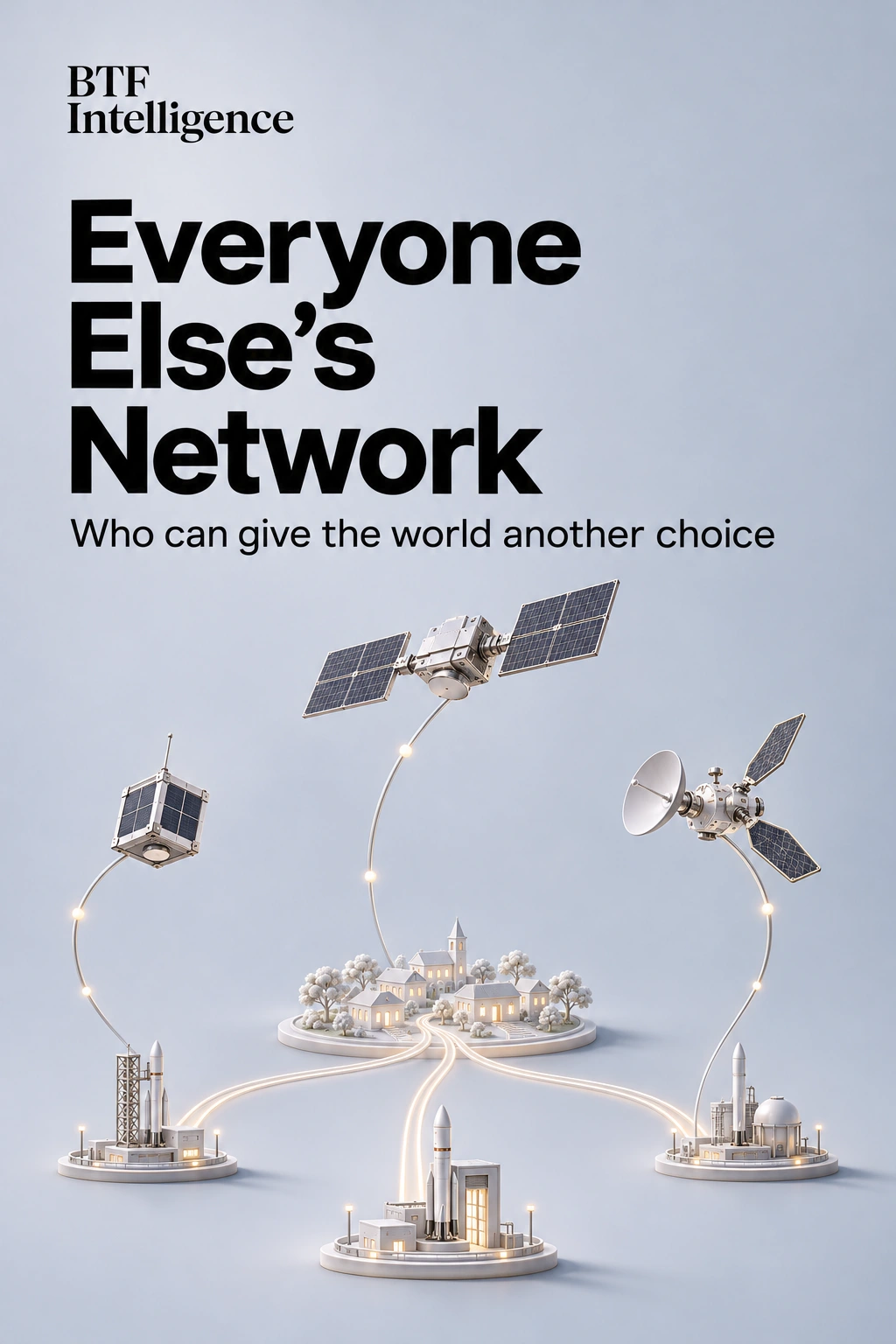
Everyone Else’s Network
Who can give the world another choice
Summary
SpaceX’s lead does not have to disappear for its customers to gain meaningful choice. The judgment of this report is that a rival matters when it can perform the work a customer needs, on terms that customer can sustain. Matching Starlink everywhere is a much larger ambition. Amazon, OneWeb, Europe’s planned IRIS² system, China’s constellations and mobile operators offer different routes toward an alternative. Their progress should be measured through dependable service and the ability to change providers, alongside the hardware they put into orbit.
Amazon’s November 15, 2026 Vulcan mission shows why launch remains central. Forty satellites were lost, even though the company had reported completing its thousandth satellite months earlier. Manufacturing capacity could not replace the missing delivery. SpaceX’s integration of satellite design, production and launch gives it more control over that sequence and more opportunities to learn from equipment in service. The advantage is substantial, but the upper-stage catch described in 51 Percent still had to become repeated, economical reuse. Neither one successful recovery nor one failed launch settles the competition.
Amazon also brings advantages from outside space. Its cloud services and business relationships can help make a satellite connection useful within systems customers already operate. Delta’s agreement for installations beginning in 2028 and AT&T’s planned managed offering show routes to future customers. They are not evidence that those services are already available. Eutelsat’s OneWeb business supplies a different kind of evidence: actual low-orbit revenue and a program to replace and improve its satellites. A smaller operating network can matter before it matches the leader’s scale.
The alternatives also differ in who they serve and who governs them. IRIS² is intended to give European authorities greater control over secure connectivity, with first launches planned for 2029. China’s programs bring another industrial and political foundation, but deployment records do not establish comparable customer performance or unrestricted availability abroad. Phone-based services address another need: the gaps between terrestrial towers. A useful handset connection does not automatically replace a school’s broadband or a ship’s dedicated terminal. More constellations will not necessarily create one market in which every customer can choose freely.
The hardest uncertainties extend beyond getting the first fleet into space. Networks must fund replacement satellites, maintain ground infrastructure and secure customers where their capacity can be sold. Government support may purchase resilience that subscription revenue alone would not justify, while introducing its own obligations and priorities. Customers face costs too: equipment, staff training and sometimes a second subscription that is rarely used. Two providers may still share a vulnerable dependency. A backup becomes valuable when it can carry essential work through the particular failure the customer needs to survive.
The evidence to watch follows four tests: repeated deployment and commissioning, service customers can order and keep using, funding that supports continuing operation, and choice that changes the customer’s position. The series began with SpaceX’s ambition to carry 51 percent of internet traffic. Dependence can arrive much sooner, one place at a time. The consequential result of competition would be the ability to leave a provider, challenge its terms or maintain another route without giving up what the connection made possible.
Dalton owns shares in Tesla and SpaceX, as confirmed on November 17, 2026. This report provides general research and does not offer personalized investment advice or recommend buying, selling, or holding a security. Editorial Standards and Disclosures · Terms of Use
Sources
November 17, 2026: Public summary published.
- Amazon Leo satellite launch progress updates
- Amazon Leo prepares for first Vulcan launch
- Quarterly financial results
- Amazon Leo Ultra and enterprise connectivity
- Delta and Amazon Leo sign agreement
- AT&T and Amazon Leo
- OneWeb renewal moves toward launch
- First quarter 2026–27 results presentation
- European Union accelerating and reinforcing IRIS²
- Blurred Orbits
- Successful launch of satellite internet low-orbit group 29
- T-Satellite now available
- Third quarter 2026 business update
- Third quarter 2026 financial results
The full report is coming soon.
The complete report will be available to members when published.
Become a member