Summary
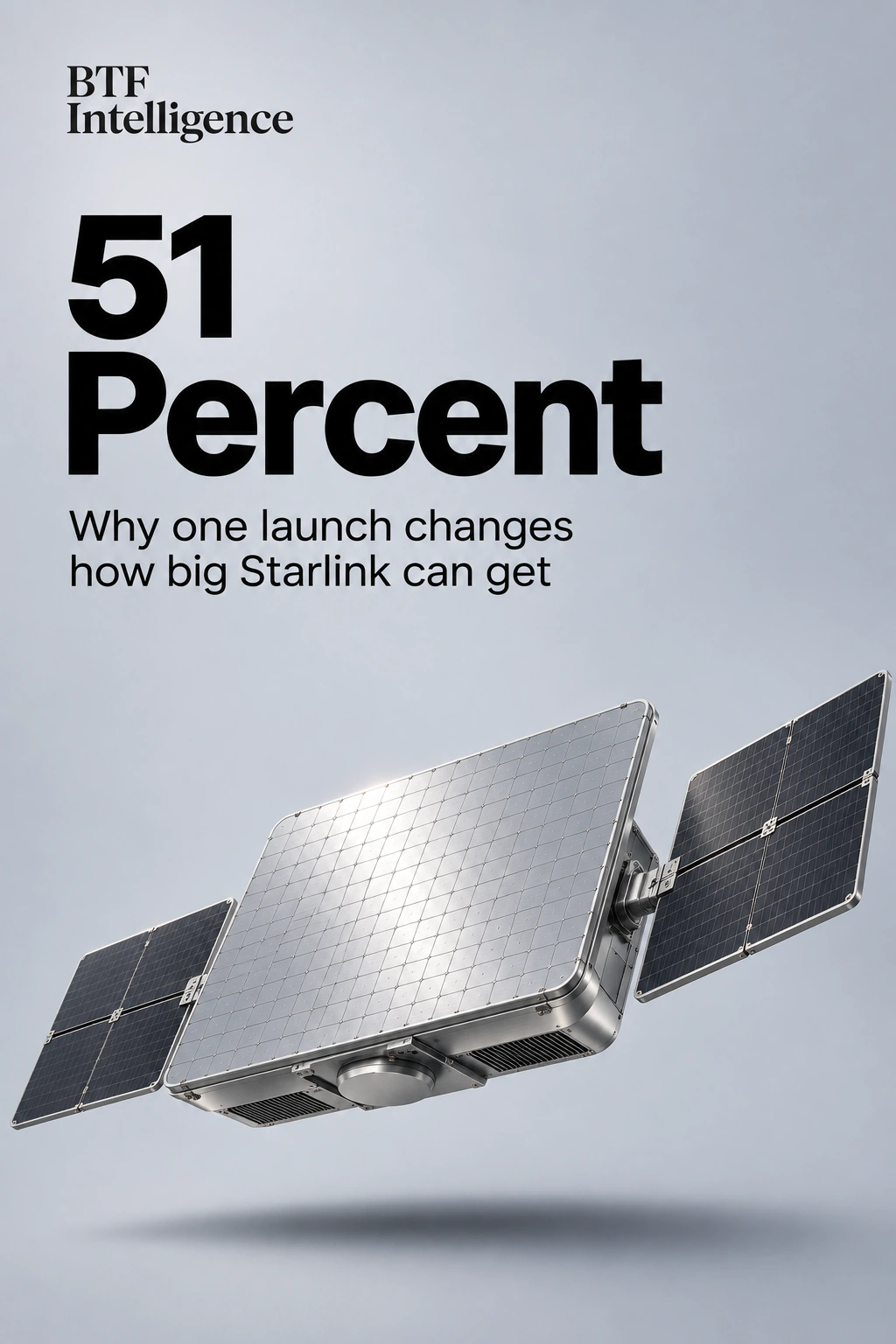
Starship’s first upper-stage catch matters to Starlink because it brings a cheaper way of expanding the network one step closer. The flight deployed twenty-six V3 satellites intended to add substantially more capacity to the network. The catch addressed a different question: how cheaply SpaceX might deliver future batches. Put the two together, and the importance of the weekend becomes clearer: SpaceX is trying to combine much larger satellites with a rocket it can recover and eventually fly again. That is the machinery behind its ambition for Starlink to become “51% of the internet.”
The number is a goal, not a measurement. Musk’s related statements point to a majority of internet traffic, rather than half of its users or revenue. SpaceX has not published a consistent global denominator against which that ambition can be tested. Capacity and traffic are different things, too. A bigger network can carry more data, but the demand has to arrive in the places it can serve. A packet can pass through several networks, so even counting the eventual share will require care.
The business supporting the ambition is already substantial. SpaceX’s Connectivity segment reported about $5.2 billion in revenue and $2.4 billion in operating income in the third quarter of 2026. It ended September with 13.6 million consumer subscriptions. Those results include enterprise and government customers, whose separate profitability is not disclosed. Operating income is also different from spare cash: satellites and launches require investment, with their costs spread over their working lives. The filings establish a strong earnings base, not an unlimited source of money for every other SpaceX project.
The immediate constraint is useful capacity on the ground. Flights 14 and 15 deployed fifty-two V3 satellites between them, but deployment does not mean full commercial service. Satellites need checkouts and operating orbits, and a small number cannot provide the same improvement everywhere all the time. Shotwell said a few hundred would be needed for a more consistent effect. Starship’s value is its potential to put up larger batches repeatedly. One recovery establishes a milestone. It does not yet establish turnaround time, reflight reliability or cost.
The ambition also reaches beyond household broadband. SpaceX is pursuing direct-to-phone connections, terrestrial coverage and orbital computing, while forecasting much greater demand from machines. Its October agreement for nationwide 800 MHz spectrum had not yet closed, and acceptance of its satellite applications was not authorization to deploy the proposed fleets. Much AI traffic may remain between data centers connected by fiber. A much larger satellite business could succeed without becoming the route for most of the world’s data.
The evidence to watch is therefore concrete: a recovered ship flying again, repeated launches at lower cost, V3 performance in daily service, and regulatory decisions that permit further expansion. Just as important is what customers will pay for the added capacity. The report traces the idea from Musk’s 2015 Seattle remarks to the present network and asks what would have to happen next. Carrying a majority of internet traffic could create enormous influence. It would not make SpaceX the owner of the internet.
This summary reflects the report dated November 15, 2026. As of November 8, 2026, Dalton owns shares in Tesla and SpaceX. Editorial Standards and Disclosures · Terms of Use
Sources
November 15, 2026: Sources checked for this edition.
- S3. Flight 15 official mission page (planned timeline) (source 2)
- S5. Original Musk posts (source 3)
- S8. SEC-filed Q3 2026 results, segment tables and subsequent spectrum agreement
- S10. October 20 earnings-call transcript, Quartr via Stock Analysis
- S12. FCC Sept. 18 accepted-for-filing notice, page 6, SAT-LOA-20260630-00264 / S00887
- S15. FCC orbital-data-center application acceptance, Feb. 4
Read the complete report.
The complete first report in this series is free to read.
Read the report free