SpaceX’s Infrastructure Bet: What Happens After the Launch?
By Dalton Skach · 4 min read
When SpaceX launches a satellite for another company, it sells a ride to orbit. When it launches its own internet satellites, it builds a network that can collect payments for years. The investor question is how much money that network can earn after the cost of building and running it.
That distinction gives substance to a remark reported by Eric Berger in Ars Technica on November 9. Kiko Dontchev, SpaceX’s vice president of launch, described the business as fundamentally an “infrastructure company” at the UP.Summit in Florida. The organizer dates the event to November 4–6.1
SpaceX makes rockets and operates Starlink, a network of satellites that delivers internet service through terminals on the ground. It also operates an artificial-intelligence business. Starlink provides a concrete way to examine the infrastructure argument: SpaceX can use its launch capability to build something it owns, then sell access to it repeatedly.
Most Falcon launches already serve SpaceX itself
In the first nine months of 2026, SpaceX classified 81 of its 110 Falcon launches as internal, roughly three quarters. The company does not record launch revenue from deploying its own Starlink satellites. Instead, it includes those launch costs in the satellite assets on its balance sheet.2
For investors, this changes what a successful launch establishes. Delivering the satellites creates the ability to provide a service. The financial return then depends on people and businesses paying for that service. Counting the flight as both a sale to Starlink and a source of future subscription revenue would overstate what the combined company earns.
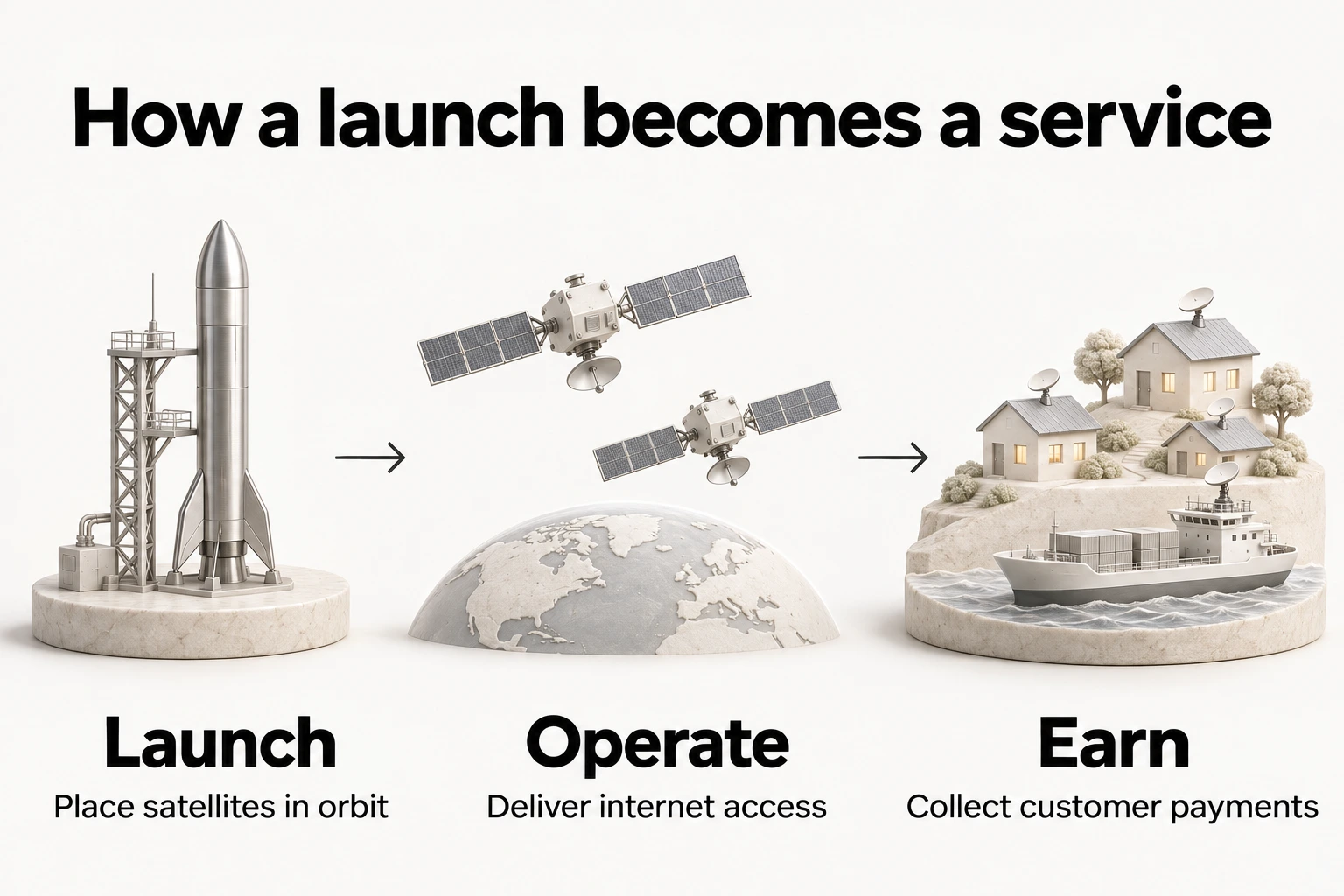
The opportunity is attractive because one launch can support many later payments. Owning the rocket and the network may also let SpaceX coordinate satellite design, manufacturing and deployment. But that ownership leaves SpaceX responsible for the money spent before customers arrive, and for equipment that eventually needs replacing.
Starship’s value is in what it can deliver economically
Ars reports that Dontchev emphasized the bandwidth carried by Starship, SpaceX’s larger rocket. Bandwidth is the amount of data a network can carry. He described a Florida launch as potentially carrying up to 20 times the bandwidth of a Falcon 9 mission. That is an executive’s capacity claim, not a forecast of revenue or profit.3
The underlying ambition predates the conference. In a network update describing July 2025 performance, Starlink projected that a Starship load of third-generation satellites would add more than 20 times the capacity of its then-current launches.4 That earlier projection supports the strategic direction. It does not independently establish the performance of a future Florida flight.
More capacity per flight could reduce the launch expense for each unit of internet service the network can supply. Whether it does depends on the cost of the flight, the satellites and the supporting ground equipment. Recovering a rocket is useful; reusing it reliably at a low total cost is what improves the economics.
There is a second condition. Extra capacity must reach markets where SpaceX can operate and customers will pay. Think of adding rooms to a hotel. More rooms create an opportunity to sell more nights, but the return depends on occupancy, room prices and the cost of keeping the property running.
Customer growth and customer value can move differently
SpaceX reported 13.6 million Starlink consumer subscriptions at September 30, up from 7.2 million a year earlier. Average monthly service revenue per consumer subscription was $69 in the third quarter, compared with $83 a year earlier. These subscriptions count service lines, not individual people.5
Lower revenue per subscription is not automatically a problem. Serving additional customers at lower prices can still be profitable if the cost to serve them falls enough. But subscriber growth alone cannot tell an investor whether that is happening. Prices, customer mix and costs all matter.
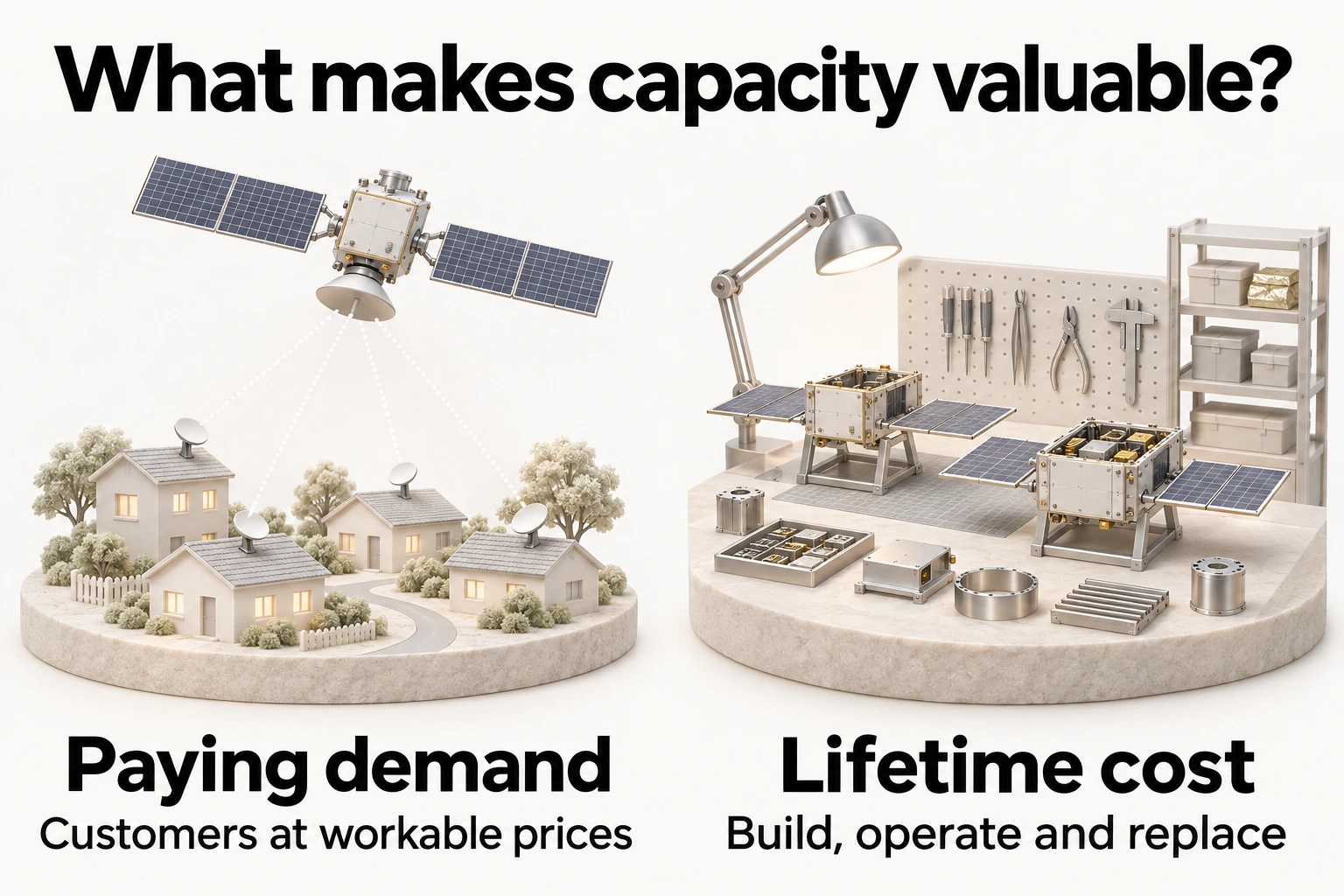
The network already produces substantial earnings. SpaceX’s Connectivity segment reported about $5.2 billion of revenue and $2.4 billion of operating profit in the third quarter.6 The next question is what each new round of investment adds. Operating profit is not the same as cash left after new construction and equipment purchases.
The investor takeaway
SpaceX’s infrastructure strategy gives its rockets a larger economic purpose: building services that customers pay to use repeatedly. I would assess the next stage of that strategy by whether additional network capacity earns back its cost, rather than treating a higher launch count as a sufficient reason to raise an earnings forecast.
Reliable Starship reuse, lower deployment costs and customer payments growing faster than the full cost of serving them would strengthen the case. Capacity that requires deeper discounts, sits underused or costs more to replace would weaken it. The investment opportunity lies in the cash the infrastructure can leave for shareholders after it has been built, operated and renewed.
This article reflects Dalton Skach’s views as of November 9, 2026. It provides general research and does not offer personalized investment advice or recommend buying, selling, or holding a security. As of November 9, 2026, Dalton owns shares in SpaceX. Editorial Standards & Disclosures · Terms of Use
Sources and calculations
- Eric Berger, Ars Technica, November 9, 2026, opening remarks. UP.Partners event page confirms November 4–6 at Kennedy Space Center. No original recording or transcript was obtained; quotations are attributed to Ars. ↩
- Space Exploration Technologies Corp., Q3 2026 Form 10-Q, pp. 39–40. CIK 1181412; ticker SPCX; accession 0001628280-26-066880. Calculation: 81 ÷ 110 = 73.6%, rounded to three quarters. ↩
- Ars Technica, “Why Falcon 9 is fading.” Florida capacity is prospective. This article assigns no firm Falcon retirement date or Florida launch date. ↩
- Starlink Network Update, “Current network performance” and “Future network capacity.” Undated page describes July 2025 performance and a future deployment target. Its capacity projection is historical company guidance, not a current measurement. ↩
- Q3 2026 Form 10-Q, pp. 39–40, consumer metrics. Managed enterprise and government accounts are excluded. ↩
- Q3 2026 Form 10-Q, Note 18, p. 32. Millions: revenue 5,248; operating income 2,367. ↩
Sources reviewed November 9, 2026. The investment framework and hotel analogy are BTF analysis. No share-price target or numerical forecast is implied.
The hero and thumbnail are original AI-generated conceptual photographic artwork. Both body visuals are original AI-generated sculpted models. They show imagined infrastructure and simplified relationships, not actual facilities, satellite designs or geographic service boundaries. Generation prompts and originals are retained with the working draft.
Go deeper: 51 Percent
What would have to work for larger satellites and more launches to expand Starlink’s business?