
Would Buying Boost Give SpaceX a Shortcut Into Wireless?
By Dalton Skach · 5 min read
Buying a phone company sounds like a quick way to enter the wireless business. But what if the companies carrying its calls can change the terms when the owner changes?
That is the investment question behind SpaceX’s reported interest in Boost Mobile. The Washington Post reported November 2 that SpaceX had discussed buying Boost or accessing its network.1 Boost is a consumer wireless brand within EchoStar. A purchase could give SpaceX an established customer business, but the value would depend on its ability to keep serving those customers.
On November 5, Semafor reporter Rohan Goswami reported that executives at AT&T and T-Mobile had separately discussed removing Boost from their networks if SpaceX acquired it. That is attributed reporting about private discussions, not an announced termination. The records reviewed for this article do not establish an agreed Boost acquisition or a carrier’s final decision.2
What a buyer would be buying
A wireless business has two jobs: winning paying customers and connecting their phones. The company sending the bill does not have to own every antenna used to deliver the service. It can pay another carrier for access to that carrier’s network.
EchoStar’s arrangement makes that distinction concrete. Its announced model combines Boost’s central network systems with AT&T’s cell sites, while retaining access to T-Mobile’s network. Those central systems help manage the service; the cell sites provide the radio connection to customers’ phones.3
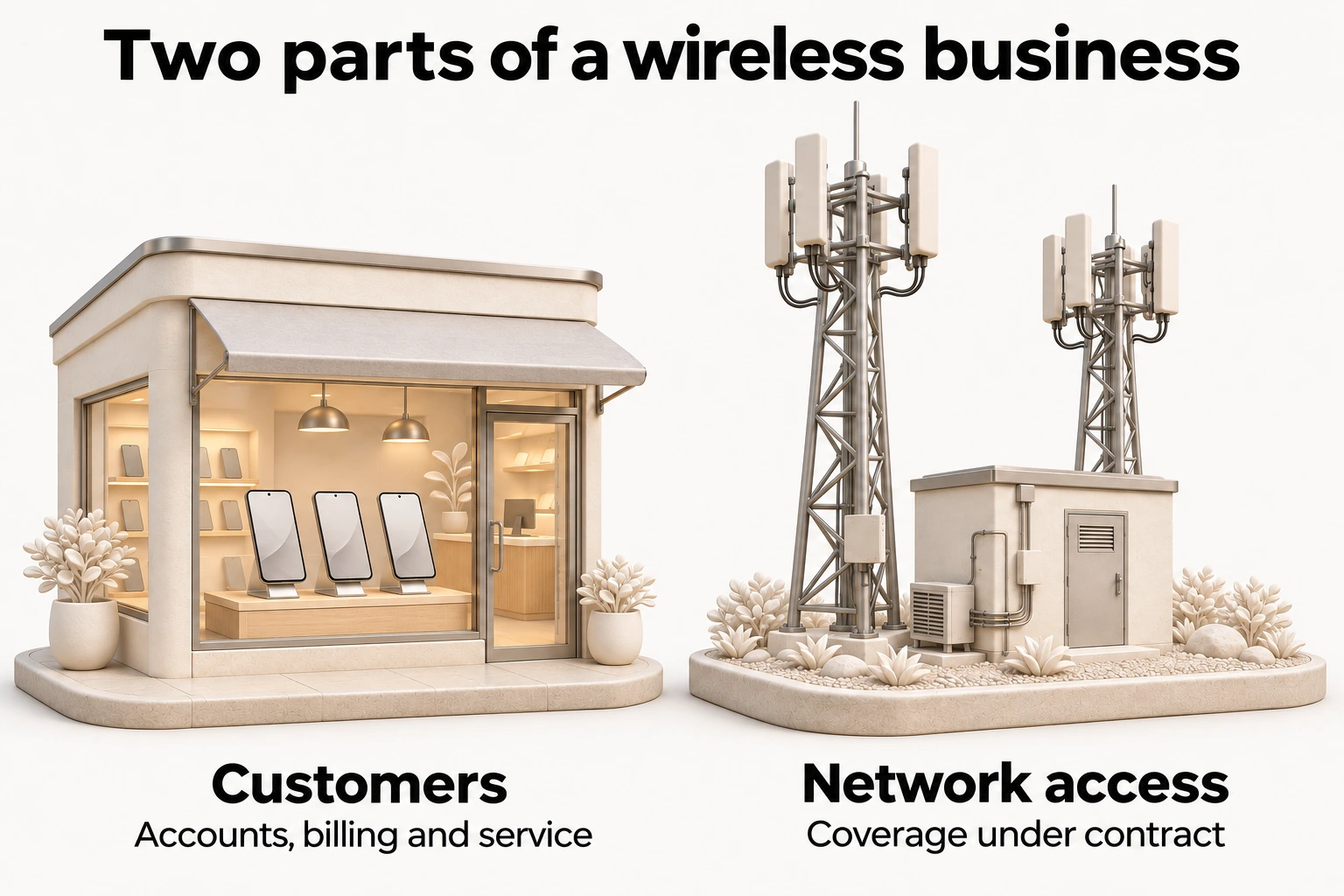
EchoStar reported about 7.2 million wireless subscribers at September 30, 2026, across a business operating primarily under Boost Mobile and Gen Mobile. That is a segment total, not a disclosed Boost-only count. It shows the scale of the existing business, without telling us exactly which customers or assets a negotiated purchase would include.4
For SpaceX, acquiring an existing operation could reduce the work of finding customers and setting up billing and service. But those advantages earn their value over time. Customers who leave during a difficult transition would take future revenue with them.
A long contract is valuable only on usable terms
EchoStar’s August 2025 disclosure described AT&T service through December 2031, with extension options. It also tied reduced rates to specified data-traffic thresholds and a transition to the new operating model. A contract’s expiry date is only one part of its economics.5
The acquisition question is whether the relevant access and pricing would remain available under new ownership. On EchoStar’s August 2026 earnings call, Charlie Ergen declined to disclose the actual contracts when asked about restrictions on a change of control. He nevertheless said EchoStar had contractual flexibility for acquisitions or partnerships.6
That leaves a real uncertainty. We cannot infer either an automatic transfer of favorable terms or an inevitable cutoff. EchoStar’s latest quarterly filing itself warns that the network operators it relies on also compete with it and may seek to restrict access when doing so benefits them.7
The economic tension is straightforward. A carrier earns money by supplying network service to another brand, but may also help that brand compete for its own customers. A more ambitious owner could change that calculation. Whether it changes contractual rights or negotiated terms would require evidence specific to the agreement.
What would make a purchase worthwhile?
I would evaluate a proposed Boost deal by asking how much customer revenue survives after paying for network access, serving those customers and funding the transition. The purchase price would then need to leave enough of that future cash for SpaceX shareholders.
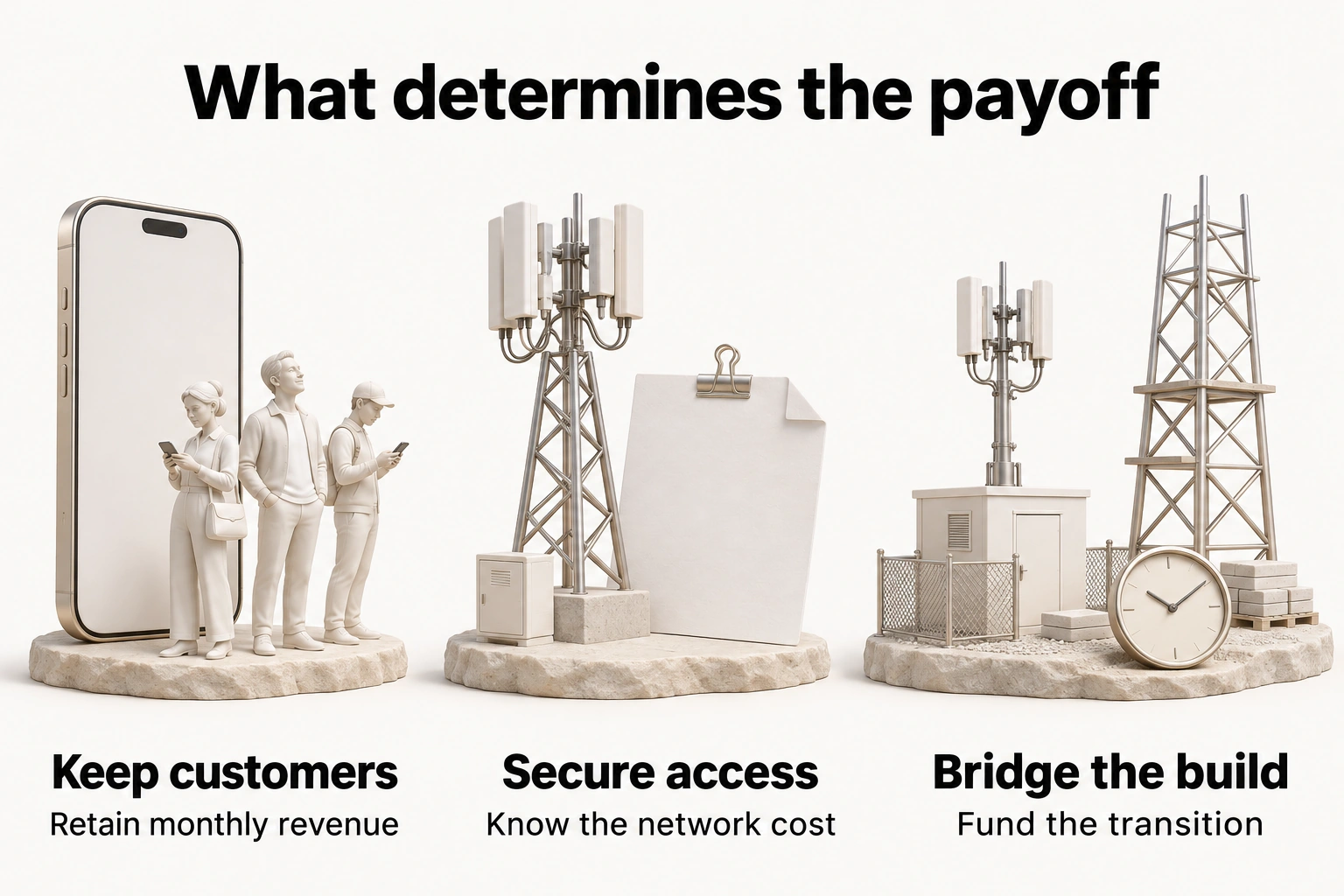
Three possible outcomes show why the terms matter. If reliable access continued at attractive rates, Boost could provide customers and revenue while SpaceX developed its broader wireless offering. If access continued but became more expensive, the same customer base could produce less cash. If access became uncertain, the buyer might need a replacement arrangement before it could justify paying for those future revenues.
These are scenarios, not forecasts. Consider a deliberately simple example: an extra $2 of monthly network cost across one million retained customers would cost $24 million a year, before any offsetting changes. Neither figure is a disclosed Boost term. The example shows how a small difference in the cost to serve each customer can change what a business is worth.8
The investor takeaway
Boost could give SpaceX a useful starting customer business. Its investment value would depend on securing the network service needed to retain those customers at a workable cost. The reported carrier resistance makes that a condition to investigate before assigning a benefit to an acquisition.
I would look for an announced transaction defining what is included, confirmation of continuing network access, and enough detail on pricing and commitments to assess cash generation. Evidence of durable access on sensible terms would strengthen the case. Higher service costs, customer losses or an expensive replacement plan would weaken it. A purchase announcement alone would leave the central investment question unanswered.
This article reflects Dalton Skach’s views as of November 9, 2026. It provides general research and does not offer personalized investment advice or recommend buying, selling, or holding a security. As of November 9, 2026, Dalton owns shares in Tesla and SpaceX and has no holdings or other financial interests in EchoStar, AT&T or T-Mobile. Editorial Standards & Disclosures · Terms of Use
Sources and calculations
- The Washington Post, November 2, 2026. Original reporting. ↩
- Rohan Goswami, November 5, 2026: original X post, read through a public mirror because direct retrieval was blocked, and cross-checked against Benzinga’s November 6 account. No independently obtained confirmation of the private discussions. ↩
- EchoStar announcement, August 26, 2025, paragraphs describing the hybrid mobile network operator arrangement. This describes the operating model, not consent to a future acquisition. ↩
- EchoStar Form 10-Q, filed November 3, 2026, Wireless business description. Exact reported total: 7.193 million at September 30, rounded to 7.2 million in the article. The transaction perimeter is unknown. ↩
- EchoStar Form 8-K, August 26, 2025, Item 8.01, Amendments to the Network Services Agreement, PDF page 4. Historical disclosed term and pricing conditions; not a legal conclusion about transferability or unpublished amendments. ↩
- EchoStar Q2 2026 earnings-call transcript, Brent Penter’s question on network contracts and Charlie Ergen’s answer. Management’s position, as reproduced by the transcript provider. ↩
- EchoStar Q3 2026 Form 10-Q, introductory risk-factor bullets on network-service dependence and competition with network suppliers. A disclosed risk is not evidence that termination has occurred. ↩
- BTF hypothetical sensitivity: $2 per customer per month × 1,000,000 retained customers × 12 months = $24,000,000 per year. Holds customer count, revenue and other costs constant. This is neither a forecast nor an estimate of Boost’s confidential wholesale pricing. The three scenarios and investment conclusions are BTF analysis. ↩
Artwork: the hero and two explanatory visuals were generated for this article on November 9, 2026. They depict an imagined shop and conceptual models, not actual facilities, coverage maps or an announced construction program. Generation prompts and originals are retained in BTF’s working source notes.
Go deeper: Build or Buy
Would buying customers and operating systems give SpaceX something that building a network cannot supply quickly?