SpaceX’s $24 Billion Bet on Power and Compute
By Dalton Skach · 3 min read
SpaceX wants to put a power plant and a supercomputer under the same owner. The proposed initial investment at Starbase is about $24 billion. The investor question is whether controlling both sides of the electricity meter earns enough to justify paying for both.
What the city notice establishes
A public hearing notice names Space Exploration Technologies Corp. as the property owner and applicant for a tax abatement. It describes a proposed gas-fired power plant and super-compute facility on approximately 444 acres inside Starbase, just east of Brownsville, between Boca Chica Boulevard and the Port of Brownsville. SpaceX would build, own and operate both facilities.1
The city commission is scheduled to consider a property tax abatement and a related economic development agreement on December 9, 2026, at 7 p.m. The approximately $24 billion estimate covers initial phases, with multiple phases and future expansion possible. The notice establishes a proposal and a hearing, not an approved incentive package or a commitment to spend the entire estimate on a particular schedule.
Gateway to Mars reported the notice on November 6. The document itself does not print an issuance date. Its December 9 date is the scheduled hearing date.2
Compute is already part of SpaceX
This is more than a rocket company experimenting with a data center. SpaceX’s September-quarter filing describes three operating segments: Space, Connectivity and Super Intelligence. The last includes compute infrastructure and applications such as Grok and Cursor. The listed company trades as SPCX.3
That context makes the proposed campus intelligible, but it does not establish its customers or workload. The city notice does not allocate the spending between generation, buildings and computing equipment. It also gives no electrical capacity, chip count or commissioning date. Those omissions prevent a useful estimate of revenue or return on the campus from this document alone.
Control has a capital cost
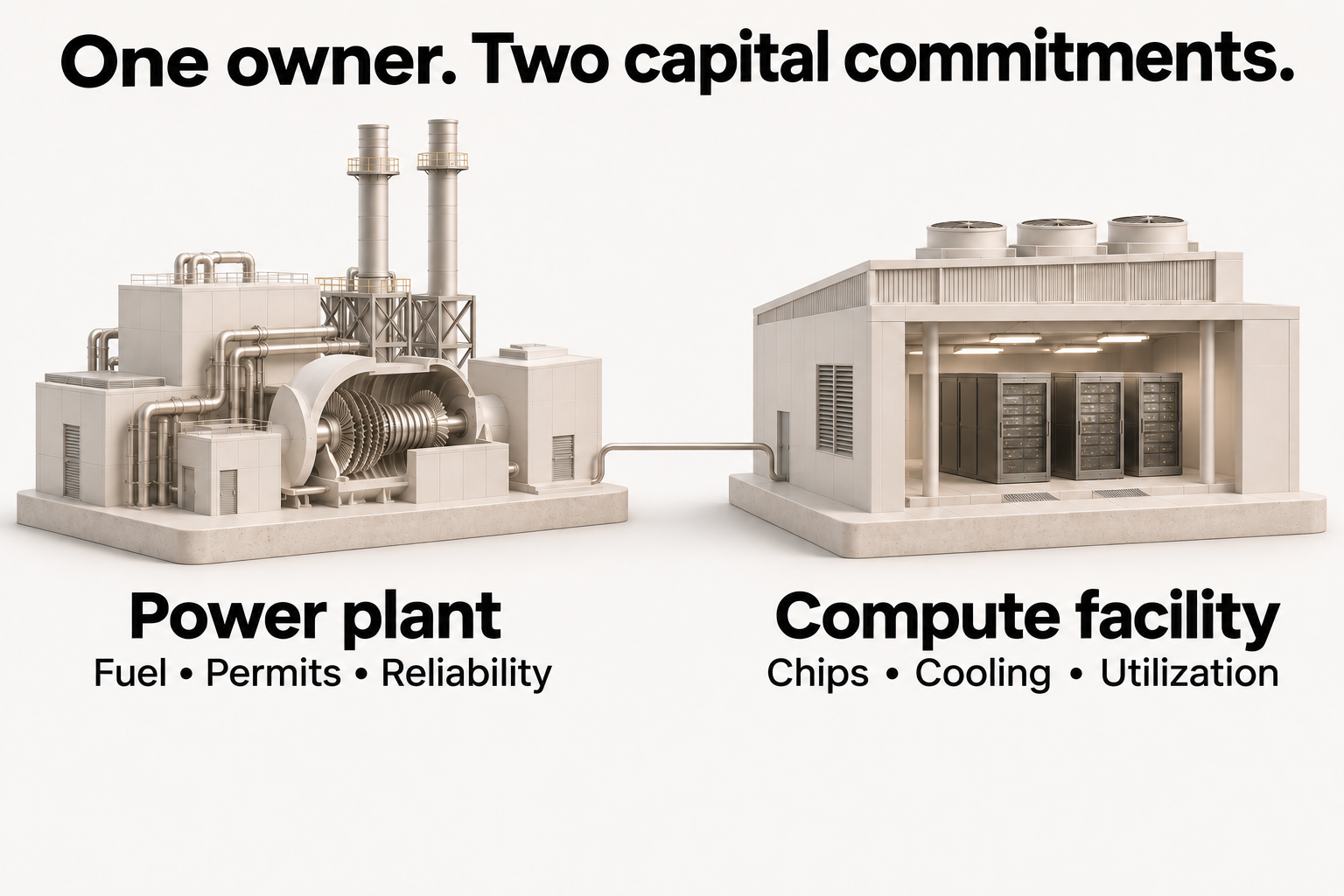
Owning generation could give SpaceX more control over the availability and cost of power for computing. Whether it does depends on fuel supply, operating reliability, permits and how the campus connects to the wider electricity system. The notice does not establish that the facility would be independent of the grid.
The economic tradeoff is straightforward. An owner can capture the benefit of coordinating power and compute, but also carries the cost when one is ready before the other. A completed plant cannot make unfinished computing equipment productive. Installed servers cannot earn a satisfactory return if the work available to them is too limited or too cheaply priced.
I would evaluate the project through cash generated or costs avoided after fuel, staffing, maintenance and equipment replacement. Internal use may create value through better products or lower purchased-compute costs. It should not automatically be modeled as new external revenue. A tax abatement could improve the calculation, but the notice supplies neither its size nor its duration.
The investor takeaway
I would treat the Starbase proposal as evidence of SpaceX’s intended infrastructure scale and as a capital requirement to investigate. I would not add $24 billion to a single year’s spending forecast or infer a matching amount of business value. The notice lacks the timing and operating assumptions needed for either conclusion.
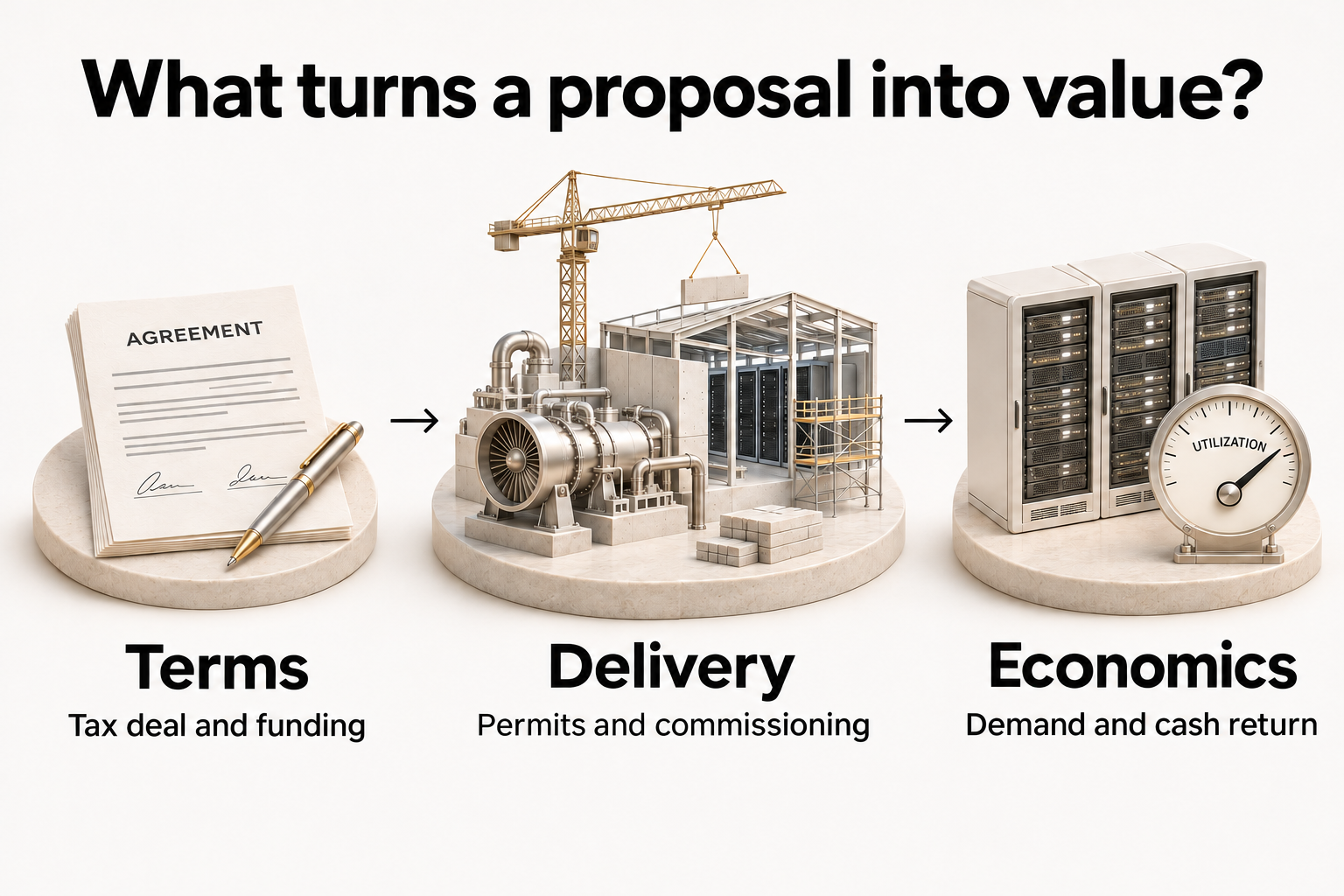
The next useful evidence is the proposed agreements, a spending and commissioning schedule, and a credible explanation of who will use the compute. My view would strengthen if those records showed funded phases matched to demand and a return that includes equipment replacement. Owning the power supply is valuable only if the resulting compute economics justify the extra capital.
This article reflects Dalton Skach’s views as of November 8, 2026. It provides general research and does not offer personalized investment advice or recommend buying, selling, or holding a security. As of November 8, 2026, Dalton holds positions in SpaceX and Tesla. Editorial Standards & Disclosures · Terms of Use
Sources and calculations
- City of Starbase, Notice of Public Hearing, page 1. Opening paragraph; property owner; location; nature of improvements; estimated cost. Hearing: December 9, 2026. Accessed November 8, 2026. Approximately 444 acres, property ID 171887; approximately $24 billion for initial phases. No issuance date is printed. Absence claims in this article refer to this one-page notice, not to all permits or company disclosures. ↩
- Gateway to Mars, Starbase Watch, November 6, 2026 entry on the power plant and super-compute proposal. Original local reporting used to locate the notice and attribute its reported posting date. The underlying PDF was independently downloaded and read. ↩
- Space Exploration Technologies Corp., Form 10-Q, quarter ended September 30, 2026. Cover page and Note 1, Description of Business. Filed October 22, 2026; accession 0001628280-26-066880; CIK 1181412. Confirms issuer, SPCX trading symbol and three segments. This filing is used for company context, not to establish this campus’s economics. ↩
No project return, capacity or revenue has been calculated. The economic discussion and second visual are BTF analytical frameworks, not company forecasts. The $24 billion is a combined estimate; no allocation between power and compute is assumed.
Hero and thumbnail: original AI-generated conceptual photographic artwork. Body visuals: original AI-generated sculpted models. None is a photograph, engineering plan, surveyed map or representation of a completed SpaceX campus. Prompts and generation provenance are retained with the draft.