
A Director Leaves SpaceX. What Changes for a Tesla Merger?
By Dalton Skach · Published 5 min read · Updated
Updated to include Elon Musk’s explanation and Alphabet’s quarter-end holdings.
A director leaves the room. Investors immediately want to know whether the deal is closer. Before changing the odds, I’d ask which decisions that director could make, and who gets to make them now.
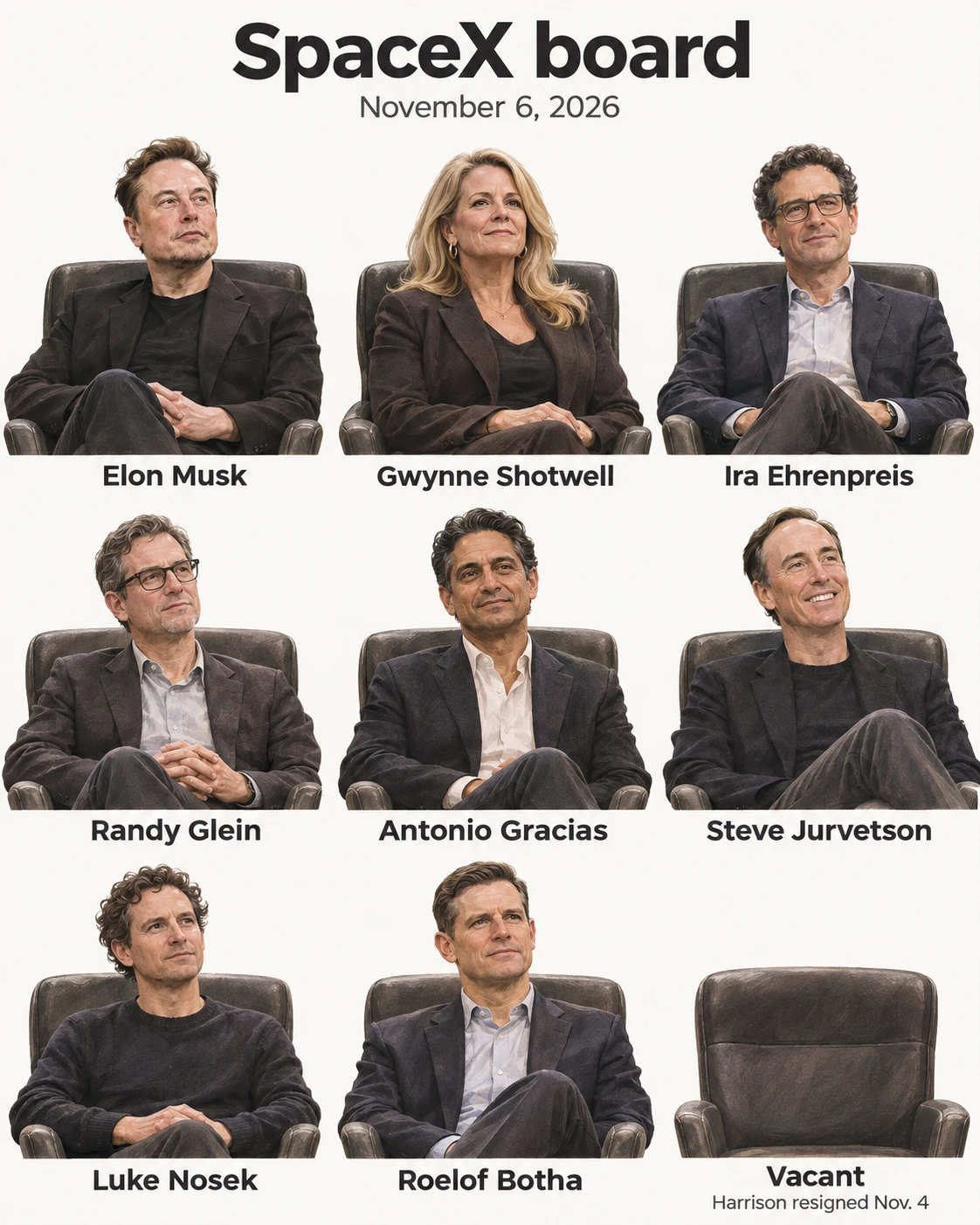
On November 6, SpaceX disclosed that Donald Harrison had resigned from its board two days earlier, effective immediately. SpaceX said the departure arose without a disagreement over its operations, policies, or practices. The filing thanked him for his service. It gave no reason for leaving, named no successor and assigned him no role on the committee considering a combination with Tesla.1
Later that evening, at 8:46 p.m. Eastern, Elon Musk supplied an explanation on X. He praised Harrison’s contribution, then wrote that there were “too many conflicts of interest with Alphabet,” leading Harrison to step down. Musk did not identify the specific conflicts or connect them to the proposed Tesla combination.7
That explanation adds context to the vacancy. It can coexist with the filing’s statement that there was no disagreement. For an investor, the next question is what changes in the people evaluating a potential deal, and ultimately in the terms shareholders might receive.
A decade of experience leaves the board

SpaceX’s final IPO prospectus dates Harrison’s board service to February 2015 and identifies him as Google’s president of global partnerships and corporate development. It credits him with experience in strategic transactions and partnerships. That is relevant experience to lose while exploring a combination of two companies with very different businesses.2
A board seat and an investment are different commitments
Alphabet’s latest holdings report lists 555,043,560 SpaceX Class A shares as of September 30, up from 551,189,500 at June 30. That is an increase of about 3.85 million shares, or 0.7%. The newer filing was published on November 6, but its holdings snapshot predates Harrison’s November 4 resignation by more than a month. It does not establish what Alphabet held when he left, or whether it bought or sold shares afterward.8
The distinction is useful: a company can have a financial interest in another business while its executive faces conflicts serving on that business’s board. Musk’s explanation concerns Harrison’s board role. It does not establish that Alphabet has changed its investment position or its view of a Tesla deal.
Who fills the empty chair?
Harrison served as a Class B director. The IPO prospectus describes a vacancy process in which Class B shareholders holding a majority of that class’s voting power, or the remaining Class B directors, can fill such a seat. The same prospectus classified Harrison as independent under the exchange listing standards.3
Those details give investors two questions for the next announcement. Who selects his successor? And what relationships would that person bring to a possible Tesla transaction? A biography can help answer the second question. The committee’s membership and authority would tell us more about who actually evaluates the terms.
Three approvals to watch
SpaceX’s September-quarter report describes three required approvals on its side of a potential combination. The special committee would have to approve, as would the board and the controlling shareholder. At the time of that filing, the committee had reached no determination and could decide against recommending a transaction.4
Special committee
Evaluates the combination
Board of directors
Decides on the proposed deal
Controlling shareholder
Must also approve
I would look for the committee roster, any replacement appointment, and the eventual explanation of how the parties negotiated. In the resignation filing and quarterly report reviewed for this article, I found no disclosure establishing that Harrison served on the merger committee. A departure from the board alone therefore gives me too little information to estimate a change in the committee’s willingness to recommend a deal.
A deal can happen on very different terms
Suppose two possible agreements both combine Tesla and SpaceX. In one, existing SpaceX shareholders receive 60% of the combined company. In the other, they receive 50%. These are illustrative ownership splits. Neither is a disclosed proposal.
At the same combined equity value, the second allocation gives SpaceX shareholders one-sixth less ownership value than the first. Both agreements would produce a completed merger. Yet the outcome for those shareholders would differ substantially.5
That is why I’d examine a board change through the eventual allocation of value. Someone buying shares needs to consider both the chance of a transaction and the terms they would receive if it happens. For a prediction-market position, the precise contract wording and resolution conditions would need their own review.
The investor takeaway
Musk’s explanation makes the departure a clearer signal about conflicts at the board level. Alphabet’s reported investment and Harrison’s responsibilities as a director need to be evaluated separately. Neither the post nor the September holdings snapshot tells us whether a Tesla combination is closer or whether SpaceX shareholders would receive better terms.
I would watch who fills the seat, what relationships that person brings, and whether the merger committee’s membership or authority changes. Proposed ownership terms would then let investors judge what a completed deal could actually deliver.
The next useful question is who will negotiate the deal, and what will current shareholders own when those negotiations are over?
This article reflects Dalton Skach’s views as of November 7, 2026. It provides general research and does not offer personalized investment advice or recommend buying, selling, or holding a security. As of November 6, 2026, Dalton holds positions in Tesla and SpaceX. Editorial Standards & Disclosures · Terms of Use
Sources and calculations
- SpaceX Form 8-K, filed November 6, 2026, Item 5.02. Effective event date November 4. ↩
- SpaceX final IPO prospectus, Management, Donald Harrison biography. Historical description as of June 2026. ↩
- SpaceX final IPO prospectus, Director Independence and Description of Capital Stock, Election and Removal of Directors. ↩
- SpaceX Q3 Form 10-Q, filed October 22, 2026, Evaluation of Potential Combination with Tesla, Inc., page 38. The diagram summarizes SpaceX’s disclosed approvals, rather than a complete closing checklist or a mandated chronological order. ↩
- BTF illustrative arithmetic. (60% − 50%) ÷ 60% = 16.7%, or one-sixth. Assumes identical combined equity value and compares the ownership value allocated to existing SpaceX shareholders. This isolates ownership allocation and does not model deal premiums, debt, dilution, taxes or integration outcomes. ↩
- Roster reconstructed from SpaceX’s leadership page, the June 17 filing appointing Roelof Botha, and the November 6 resignation filing above. The retrieved leadership page still listed Harrison; this illustration applies the subsequent resignation. Portraits are generated editorial interpretations. ↩
- Elon Musk’s original reply to Sawyer Merritt on X. Posted November 6, 2026 at 8:46 p.m. Eastern, equivalent to November 7 at 01:46 UTC. This is Musk’s public explanation, not a new SEC filing. ↩
- Alphabet Form 13F information tables for September 30, 2026 and June 30, 2026, Space Exploration Technologies Class A row. The Q3 filing index records a November 6 filing date and September 30 reporting period. BTF calculation: 555,043,560 − 551,189,500 = 3,854,060 shares; divided by 551,189,500 = approximately 0.7%. These are quarter-end holdings snapshots, not a transaction log. ↩