Waymo’s Bigger Map Has to Earn Its Keep
By Dalton Skach · 4 min read
A robotaxi can serve your neighborhood and still be useless for the trip you want to take. Add the station, the restaurant or the other end of your commute, and the same service becomes a more credible everyday choice.
That is the opportunity behind Waymo’s latest expansion. On October 27, the company announced nearly 250 additional square miles across five existing markets, with the rollout planned over the following week. For investors, the question is whether those new destinations help each vehicle earn more, or require more vehicles to cover a wider area.1
What the expansion connects
Waymo’s announcement names Torrance in Los Angeles’s South Bay, the zoo farther south in Nashville, more eastern coverage and enhanced downtown service in Orlando, La Jolla in San Diego, and southern Bay Area coverage including Berryessa BART Station. Orlando’s eastern coverage was set to nearly double. That is a description of one part of its service area, not a doubling of the entire Orlando market.
The Los Angeles rollout became more concrete on November 3. The Los Angeles Times reported service to Torrance, El Segundo and Manhattan Beach within a 210-square-mile LA service area. LAX remained unavailable, according to that report. The airport distinction matters: reaching nearby neighborhoods does not make an airport trip bookable.2
A larger map can make the existing service better
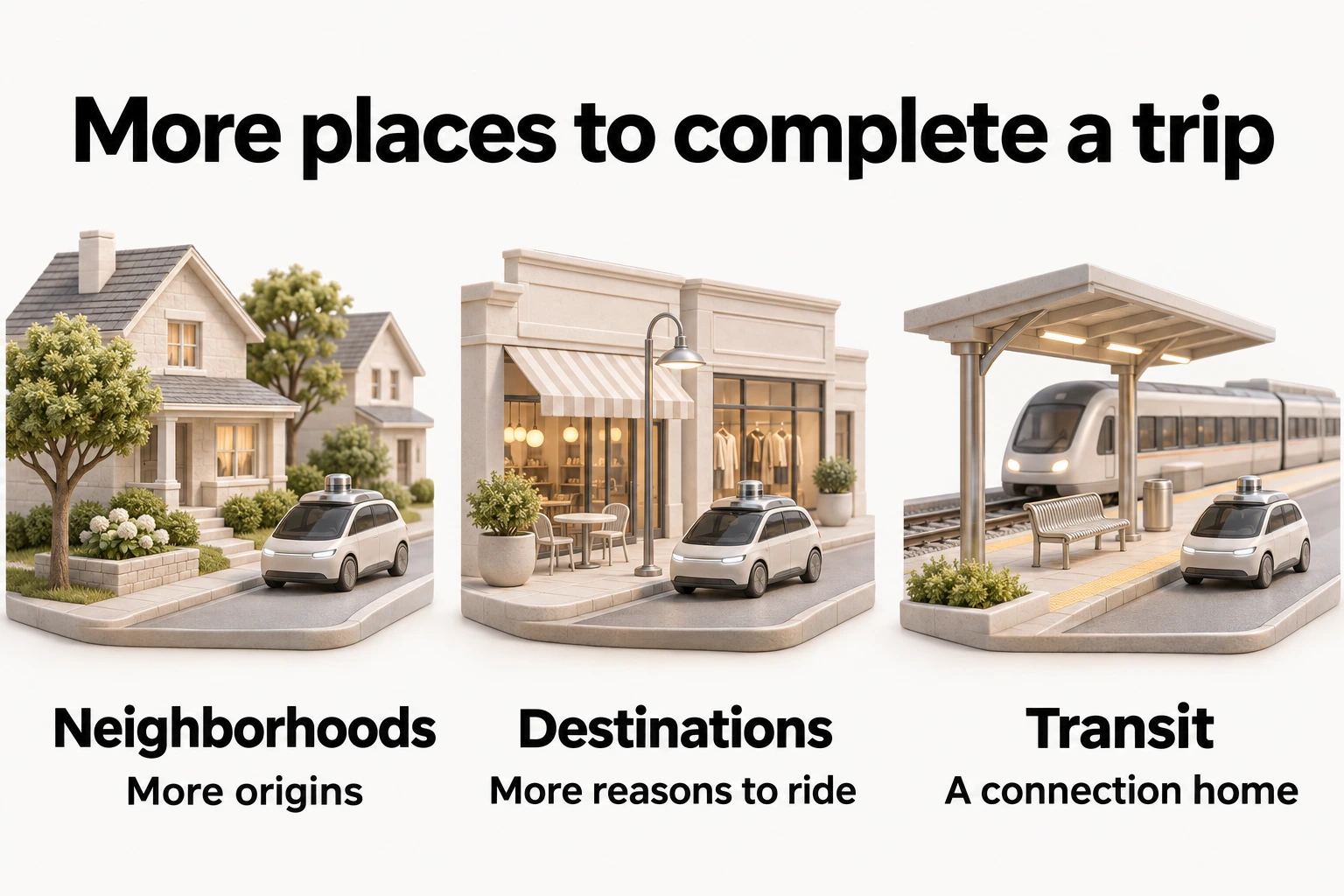
Consider a commuter who can get a ride from home to a rail station but cannot get one back from the station at night. Closing that gap could win both legs of the journey. Similarly, adding a destination may give people already inside the service area another reason to open the app. This is the business logic of expanding within a market: new coverage can make the old coverage more useful.
Berryessa provides a concrete place to test that idea. A rail connection creates a potential stream of trips between a station and surrounding neighborhoods. It does not establish that those trips will be frequent, evenly distributed through the day or profitable. Those are operating questions, not facts contained in the expansion announcement.
The cost of reaching farther
The same expansion can work against utilization. A car carrying a passenger to the edge of the service area may have to drive back empty. A broader territory can also require more vehicles to maintain pickup times, tying up capital before enough new demand arrives. Charging, cleaning and maintenance still take cars out of service.
If Waymo adds vehicles to support the larger area, the economic test is whether the additional fares cover the operating burden and the capital committed. The announcement does not disclose how many cars the expansion needs, how much demand it adds or what it does to city margins.
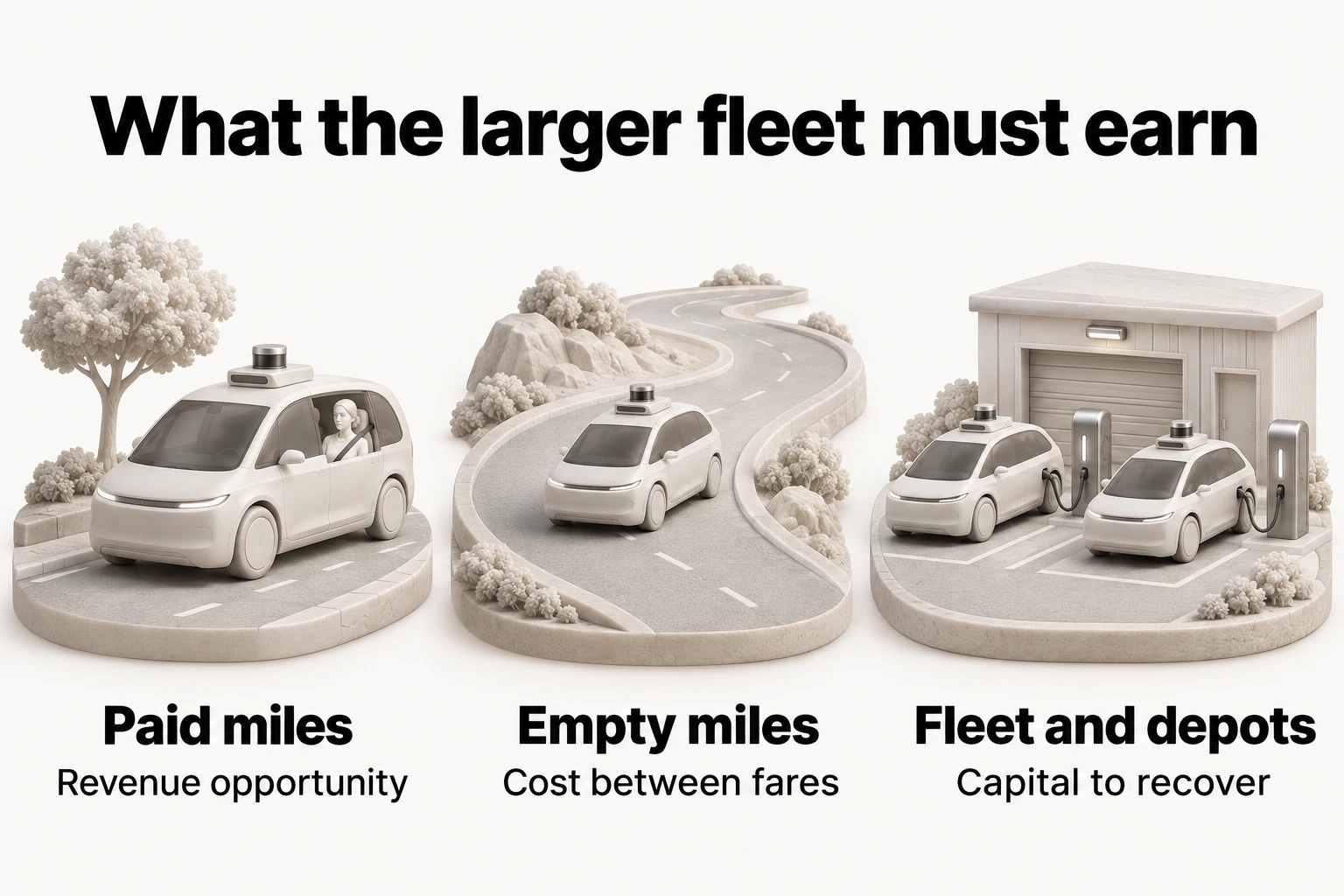
A simple scenario shows why total rides are insufficient. Suppose a city’s paid miles rise 20% while its average active fleet rises 10%. Paid miles per active vehicle increase about 9%. If the fleet instead rises 30%, paid miles per vehicle fall about 8%, despite the same growth in paid miles. These are illustrative assumptions, not Waymo results.3
Even the better utilization outcome would leave another question: how many empty miles and operating dollars were required to earn those paid miles? An investor assessing a fleet or depot investment would need that answer before translating geographic growth into a return forecast.
The investor takeaway
Waymo’s expansion gives customers more reasons to use an existing network. It strengthens the case for broader trip demand, but the announcement alone does not justify a higher profitability assumption.
I would look for paid miles per active vehicle, the share of miles driven empty, and the additional fleet and depot spending in each expanded market. Sustained improvement in utilization without a disproportionate rise in costs would make this expansion economically convincing. A larger map accompanied by more idle cars would point the other way.
This article reflects Dalton Skach’s views as of November 8, 2026. It provides general research and does not offer personalized investment advice or recommend buying, selling, or holding a security. As of November 8, 2026, Dalton does not directly own Alphabet shares and has no direct or private interest in Waymo. Editorial Standards & Disclosures · Terms of Use
Sources and calculations
- Waymo, “From the road,” October 27, 2026. Opening paragraph and five city bullets. Announcement date: October 27. Planned rollout: the following week. Nearly 250 square miles is the combined addition, not a per-city figure. The announcement contains no city-level fleet additions or profitability results. ↩
- Caroline Petrow-Cohen, Los Angeles Times, November 3, 2026. Opening service-area paragraphs report the November 3 rollout, three South Bay additions, 210-square-mile LA area and lack of LAX service. This article uses that dated reporting, not a claim of a fresh airport-status check. ↩
- BTF illustrative calculation: paid miles per active vehicle change equals (1 + paid-mile growth) ÷ (1 + active-fleet growth) − 1. With 20% more paid miles: 1.20 ÷ 1.10 − 1 = 9.09%; 1.20 ÷ 1.30 − 1 = −7.69%. Comparable periods and average active fleets are assumed. Neither case models fares, costs or profit. ↩
Artwork: original AI-generated conceptual hero and two sculpted-model illustrations, created November 8, 2026. They do not document actual vehicles, service boundaries or facilities. The thumbnail derives from the hero. Prompts and source records are retained with the draft.