Why Tesla Is Making Room for Cybercab at Its Texas Factory
By Dalton Skach · Published 5 min read · Updated
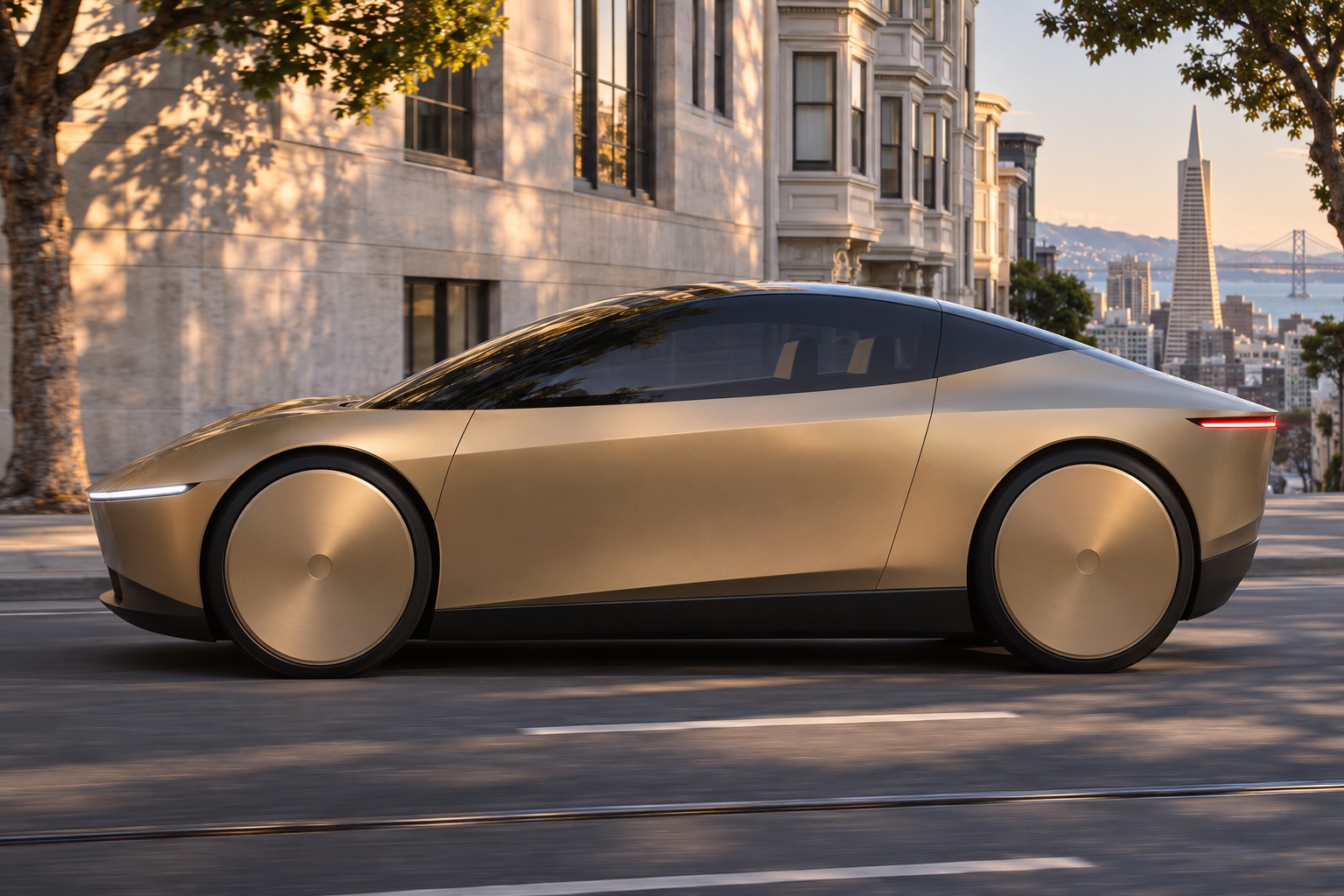
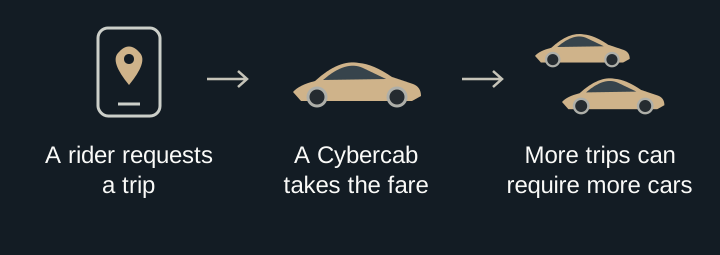
Picture two identical Cybercabs leaving Tesla’s factory in Austin. A fleet operator buys the first. Tesla keeps the second and sends it across town to pick up a passenger. Tesla gets paid for the first at delivery. The second has to earn its cost back, ride by ride.
On November 6, Elon Musk said Cybertruck production in Texas would wind down around the middle of 2027 so Tesla could build more Cybercabs. The taxi was already in production and carrying riders in Austin. Tesla is making room for a larger fleet while its eventual owners are still an open question.1
On November 7, Musk put the planned dismantling of the Cybertruck line at around June or July 2027. He said the order backlog exceeded what Tesla could build before then and that the company would add an extra shift to try to fulfill the orders. He did not give a backlog count or an output target for the additional shift.9
What Texas has room to build
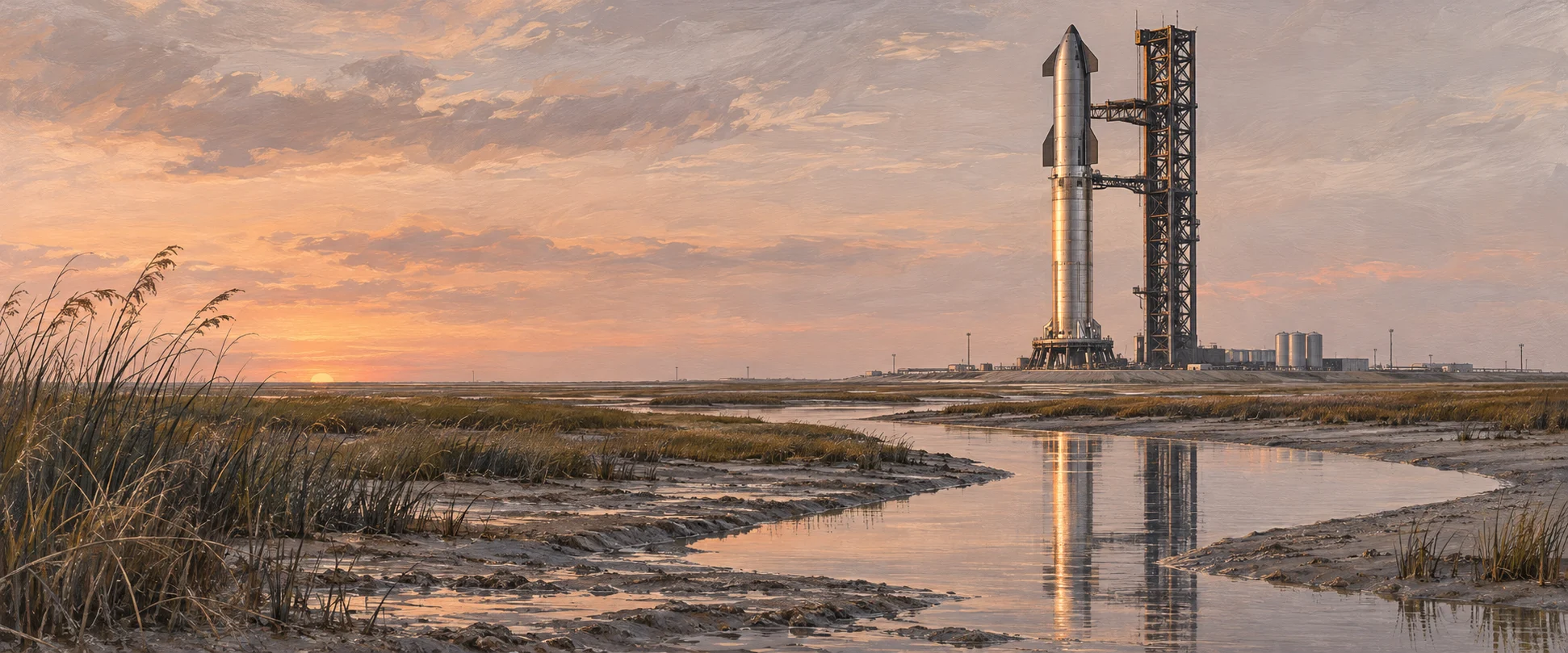
Gigafactory Texas sits on 2,500 acres. Tesla describes more than 10 million square feet of factory floor, roughly 174 American football fields including the end zones. Tesla also reports Texas battery-cell production and construction for Optimus. The company hasn’t broken out how many square feet each vehicle uses or how much of the truck operation will move over to the taxi.2
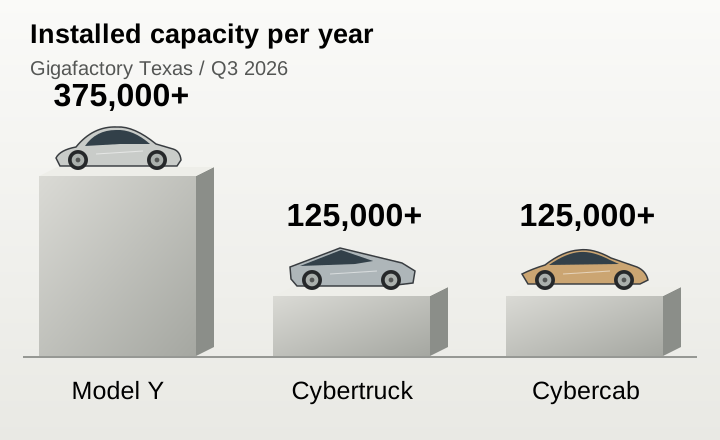
Kelley Blue Book estimates Americans bought 11,586 Cybertrucks in the first nine months of 2026, down from 16,097 a year earlier. That’s about 4,500 fewer pickups. Those historical sales estimates and Musk’s new backlog statement measure different things. A backlog can exceed what Tesla plans to build before a shutdown without establishing sustained demand at the factory’s installed capacity. The new statement qualifies the picture of spare space: Tesla says it has truck orders to fill while it prepares to devote the line to Cybercab.4
Who will own the fleet?
On Tesla’s October earnings call, management said it was working toward putting Cybercabs in customers’ hands by year-end. Musk also said he expected Tesla to own the vast majority and use them to sell rides. In the public materials we reviewed, we found no bulk order for hundreds of thousands of Cybercabs or purchase commitment from Uber, Lyft or a private equity buyer. A signed order with a quantity and delivery schedule would give investors a reason to expect more outside sales.5
An individual could buy one. An entrepreneur who wants to earn money from rides would also need access to a network and enough fares to cover financing, insurance, cleaning and downtime. Tesla could earn additional fees if the owner uses its network, depending on the terms it offers.
A fleet buyer could take thousands. A ride platform such as Uber or Lyft could buy vehicles itself, or a private-equity-backed operator could own the cars and pay a platform to find riders. The fleet owner bears the cost of empty seats.
Tesla could keep the keys. If Tesla owns the car, every idle hour ties up its own money. On the October call, vehicle engineering chief Lars Moravy explained how demand for rides was already shaping the build schedule.
“Right now, we’re building at the rate that the Robotaxi service needs the vehicles.”
Who finances a 50,000-car year?
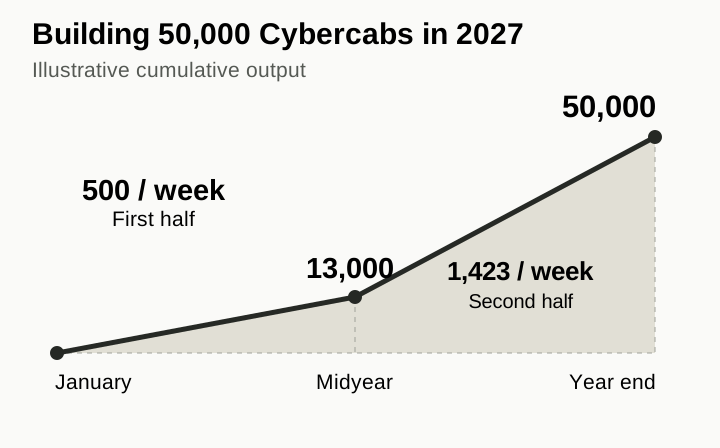
Consider an illustrative 2027 in which Austin builds 50,000 Cybercabs. If Texas averages 500 cars a week through June, it would have to nearly triple that pace in the second half. The June/July conversion window does not establish when the additional Cybercab capacity would begin producing. Dismantling, retooling and ramping the line could leave less time for that increase.
Suppose outside buyers take 10,000 and Tesla keeps 40,000. Reverse the mix and the factory still builds 50,000. But Tesla now has 30,000 fewer cars to finance and put into service itself, and 30,000 fewer from which it can keep the full stream of future fares. For a family office considering owning the vehicles, the question is whether the fares left after operating costs would justify taking that risk.
Why the board counts cars in service
One milestone in Musk’s 2025 pay award requires a daily average of at least one million robotaxis operating commercially by Tesla or on its behalf for three consecutive months. An outside buyer’s car can count if it enters qualifying service. Earning shares also depends on Tesla’s market value and the other award terms.8
The investor takeaway
Musk’s clarification makes the factory decision more concrete: Tesla plans to prioritize Cybercab space while trying to fulfill outstanding truck orders. It does not establish the return on that choice. A conversion schedule with an output ramp, followed by evidence that the added cars are earning fares, would make the investment case easier to assess.
When Tesla reports its next batch of Cybercabs, I’d look for three numbers alongside factory output: how many outside buyers took, how many Tesla kept, and how many of the cars it kept started earning fares. Outside sales show the market for the vehicle. Paid miles per car show how much business Tesla can earn from the ones it owns.
This article reflects Dalton Skach’s views as of November 8, 2026. It provides general research and does not offer personalized investment advice or recommend buying, selling, or holding a security. As of November 8, 2026, Dalton holds positions in Tesla and SpaceX. Editorial Standards & Disclosures · Terms of Use
Sources and calculations
Update history · November 8, 2026
Added Musk’s clarification on the planned June/July 2027 conversion, Cybertruck backlog and extra shift.
- Reuters on Musk’s announcement · Tesla’s Austin fleet update ↩
- Tesla’s factory overview · Tesla’s manufacturing update ↩
- Tesla grouped 7,004 vehicles in “other models.” Even counting all as trucks, 7,004 × 4 ÷ 125,000 gives an upper bound of about 22.4%. Capacity, page 6 · Production, page 5 ↩
- Kelley Blue Book U.S. sales estimates ↩
- Tesla Q3 earnings call, customer ownership discussion ↩
- Tesla earnings call transcript ↩
- BTF scenario for two 26-week halves: 500 × 26 = 13,000. The remaining 37,000 require about 1,423 cars a week. Tesla gave no unit target in the announcement. Reuters ↩
- Tesla’s milestone definition · Award terms in Tesla’s quarterly filing ↩
- Elon Musk’s November 7, 2026 post. The post specifies an approximate June/July 2027 line conversion, a backlog exceeding remaining planned production, and an extra shift intended to help fulfill orders. It provides no backlog quantity or incremental output target. ↩