Tesla’s $10 Billion Solar Bet Has to Earn Its Keep
By Dalton Skach · 4 min read
Clearing land is the visible beginning of a factory. Tesla’s proposed solar plant has a much larger task ahead: turning billions of dollars of production equipment into panels that earn their cost back. The new signs of activity at Project Crystal Sun make that investment question more immediate.
What changed at Fort Bend
On November 9, S.E. Robinson Jr. reported earthworks at the proposed Fort Bend County site, describing clearing, equipment staging and grading. He said he had visited the previous day. Sawyer Merritt characterized the activity as Tesla having “officially started construction.” At 10:21 a.m. Eastern, Elon Musk posted “Project Crystal Sun,” amplifying the story.1
That is a meaningful change in the public signals around the project. On November 5, Spectrum News reported that Fort Bend was still competing with an out-of-state location. Musk’s acknowledgment strengthens the interpretation that Tesla is moving forward in Texas. His three-word post does not specify the scope of work, authorize a spending schedule or reaffirm a production date.2
There is also a separate paper trail for preparations. In a September 15 application to Texas environmental regulators, Amrize South Central sought authorization for three temporary concrete batch plants serving Project Crystal Sun in Richmond. Its cover letter anticipated construction under that authorization beginning in November 2026. That supports the chronology of preparatory work, though the application itself is neither an issued permit nor proof that Tesla has committed the entire project budget.3
The machines carry the investment case
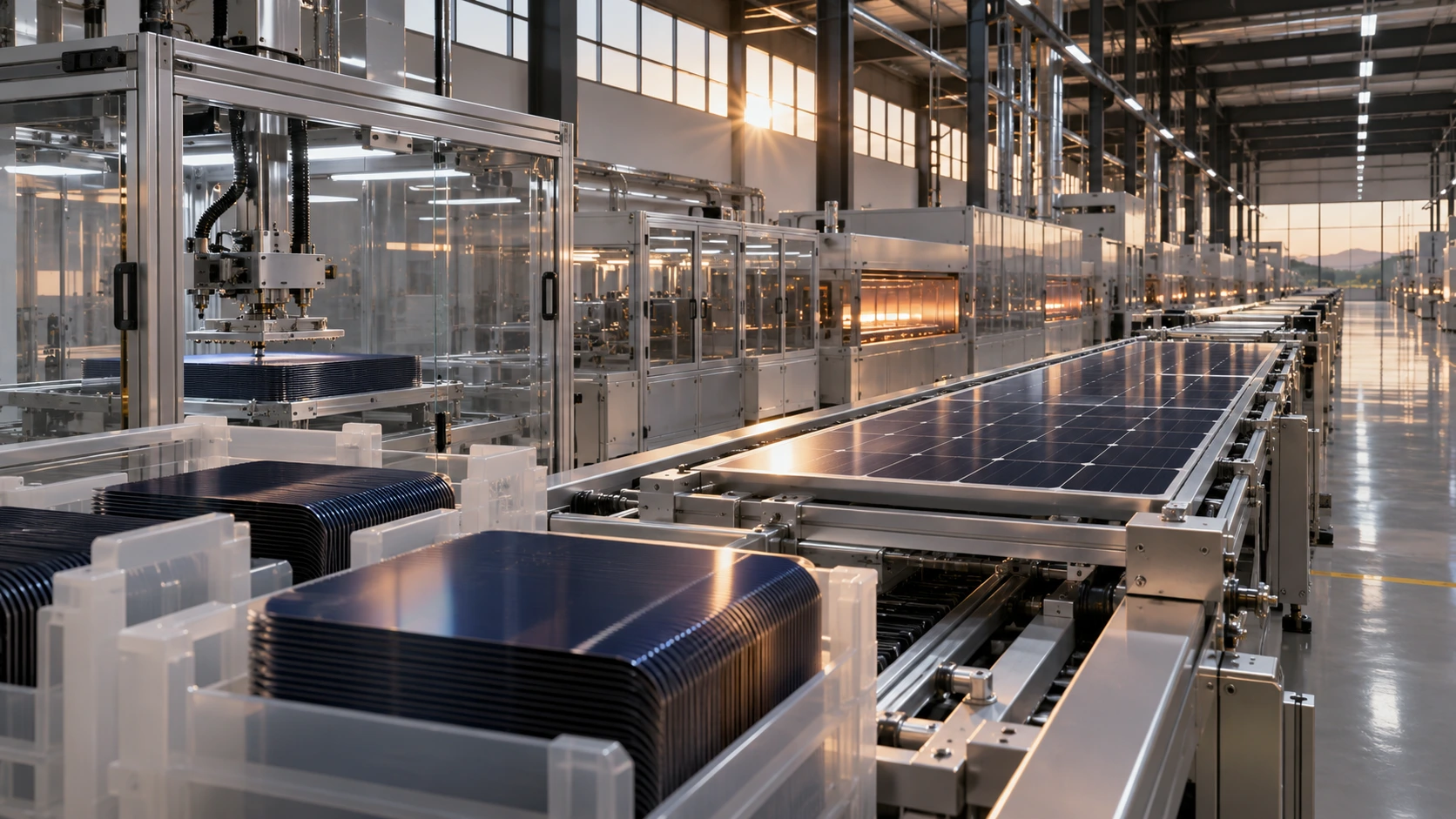
Tesla’s JETI application describes a solar-cell and module manufacturing facility. Its equipment list extends upstream into ingots and wafers, alongside coating, metallization, testing and automation. The ambition is to control several stages of production, rather than only assemble purchased cells into finished panels.4
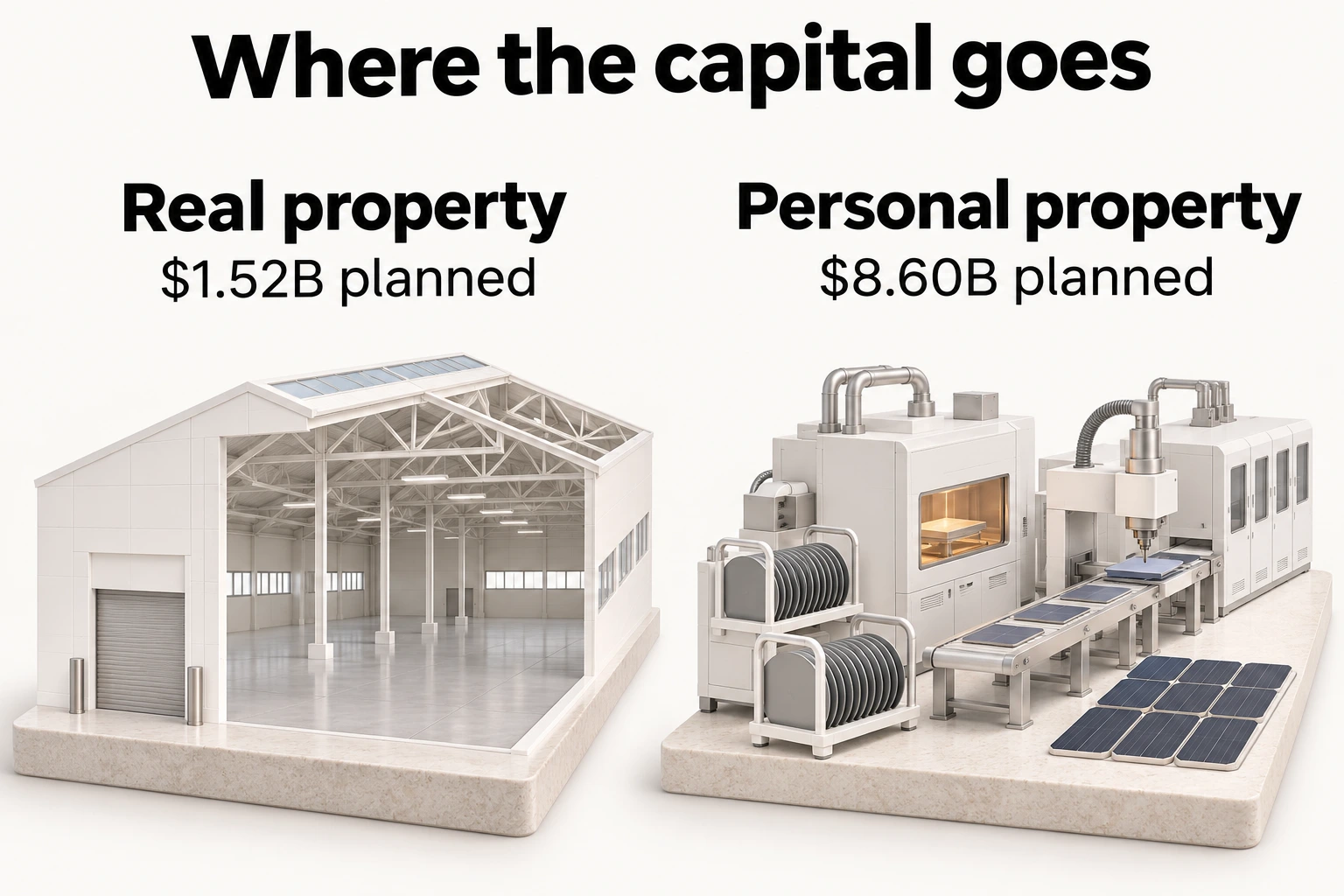
The proposed $10.116 billion investment divides into $1.517 billion of real property and $8.599 billion of personal property. The latter category accounts for 85% of the total. This is an equipment-heavy manufacturing proposal, which is why a cleared site resolves only a small part of the investment question.5
Vertical integration could give Tesla more control over supply, process design and the cost of each manufacturing step. It also makes Tesla responsible for getting those steps to work together. Weak yields upstream can leave downstream equipment waiting. Slow qualification can tie up cash in inventory. High output is valuable only if enough of it meets specifications and can be sold at an adequate margin.
The useful comparison is the cost of a saleable panel from this integrated plant against the cost of sourcing equivalent components or finished products elsewhere. That comparison must include labor, materials, power, maintenance, scrap and the capital tied up in the factory. Owning more stages creates an opportunity to improve that calculation; it does not establish the result.
Construction is earlier than commercial scale
The application targets construction completion in 2028 and commercial operations in the first quarter of 2029. Those dates come from the existing filing. They are not a new timetable supplied by Musk’s post. The employment model reaches 9,712 in 2033, so the headline jobs number should not be read as opening-day staffing.6
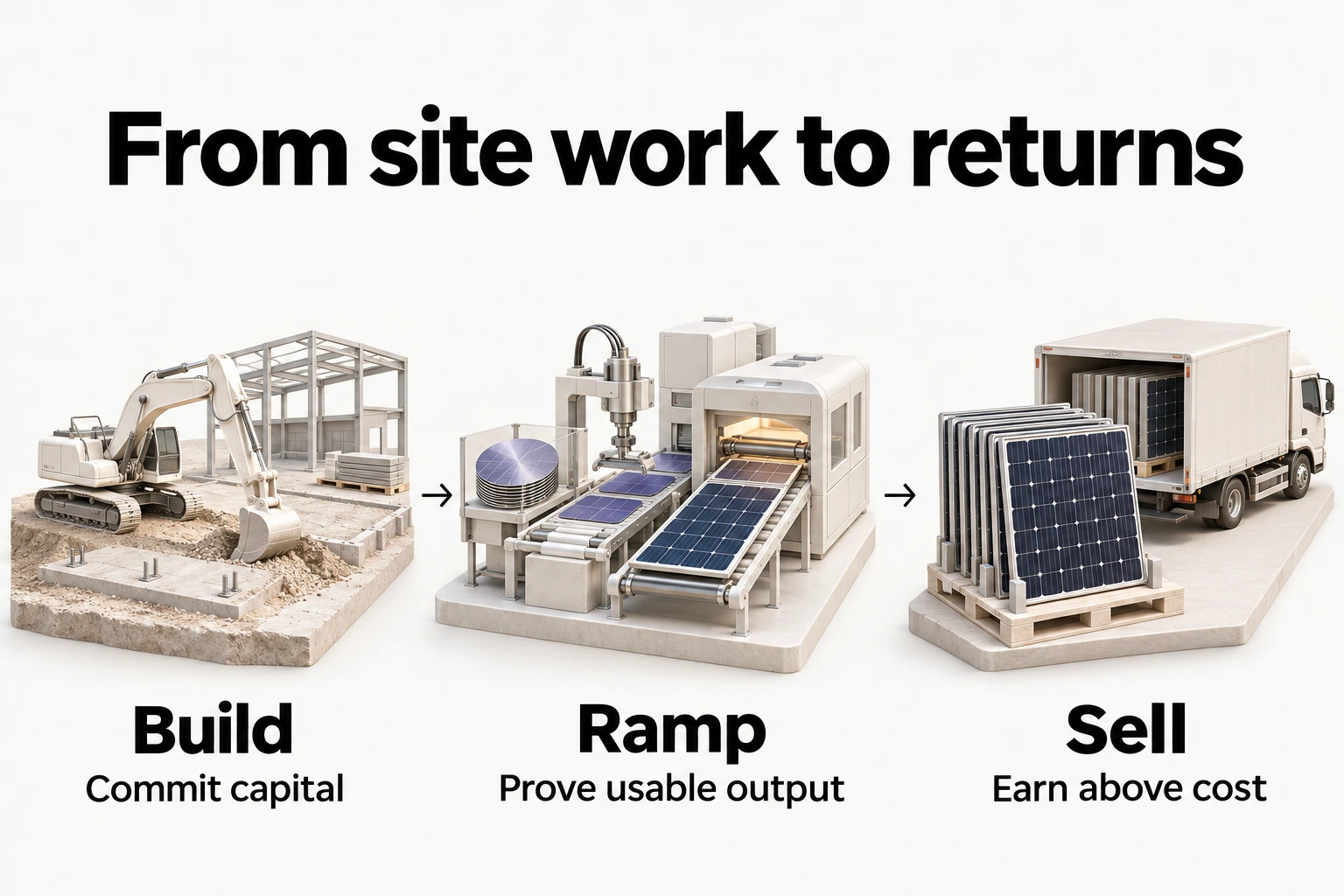
For a Tesla forecast, I would separate construction spending, usable output and profitable sales. A factory can advance through one stage while the next remains uncertain. Groundwork can bring cash outlays closer without bringing an equivalent amount of revenue forward.
Tesla had already told investors in its October quarterly update that infrastructure build-out, including solar, was underway. The Fort Bend report should therefore prompt a check of how much solar investment is already included in a forecast. Adding the whole project budget on top of existing capital-spending assumptions could count the same investment twice.7
The same discipline applies to the AI and space-computing narrative. A possible need for solar panels is not a customer order. The project records reviewed here do not establish contracted demand from SpaceX or an allocation of this plant’s output to computing. If such a relationship emerges, Tesla investors will need to know who purchases the panels, on what terms and which company retains the economic benefit.
The investor takeaway
The site-work report and Musk’s acknowledgment make Crystal Sun more credible as an approaching capital commitment. They do not yet establish what return Tesla will earn on it. I would update the assessment of execution progress before raising a solar earnings forecast.
The evidence that would change that conclusion is a project-specific spending and capacity plan, followed by commissioned equipment, reliable yields and customer demand at prices that cover the full cost of production. The opportunity is a competitive domestic solar manufacturing business. The next test is whether Tesla can turn its control of the production chain into an advantage large enough to pay for owning it.
This article reflects Dalton Skach’s views as of November 9, 2026. It provides general research and does not offer personalized investment advice or recommend buying, selling, or holding a security. As of November 9, 2026, Dalton owns shares in Tesla and SpaceX. Editorial Standards & Disclosures · Terms of Use
Sources and calculations
- S.E. Robinson Jr., original site-work post, November 9, 2026, 9:41 a.m. ET; linked flyover. His text dates the visit to November 8. Sawyer Merritt’s construction characterization, November 9, 9:55 a.m. ET; Elon Musk’s “Project Crystal Sun” post, November 9, 10:21 a.m. ET. Post texts and timestamps retrieved through the X data provider; Musk and Robinson texts also retrieved through live page requests. Musk’s quote-post relationship was supplied in the original alert; the text retrieval did not expose quoted-post metadata. Site observations and identification are attributed to Robinson, not independently surveyed or geolocated by BTF. No claim is made that November 8 was the first day work occurred. ↩
- Valencia Jones, Spectrum News, “Tesla considers Fort Bend for $10 billion solar manufacturing site”, published November 5, 2026, 5:13 p.m. CT. Site-selection discussion identifies an alternative outside Texas. Interpretation of the later posts is BTF analysis. The article does not treat the “largest” characterization as a verified capacity ranking. ↩
- Amrize South Central, application for temporary concrete batch plants, TCEQ record 10232113, cover letter dated September 15, 2026, PDF page 1. Three proposed plants, Richmond location and anticipated November 2026 construction under the requested authorization. Read from the downloaded primary document. Permit issuance and the current scope of authorized work were not established. ↩
- Tesla, Inc., JETI application J0050, Lamar CISD, signed July 22, 2026 and posted August 6. PDF page 8, Tab 2, describes the products; page 13, Tab 5, lists eligible equipment. Parcel descriptions on page 9 explicitly say the project may occupy only portions of the listed parcels. No 3,000-acre factory footprint is asserted. ↩
- Same J0050 application, PDF page 29, Economic Benefit Statement section 01, capital-investment table. Real property: $1,517,415,000. Personal property: $8,598,685,000. Total: $10,116,100,000. Personal-property share = 8,598,685,000 ÷ 10,116,100,000 = 85%. Visual values rounded to $1.52B and $8.60B; these independently rounded values need not sum to the rounded headline total. The visual’s machinery represents the personal-property category conceptually, not an itemized equipment allocation. ↩
- Same J0050 application, PDF page 4, Project Timeline; page 8, Tab 2; page 28, employment table. Completion year 2028; commercial operation target Q1 2029; modeled headcount 9,712 in 2033. These are application projections, not a newly confirmed construction schedule or actual hiring. ↩
- Tesla Q3 2026 Update, released October 21, page 9, Outlook, infrastructure update. The general solar build-out statement does not identify Fort Bend or isolate this project’s budget. Company identity verified against Tesla, Inc., Form 10-Q for the quarter ended September 30, 2026, cover, Nasdaq ticker TSLA, accession 0001628280-26-066775. Forecast treatment and commercial tests are BTF analysis. ↩
Artwork: original AI-generated conceptual factory hero and thumbnail, plus two sculpted-model explanations, created November 9, 2026 using the built-in imagegen tool. None depicts the actual Fort Bend site, installed equipment or a construction plan. Full prompts and provenance are retained in the editorial source record.