Why SpaceX Is Building Its Own Solar-Cell Supply
By Dalton Skach · 5 min read
SpaceX wants to run artificial intelligence on satellites powered by sunlight. It has now ordered the machinery to make their solar cells. Can building its own supply turn that ambition into dependable computing capacity?
A factory order with a price
On November 10, Germany’s SINGULUS Technologies announced a contract to supply SpaceX with a complete solar-cell production line. Its formal disclosure puts the first line’s order value above €60 million, with delivery scheduled for the first half of 2027.1
Additional lines are planned under the partnership. SINGULUS describes an eventual scale above 100 gigawatts of production equipment, tied to SpaceX’s satellite manufacturing expansion in Bastrop, Texas. It does not disclose the first line’s capacity or a timetable for reaching that broader scale.
Those are different commitments: a priced first order, a delivery target and a much larger ambition.
Why a rocket company needs solar-cell machinery
Starmind is SpaceX’s planned network of satellites carrying computers for AI work. Instead of drawing electricity from a utility, the satellites would collect sunlight and send computing results through laser connections to the Starlink communications network.2
SpaceX presents orbital computing as a way around the difficulty of securing enough electrical power on Earth. Its Starmind page describes a factory under construction in Bastrop, with satellite production and deployment planned to begin as soon as late 2027. These remain company plans.
For that business to work, SpaceX needs a repeatable way to build the solar hardware that powers the computers. SINGULUS’s equipment would let it manufacture cells at its Texas facility. Mike Nicolls, SpaceX’s senior vice president of Starlink, identifies Starmind as the intended use.3
The operating logic is straightforward: if solar-cell availability limits satellite production, bringing that step inside the factory could give SpaceX more control over supply and design. The announcement does not establish how much time or money it will save.
What the machines will make
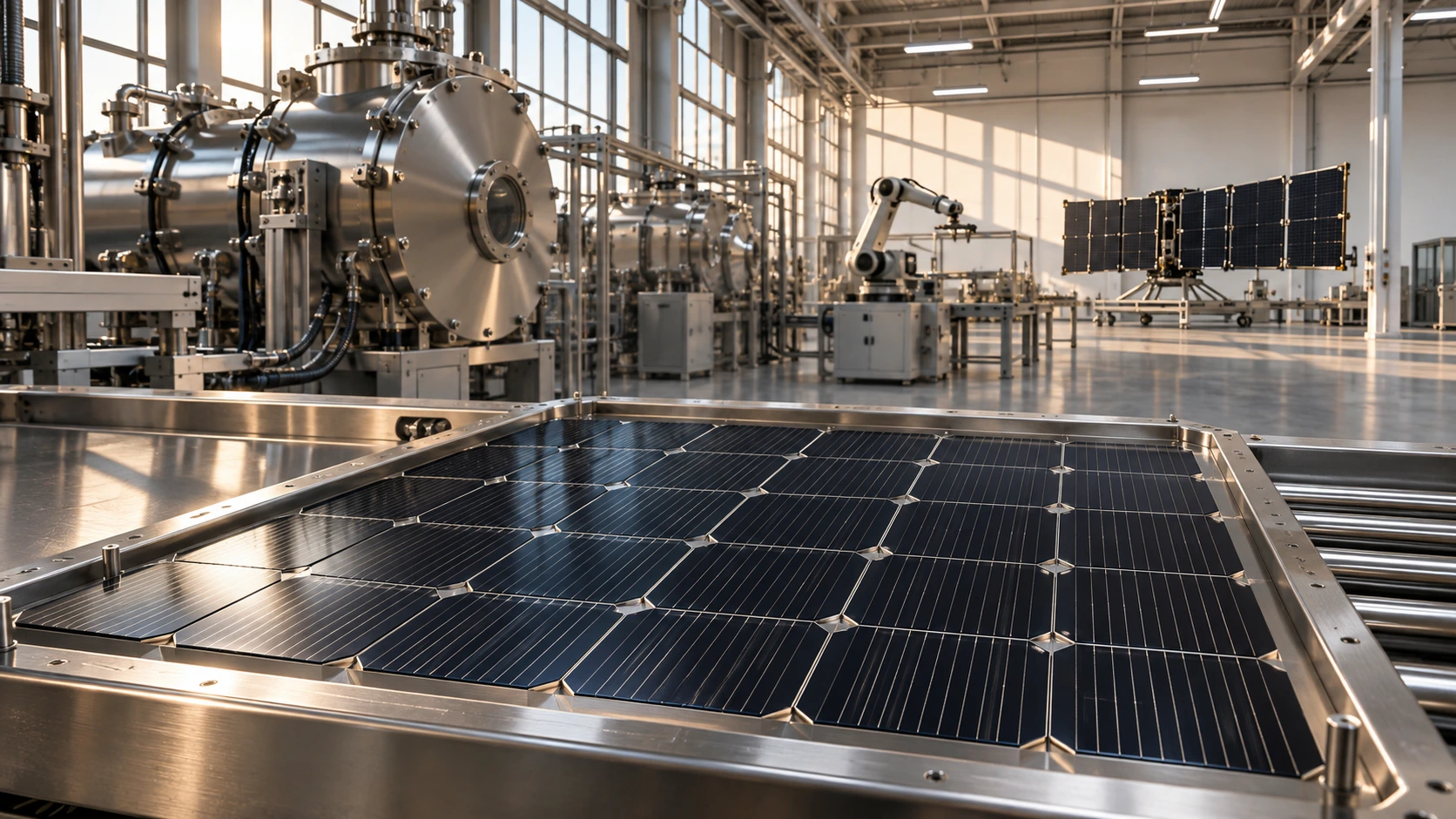
A solar cell converts light into electricity. Many cells are connected to form the panels on a satellite’s solar wings. This order is for equipment that makes the cells, rather than a shipment of finished satellites or an operating power plant.
The chosen technology is called heterojunction, or HJT. It combines a crystalline silicon wafer with extremely thin layers of another form of silicon. Those layers help reduce electrical losses at the wafer’s surface, allowing more of the light’s energy to become usable electricity.4
Making that structure consistently requires precise processing. SINGULUS brings expertise in cleaning and treating surfaces, depositing thin coatings and thermal processing. A complete line brings those capabilities together, but SpaceX will still need to get it running reliably.
Why 100 gigawatts needs careful reading
The large number describes the intended scale of production equipment. It does not tell us how much electricity SpaceX is generating in orbit, how many satellites are operating or how much AI work they can perform.
Think of an aircraft factory’s advertised capacity. The number of planes it could build is different from the number flying passengers. Between the two sit manufacturing, testing, delivery and daily operation.
Here, the cells must become working solar arrays, be integrated into satellites and reach orbit. The computers also need chips, communications and a way to shed heat. SpaceX itself identifies launch capacity, power generation and AI chips as constraints on scaling Starmind.
A useful assessment therefore needs actual cell output and satellite performance. Dividing the 100-gigawatt ambition by a satellite’s advertised power would skip too many missing steps to produce a credible fleet forecast.
Control comes with a factory to run
SpaceX is also helping finance the supplier. SINGULUS says their partnership began in March 2026, when SpaceX provided funding, followed by additional funding in October through a secured loan that ranks behind certain other debt.
That makes this a deeper relationship than a one-off equipment purchase. Our interpretation is that supporting the supplier could help SpaceX secure a manufacturing path it expects to need. The disclosed financing does not establish that SpaceX owns SINGULUS or has exclusive access to its technology.
Making cells internally could let the satellite and manufacturing teams adjust the product together. It also leaves SpaceX responsible for staffing the line, maintaining it and paying for output that fails quality checks.
The share of production good enough to use is called yield. A line with poor yield consumes materials and time without delivering enough usable cells. Even a technically successful line can be expensive per cell if satellite assembly or launch delays leave it underused.
The business test is whether this factory helps SpaceX deliver reliable computing at a competitive total cost, including manufacturing and launch. Cheaper solar cells would help, but they cannot settle that question alone.
The next proof is usable output
The order makes Starmind’s supply chain more concrete. The next meaningful evidence is delivery and acceptance of the first line, followed by sustained output of cells that meet the satellite’s requirements.
Strong yields, reliable arrays and satellites performing useful computing would support the case for adding more lines. Delayed acceptance, heavy scrap or a growing pile of cells waiting for satellites would weaken it.
SpaceX has committed to machinery. Whether that commitment becomes an advantage depends on how well the factory and the orbital system work together.
This article reflects Dalton Skach’s views as of November 10, 2026. It provides general research and does not offer personalized investment advice or recommend buying, selling, or holding a security. As of November 10, 2026, Dalton owns shares in SpaceX and has no shares or other financial interests in SINGULUS Technologies. Editorial Standards & Disclosures · Terms of Use
Sources and calculations
- SINGULUS Technologies, formal supply-contract disclosure, November 10, 2026. Opening three substantive paragraphs: first-line order value above €60 million, first-half 2027 delivery, planned additional lines, wording of the 100+ GW ambition and March/October financing. This is the issuer’s Article 17 MAR disclosure, not a US SEC filing; no SEC accession is asserted. The issuer’s Share information identifies exchange symbol SNG and ISIN DE000A1681X5. ↩
- SpaceX, Starmind, undated live product page, read November 10, 2026. “Space-based compute,” “Laser Connectivity,” “Gigasat Factory” and “Limiting Factors” sections. Describes the proposed architecture, Bastrop factory and timing. Cost, cooling and deployment claims are company expectations rather than independent performance findings. ↩
- SINGULUS, companion corporate announcement, November 10, 2026. Mike Nicolls quotation identifies Starmind and Texas production; Lars Lieberwirth quotation describes the process platform. This version omits the price supplied in the formal disclosure. ↩
- EPFL Photovoltaics and Thin Film Electronics Laboratory, silicon-based heterojunction solar cells, undated technical explainer, read November 10, 2026. Opening explanation, Figure 2 discussion and “Surface passivation” section support the simplified explanation of HJT. Laboratory efficiency records are not treated as performance specifications for SpaceX’s line. ↩
Research cutoff and draft date: November 10, 2026. The issuer announced the signed contract that day; the precise signing date and the supplied 2:04 p.m. ET posting time were not established by the records reviewed. The underlying contract was not available in those records. The first-line capacity, full expansion schedule, acceptance conditions and total partnership value remain unspecified there.
No fleet count, cost saving or revenue forecast is calculated. The 100+ GW wording is a future equipment-scale statement with no annual output convention or detailed measurement basis supplied in the announcement. It is not converted into operating solar power or computing capacity. Discussion of yield, utilization and financing incentives is analysis.
Holdings record: SpaceX ownership is carried forward from Dalton’s November 8, 2026 standing confirmation. Dalton confirmed on November 10, 2026 that he has no shares or other financial interests in SINGULUS Technologies.
The hero and thumbnail are original AI-generated conceptual photographic artwork of an imagined solar-cell factory, not an actual SpaceX or SINGULUS facility. Both body visuals are original AI-generated sculpted models. They explain processes and tradeoffs rather than document real equipment. Generation prompts and source captures are retained with the private draft.