Apple Can Keep Control. SpaceX Can Still Get Paid.
By Dalton Skach · 6 min read
Apple wants Siri to do more than answer questions. It wants the assistant to carry out tasks across the apps people use. A prediction that Grok will become Siri’s brain raises a better investor question: who needs to own which part of that experience to make money?
The post makes a plausible strategic argument. Apple should want capable AI suppliers that do not threaten the iPhone. SpaceX, which owns the business behind Grok, could offer both models and computing capacity. But the public records reviewed for this article do not establish an Apple–Grok agreement. And several details point toward a more interesting conclusion than one company winning the entire assistant.
Apple has already separated the jobs
Imagine asking Siri to find a restaurant from a message and book a table. The assistant needs permission to read the message and use the booking app. A model needs to interpret the request. Computers need to run that model. Those are different jobs, even when the customer experiences them as one conversation.
Apple’s existing design makes that distinction concrete. Its latest foundation models were custom-built with Google. Some run on Apple devices, some on Apple silicon in the cloud, and its most capable server model runs on Nvidia processors in Google Cloud.1
Apple says it retains complete control over the software for Private Cloud Compute, its system for processing sensitive requests remotely. Devices accept only software Apple has cryptographically approved. That is a stronger protection against dependence than simply choosing a supplier that does not currently sell a phone.2
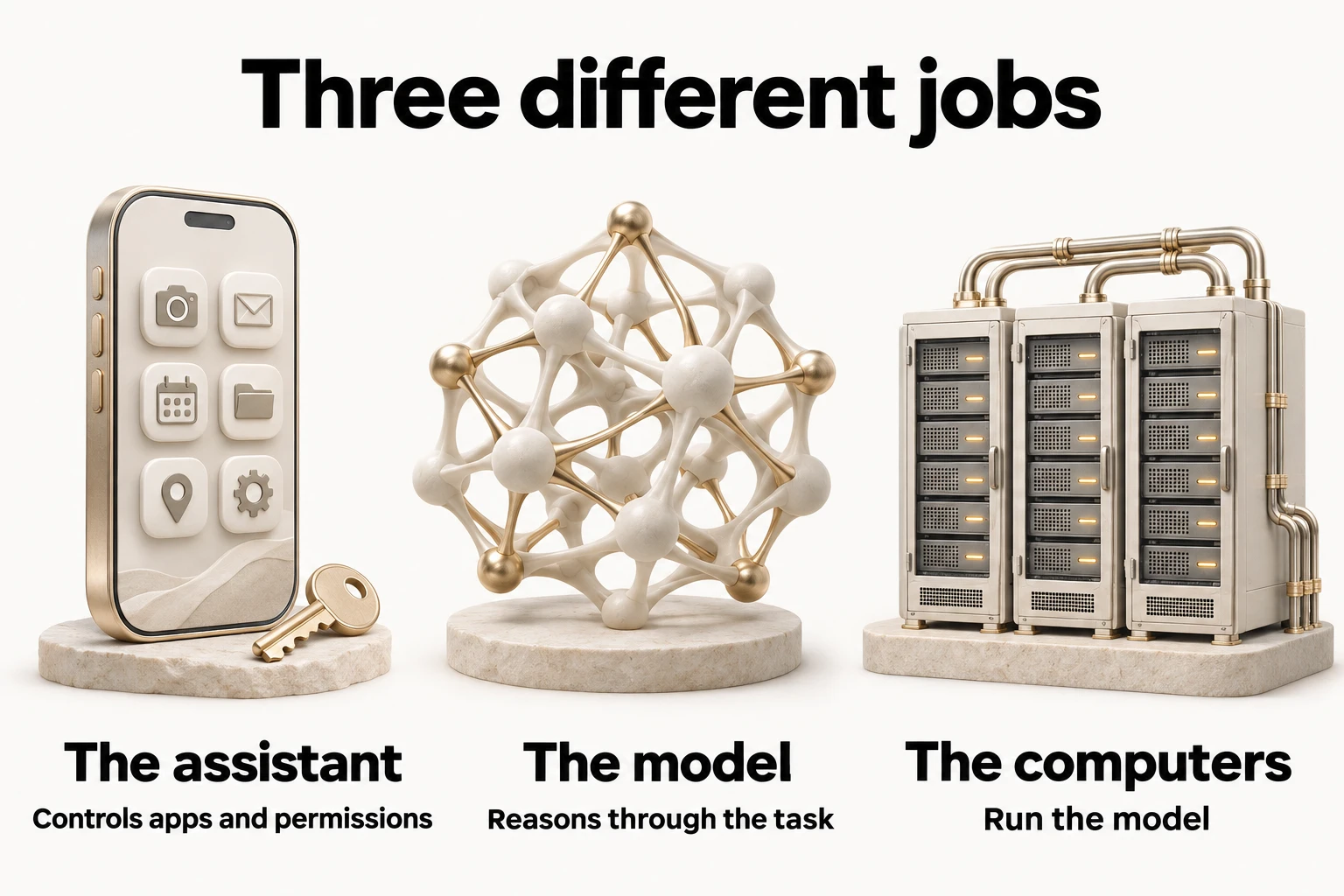
This does not make Google easy to replace. A model built jointly with a supplier can require substantial engineering and testing to move. But buying technology from a competitor is not the same as handing that competitor the customer relationship or unrestricted access to personal data.
For Apple investors, the important question is whether Apple can keep control of the experience while buying improvements in intelligence at an acceptable cost. A second supplier would create negotiating leverage only if its product were good enough, secure enough and practical to adopt. Having a second name on a list is insufficient.
Count completed tasks, not installed devices
Apple reported more than 2.5 billion active devices in January. That is a distribution advantage, not a count of unique people or eligible, paying AI users.3
On November 3, Apple opened a developer preview that lets apps expose more content and actions to Siri. The announcement says these new integrations will first reach customers in a few months, with App Store submissions opening in the spring. It also specifies compatible devices, regional restrictions and daily limits for server-based features. Expanded access will carry a fee in the future.4
Start an earnings model with people actually using the service, how often they ask it to work, how much work stays on the device, and the cost of the remainder. Then include retries, failed actions and support. A cheap answer is not cheap if the assistant needs several attempts to finish the job.
Benchmarks therefore matter, although no single leaderboard settles the question. A weaker model can consume more computing by making mistakes. For Apple, success means the value of better devices, stronger customer retention and any AI fees exceeds the full cost of delivering the service. Unlimited cloud use across the installed base is neither a necessary product design nor an established commitment.
SpaceX can sell computing to its competitors
SpaceX already has another route to AI revenue: supplying the machinery on which someone else’s model runs. Anthropic, the company behind Claude, discloses agreements with SpaceX’s AI subsidiary for access to Nvidia-powered computing.
Its November 2 amended IPO filing describes spending of up to $120.5 billion through terms extending into 2029. But the next sentence changes how an investor should read that number. After initial non-cancelable periods ending in January and March 2027, either party can cancel the respective agreements on 90 days’ written notice.5
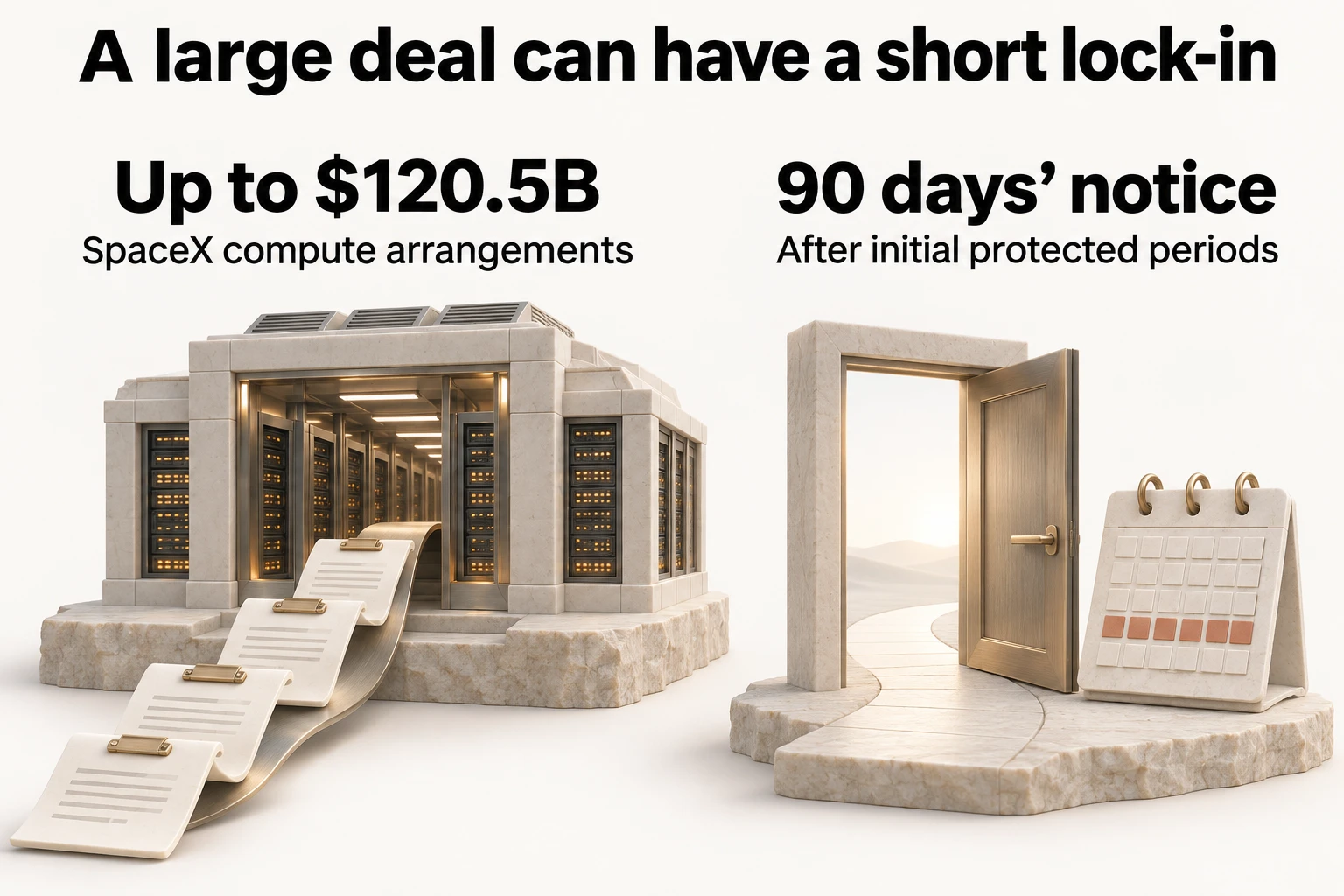
This is evidence of a substantial commercial relationship. It is not $120.5 billion of guaranteed future revenue. The ability to leave does not mean Anthropic will leave, but it makes continued competitiveness and the ability to find replacement customers important to the value of the equipment.
For SpaceX shareholders, this is the useful piece of the puzzle: Grok does not have to win every customer for SpaceX to earn AI revenue. In principle, supplying computing could allow SpaceX to benefit from an assistant powered by another model. An Apple arrangement of that kind remains a scenario, not an announced business.
The same distinction applies to capacity. On its October 20 earnings call, SpaceX described nearly 2.2 gigawatts of nameplate computing capacity as an end-of-October target. The reported September-end figure was 1.7 gigawatts. The post turns the target into an achieved result. Neither figure tells investors how much capacity is available for Apple or what profit it would earn.6
A legal truce is not a purchase order
There is a genuine change in the relationship. A September 14 court filing says X and SpaceXAI resolved their claims against Apple and sought dismissal with prejudice. It does not disclose a Siri contract or establish why the dispute ended.7 The timing after John Ternus became CEO is not evidence that his appointment caused a commercial agreement.
Nor would owning satellite connectivity automatically confer the right to control apps on an iPhone. A network carries information; the operating system decides which actions an assistant may take. Those capabilities might complement one another commercially, but one does not establish the other.
The investor takeaway
For Apple, I would watch control of the customer experience and the cost of reliably completing tasks. For SpaceX, I would watch paying computing customers, contract durability and returns after financing, operating and replacing the equipment. A Grok announcement alone would answer neither question.
The strongest lesson is that Apple can retain the assistant while purchasing intelligence, and SpaceX can sell computing even when a competing model wins. Evidence of an Apple contract specifying deployment, privacy obligations, payment terms and minimum commitments would strengthen the partnership case. Sustained usage at sensible costs would strengthen Apple’s economics; customer retention and attractive computing margins would strengthen SpaceX’s. Until then, I would keep a Siri deal out of the base forecast.
This article reflects Dalton Skach’s views as of November 9, 2026. It provides general research and does not offer personalized investment advice or recommend buying, selling, or holding a security. As of November 9, 2026, Dalton owns shares in SpaceX and the Vanguard S&P 500 ETF (VOO). VOO provides indirect exposure to Apple and Alphabet, and further indirect exposure to OpenAI through portfolio companies such as Microsoft. Editorial Standards & Disclosures · Terms of Use
Sources and calculations
- Apple Machine Learning Research, Introducing the Third Generation of Apple’s Foundation Models, June 8, 2026, updated September 9; opening model descriptions and “Training Recipe.” Distinguishes model development, on-device execution and cloud execution. ↩
- Apple Security Research, Expanding Private Cloud Compute, June 8, 2026, opening and concluding architecture discussion. Apple’s stated security commitments and software-control design, not an independent security audit or proof that another hosting provider qualifies. ↩
- Apple, fiscal first-quarter results, January 29, 2026, CEO remarks. More than 2.5 billion active devices is a historical company-wide installed-base measure; no conversion to unique users is assumed. ↩
- Apple Developer, Siri AI is now open to all developers, November 3, 2026, developer rollout and availability footnotes. The broader third-party integrations are a developer preview; the article does not imply that every Siri feature is awaiting launch. ↩
- Anthropic, PBC, Form S-1/A, filed November 2, 2026; “Infrastructure Service Arrangements,” pp. 175–176, specifically SpaceXAI on p. 176. CIK 2130357; accession 0001628280-26-068676. Agreements entered and amended May–October 2026; prospective capacity delivery and termination terms are not realized revenue. SpaceX.AI LLC is identified as a wholly owned subsidiary of Space Exploration Technologies Corp. ↩
- SpaceX Q3 earnings call, transcript published by The Motley Fool, October 20, 2026, CFO Bret Johnsen’s capacity discussion. Company statements distinguish 1.7 GW at September 30 from the nearly 2.2 GW October target and 2.5–3 GW year-end target. No subsequent confirmation of the October milestone was established in this review. ↩
- X Corp. and SpaceXAI v. Apple et al., motion to dismiss claims against Apple, September 14, 2026, case 4:25-cv-00914-P, docket 385, p. 1. Commercial terms and motive are not disclosed. Apple’s April 20 succession announcement gives September 1 as Ternus’s effective date. ↩
Reviewed November 9, 2026. The supplied post had no author, link or publication date. Its partnership prediction is treated as commentary, not original reporting. The accompanying fact-check record addresses the other claims. No probability, share-price target or Apple–SpaceX revenue forecast is assigned.
Analytical framework: annual cloud expense depends on active users × tasks per user × share of tasks requiring cloud work × average cloud cost per task, with cost per task including repeated model calls and retries. This is a simplified relationship, not a numerical forecast. Computing revenue must be assessed against operating expense, equipment replacement and financing; gross capacity and maximum contract values are not profits.
The hero and thumbnail are original AI-generated conceptual photographic artwork. Both body illustrations are original AI-generated sculpted models. They depict imagined objects and simplified commercial relationships, not actual products, facilities or documentary evidence. Prompts and originals are retained with the draft.