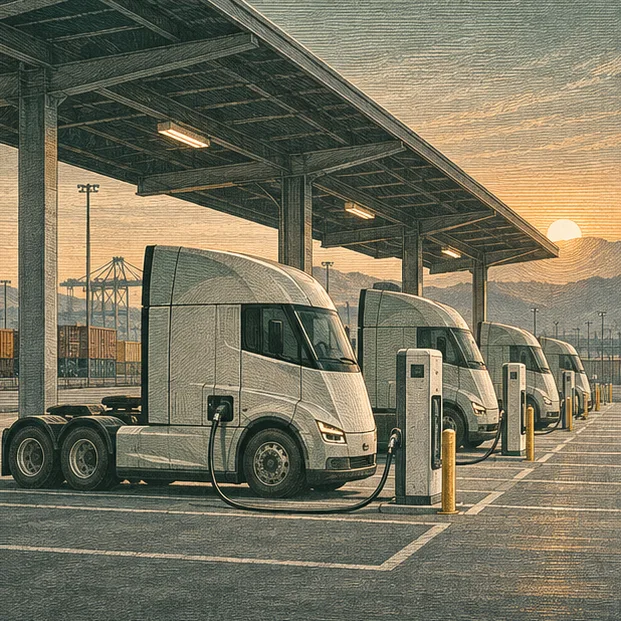
Who Owns the Electric Mile?
Who gets paid when a truck starts buying electricity at the yard?
Summary
The value of an electric mile depends on getting the right truck out of the yard on time. Cheap energy helps. A fleet also needs an electrical connection, a usable charging window and enough working vehicles to spread the cost of the depot. The division of the savings depends on which party supplies those things and which party bears the risk.
For this calculation, leave the twelve box trucks at their yard and consider a separate, larger fleet of forty heavy tractors. Give each tractor 60,000 miles of annual work. Assume the old diesels average six miles per gallon and diesel costs four dollars per gallon. The fleet drives 2.4 million miles a year, buys 400,000 gallons and pays $1.6 million for diesel. The equivalent electric route is assumed to need two kilowatt-hours measured at the site’s electricity meter per mile, including charging losses. On these assumptions the fleet buys 4.8 million kilowatt-hours. At an assumed energy-only rate of fifteen cents per kilowatt-hour it spends $720,000 on the energy component. All the prices and operating assumptions in this example are illustrative.
The difference is $880,000 a year. That is the entire space available for additional costs before considering other differences between the vehicles and the work. Out of it might come charging equipment, connection charges, service, lease payments, billing for electrical capacity, higher vehicle financing or some combination of these. Savings on maintenance could create additional room. Lost payload, missed work or a requirement to keep a spare vehicle could use it up. An operator selling charging by the kilowatt-hour cannot assume the fleet will hand over all $880,000. The fleet has to see a reason to take the vehicle and schedule risk in the first place.
Put $600,000 a year of incremental fixed depot costs into the example, with the fifteen-cent energy component unchanged. A fleet using all forty tractors as planned now has $280,000 left from the original energy advantage before vehicle-level differences and other costs. Put only twenty on the same site and run the same annual miles per tractor. The energy advantage falls to $440,000. If the fixed costs cannot yet be reduced, the project is short $160,000 before the other items. A busy depot and an unprofitable depot can have identical hardware, tariffs and electricity use per mile. The missing input is the number of miles over which the installation is being paid for.
It is easy to confuse being technically available with being useful at four in the morning. A port can be online and occupied, reachable only by a different vehicle, or delivering less power than the dispatcher requires because equipment is sharing capacity. A tractor can be physically connected and unable to start a paid session. At a neighborhood passenger charger a ten-minute delay can be an irritation. For a truck that misses a booked receiving slot, the consequence can reach another driver, a warehouse crew and the next load. A fleet service contract should be evaluated against successful departures with the required charge, alongside the simpler measure of hours a charger reports itself available.
Tesla’s Powerpack and Megapack belong in this story because they made stationary battery storage a recognizable piece of industrial equipment. Tesla described Megapack in its 2019 Impact Report as a product designed for utility-scale projects, building on the work it had done with earlier systems including Powerpack. The word Megapack should not be treated as the generic answer to every truck charger or every small business. The compelling case is a place with a valuable gap between when energy can be obtained and when vehicles need it, enough repeated use to pay for the installation, and limited or expensive alternatives. Such a gap can also be supplied by competing storage equipment.
Dalton Skach held shares in Tesla and SpaceX as of November 8, 2026.
Sources
November 24, 2026: Chapter sources and operating examples.
- Tesla Oasis, Lost Hills, California
- 2024 Impact Report
- Semi Charging
- Electricity generation, capacity, and sales in the United States
- The 21st Century Truck Stop
- 2025 Form 10-K
- Electric Vehicles for Fleets
- Estimating the Breakeven Cost of Delivered Electricity To Charge Class 8 Electric Tractors
- Cambium documentation
- Schedule BEV, Business Electric Vehicle Service
- 2019 Impact Report
Read the complete report.
The preview is free. Become a member to read the complete report, with quarterly or annual access to the member research archive and new member reports during your subscription.
Become a member to read