Summary
The first measurable loss of oil demand may show up in the fuel-card account of a single distributor. A truck that works the same route every weekday can displace more gallons than several lightly driven cars. The station that used to supply that fleet can feel the change long before it shows up in national figures.
Lay the keys to a family SUV, a ride-hail sedan and a regional box truck on a counter. A registration clerk sees three vehicles. A fuel seller sees three quite different accounts. Give each vehicle an ordinary job and follow it over a year. The three schedules here are deliberately constructed to make the arithmetic visible. The miles, fuel economies and working days are assumptions. We have no access to the accounts or traffic records of either property in Lost Hills.
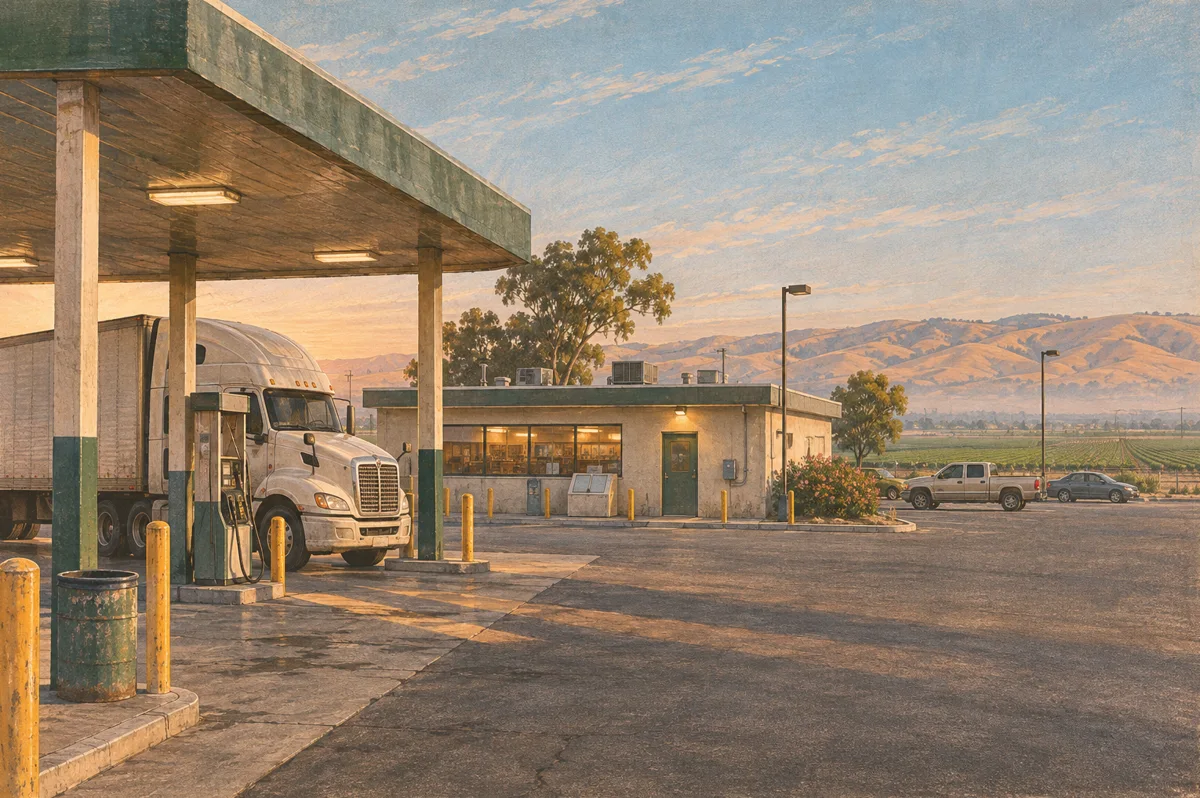
The box truck goes 96 miles on each of 250 working days. Assume eight miles per gallon of diesel. Its route takes 3,000 gallons a year. That volume comes out of a different tank at the terminal. The truck might get everything from a distributor who fills a tank at the company yard. It could instead use one public station at the beginning of every shift. A picture of the truck beside a charger would look much the same in either case. The first fuel seller to feel the change would be entirely different.
The question can actually be put to passengers. In a survey published in 2018, metropolitan Boston’s regional planning agency asked people riding with companies such as Uber and Lyft how they would have made that particular trip if the service had been unavailable. Forty-two percent said they would have used public transportation. That was a sample of passengers in a region with trains and buses, answering a question about human-driven ride-hailing. The result worth carrying out of Boston is the question itself. A rider who would have taken an already scheduled train offers a fleet a paying fare and leaves very little immediate gasoline demand to displace.
Take the box truck from earlier. Over a full year its route called for 3,000 gallons. Twelve routes amount to 36,000 gallons if the electric trucks do all the old work. Suppose the card records show three quarters of that diesel came from your pumps. Your share was 27,000 gallons. A business that sold 540,000 gallons of diesel last year has just lost five percent of its annual diesel volume to a single fleet decision. A business doing twice the trade loses two and a half percent. You need no forecast of electric market share in California to do either sum.
My expectation is that the early, readily identifiable losses will cluster around recurring routes and concentrated fuel accounts. A delivery fleet whose trucks return to the same yard has both the incentive to electrify a busy route and the records to show what went away. I would change the order of that prediction in a city where repeat electric cab riders consistently replace long gasoline trips while local depots sit waiting for power. I would lower my estimate of the whole effect in a market where the new rides largely serve former transit passengers and diesel relief trucks still do much of the freight work. Those outcomes would produce some equally handsome pictures of electric vehicles.
Dalton Skach held shares in Tesla and SpaceX as of November 8, 2026.
Sources
November 24, 2026: Chapter sources and operating examples.
- Love’s Travel Stop #230, Lost Hills, California
- Tesla Oasis, Lost Hills, California
- 2024 Impact Report
- Semi Charging
- Use of gasoline
- 2024 Highway Statistics, Table VM-1
- Fare Choices
- 2018 Base-year Emissions Inventory Report
- Field Evaluation of Medium-Duty Plug-in Electric Delivery Trucks
- Sacramento electric fleet in Run on Less – Electric DEPOT
- Port of New York and New Jersey Drayage Electrification Study
- Factors affecting diesel prices
- Electricity generation, capacity, and sales in the United States
- Refinery closures present risk for higher gasoline prices on the West Coast
Read the complete report.
The complete first report in this series is free to read.
Read the report free