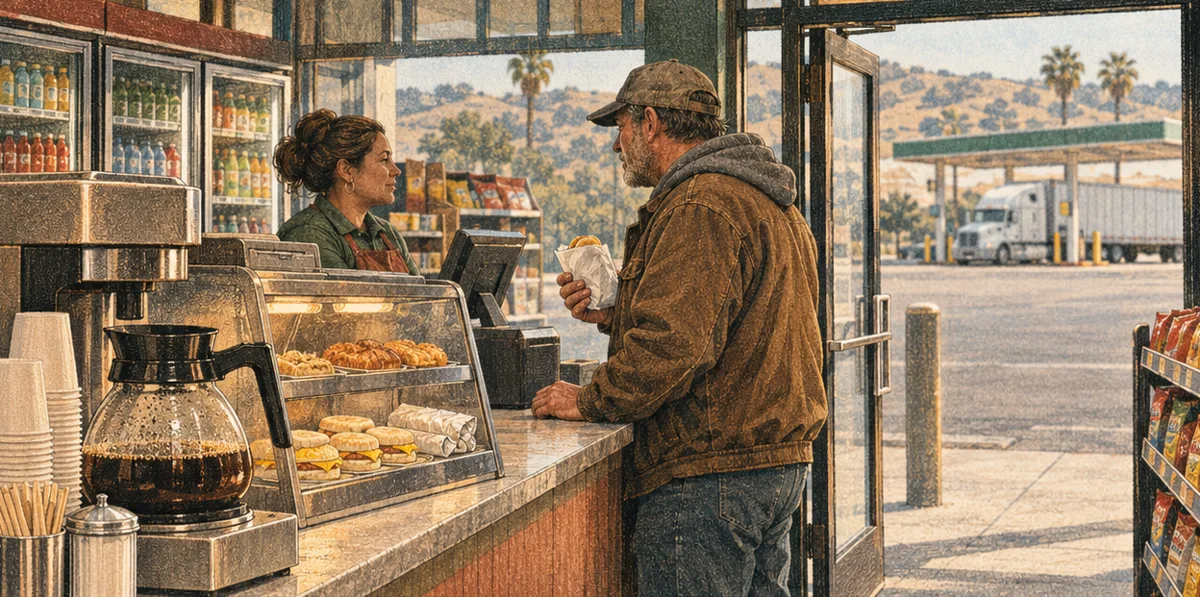
The Customer Who Never Comes Inside
What is a lost fuel customer worth to the kitchen behind the pumps?
Summary
A roadside store can lose its breakfast trade before the road loses any traffic. The financial question for the owner is how many customers came in because their vehicles needed fuel, what they bought and how much of that sale paid for keeping the doors open.
In the twelve-truck example, the station loses 27,000 gallons a year. At an assumed twenty cents of contribution per gallon, that costs $5,400. The fuel ledger tells us almost nothing about the business those same drivers did on the other side of the glass.
Suppose the twelve trucks in the account worked 250 days a year. At each of 3,000 potential truck-days, assume there was a one-in-four chance of an inside purchase that goes away when the route changes. That makes 750 lost purchases. At an average ticket of eight dollars, $6,000 of inside revenue disappears. Suppose the store retained half of those dollars after merchandise and packaging costs. The immediate loss is another $3,000 before any change to scheduled labor. Put it beside $5,400 from diesel and the annual exposure is $8,400. The store owner has lost more than the fuel margin calculation suggested and far less than the sum of the missing receipts. These are illustrative assumptions, independent of the proportion of fuel bought here. A driver could stop for lunch on a day she fueled somewhere else.
Change one fact. Half the people who would have bought breakfast come in anyway on the drive to work. Then the lost inside contribution falls to $1,500. Or assume every former visit disappears, but an arrangement with the depot supplies a tray of prepaid sandwiches each morning. The relevant amount is what the cook keeps after preparing, packing and delivering the sandwiches. A much larger catering order can leave her worse off if it requires paying a person to drive while a second person must cover the register. The old business was quietly paying for a delivery route with somebody else’s wheels.
An owner could begin at the door with a pad of paper. On three comparable mornings, ask twenty customers what they would have done if the pumps had been closed but the store had been open. Then ask another twenty what they would have done if the store had been closed but the pumps had been open. Write down the answers beside the actual purchases, without taking names. There are limits to what people can tell you about an imagined choice. An actual scheduled pump repair or an actual kitchen closure would give a better test. Either can reveal more about a property’s value than a countywide count of electric vehicles. The experiment need only settle whether the breakfast business has a life of its own.
Imagine a woman who stops near closing time on her way home from the hospital. Her route past the station is short and almost always the same. She buys milk, puts four dollars into the air machine over the course of a month and uses the bathroom twice a week. She buys very little fuel here. From the standpoint of the diesel account she hardly exists. From her own standpoint the station is the only well-lighted place between work and a dark stretch of road where someone will recognize her. Remove the fuel business and the town may lose a service it never knew it had bought. The value to her is quite capable of exceeding what her individual purchases contribute to the proprietor.
Dalton Skach held shares in Tesla and SpaceX as of November 8, 2026.
Sources
November 24, 2026: Chapter sources and operating examples.
- C-Store Foodservice Delivered Exceptional Growth in 2024
- Fiscal 2025 Form 10-K
- Jason’s Law Commercial Motor Vehicle Parking Survey and Comparative Assessment
- Resources for Underground Storage Tank Owners and Operators
- Maryland Opens First Fully Converted Gas-to-Electric Refueling Station in the United States
- Aurora Begins Commercial Driverless Trucking
Read the complete report.
The preview is free. Become a member to read the complete report, with quarterly or annual access to the member research archive and new member reports during your subscription.
Become a member to read