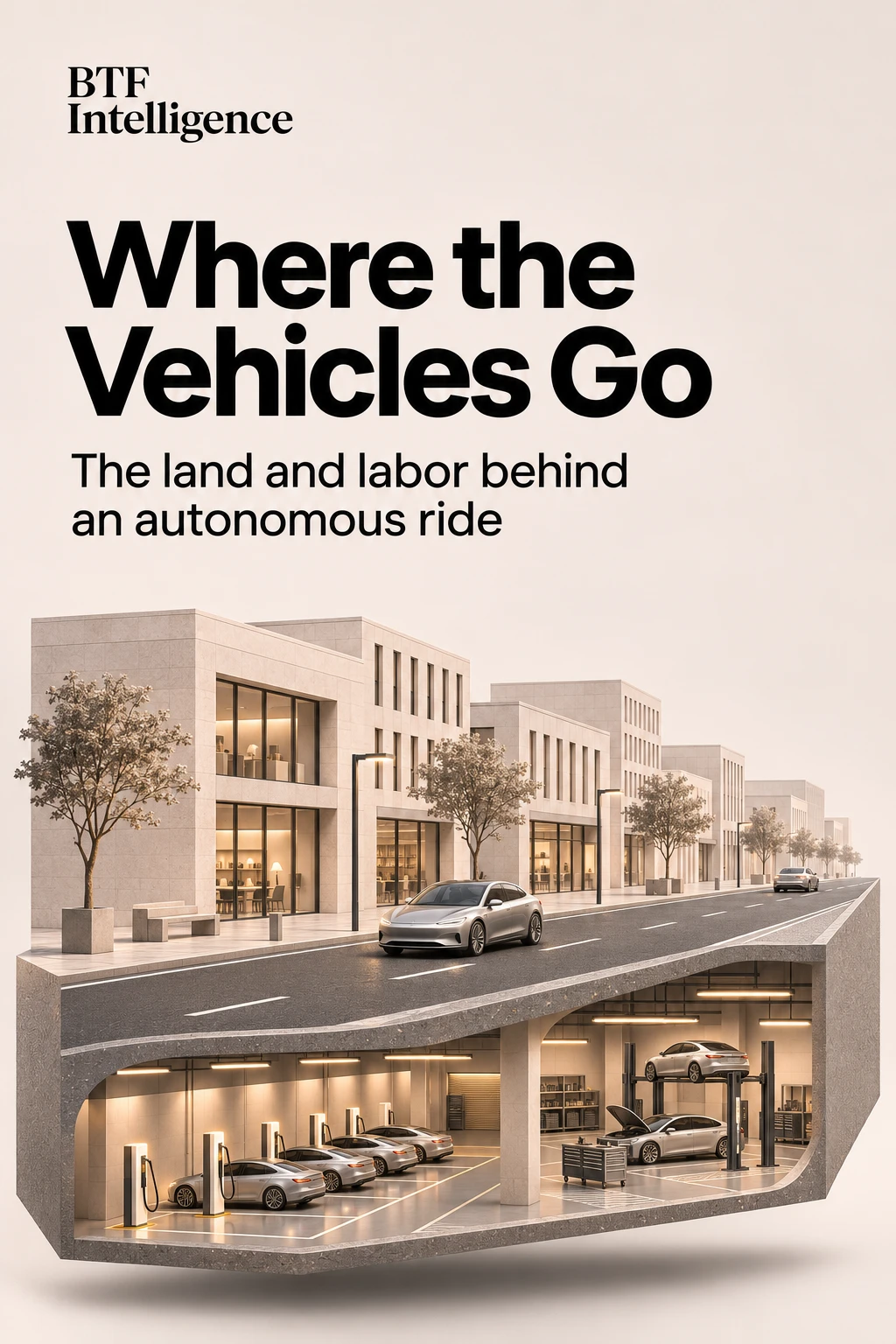
Where the Vehicles Go
The land and labor behind an autonomous ride
Summary
Autonomy could reduce the land needed to store vehicles at destinations while increasing the value of selected sites that keep those vehicles operating. The advantage belongs to locations that reduce the cost and uncertainty between useful journeys. It does not follow automatically from owning an empty lot near a service area. This report examines the physical network behind the ride: charging, cleaning, maintenance, staging and boarding. Its central judgment is that dependable access, power and operating arrangements matter more than a property's association with autonomous vehicles.
Lyft's Nashville depot provides a concrete starting point. Its October 2026 announcement described an 80,000-square-foot facility with charging equipment, repair bays and parts storage. November remarks confirmed the permanent depot's opening and described servicing in the early morning after late-night demand eased. Other corporate arrangements show driving technology, fleet operations and facilities divided among different companies. The distinction matters to owners because the recognizable passenger brand may not be the tenant or party responsible for improvements. Announced capacity and partnerships also do not establish a site's profitability or its actual throughput.
The report builds an illustrative operating day rather than assuming vehicles are continuously available. One hundred cars traveling 200 miles each, at an assumed battery consumption of 0.30 kilowatt-hours per mile, need 6,000 kilowatt-hours daily. With assumed charging efficiency of 90 percent, the electrical requirement becomes roughly 6,667 kilowatt-hours. Even that straightforward calculation says little about the workable schedule. Cars return at different times, charging rates vary, and cleaning or repairs compete for labor and space. Average capacity is a starting point, not proof that a facility can absorb peaks and disruptions.
Location then becomes a comparison of complete operating costs. A cheaper site can lose its advantage through empty travel, delayed electrical service or an unsuitable layout. Managed charging can reduce an electricity bill only within the scheduling flexibility the fleet actually possesses. Storage and solar introduce their own costs and constraints. At the passenger end, fewer long-stay spaces may coexist with a more demanding pickup problem. The report's event example shows how boarding time and concentrated departures determine theoretical bay requirements, while emphasizing that smooth averages are inadequate design standards for a real venue.
The commercial uncertainty is who pays for the necessary capacity and who bears the risk when demand falls short. Landlords, charging providers and fleet managers can hold different obligations under superficially similar partnerships. Fixed commitments can raise the cost per completed trip when activity declines. Announced timelines can also change: the April 2026 Hertz and Uber announcement anticipated service that year, while Uber's November remarks placed the Lucid and Nuro Bay Area commercial launch in the first quarter of 2027. A partnership's existence should remain distinct from its operating start and eventual earnings.
At Sunrise, the report does not identify an undisclosed fleet project or assume a depot is the site's best use. It asks how any proposal would compete with housing, customer access and other development possibilities. Evidence should include a confirmed electrical plan, workable circulation, credible customer commitments and measured effects on useful vehicle time. The next report extends that inquiry beyond the operator and owner, examining how the same change distributes benefits and costs across households, businesses, neighborhoods and the public budget.
This report reflects Dalton Skach’s views as of November 23, 2026. As of November 23, 2026, Dalton Skach owns shares in Tesla and SpaceX and holds no positions in Kimco Realty, Prologis, ABM Industries, EVgo or Verra Mobility. This is general research, not personalized investment advice or a recommendation to buy, sell or hold a security. Terms of Use.
Sources
November 23, 2026: Public summary published. The complete edition remains private.
- Flexdrive Nashville depot announcement
- Lyft Q3 2026 prepared remarks
- Next stop: Miami
- Scaling our fleet through U.S. manufacturing
- Electric Vehicles for Fleets
- Managed EV Charging for Federal Fleets
- Business electric vehicles
- Curb Allocation Change Project
- Passenger Loading Zones
- Hertz and Uber fleet partnerships
- Uber Q3 2026 prepared remarks
- Vehicles and the Grid
- AV Program Quarterly Reporting
- Autonomous Vehicles Policy
- Sunrise Tomorrow project overview
The full report is coming soon.
The complete report will be available to members when published.
Become a member