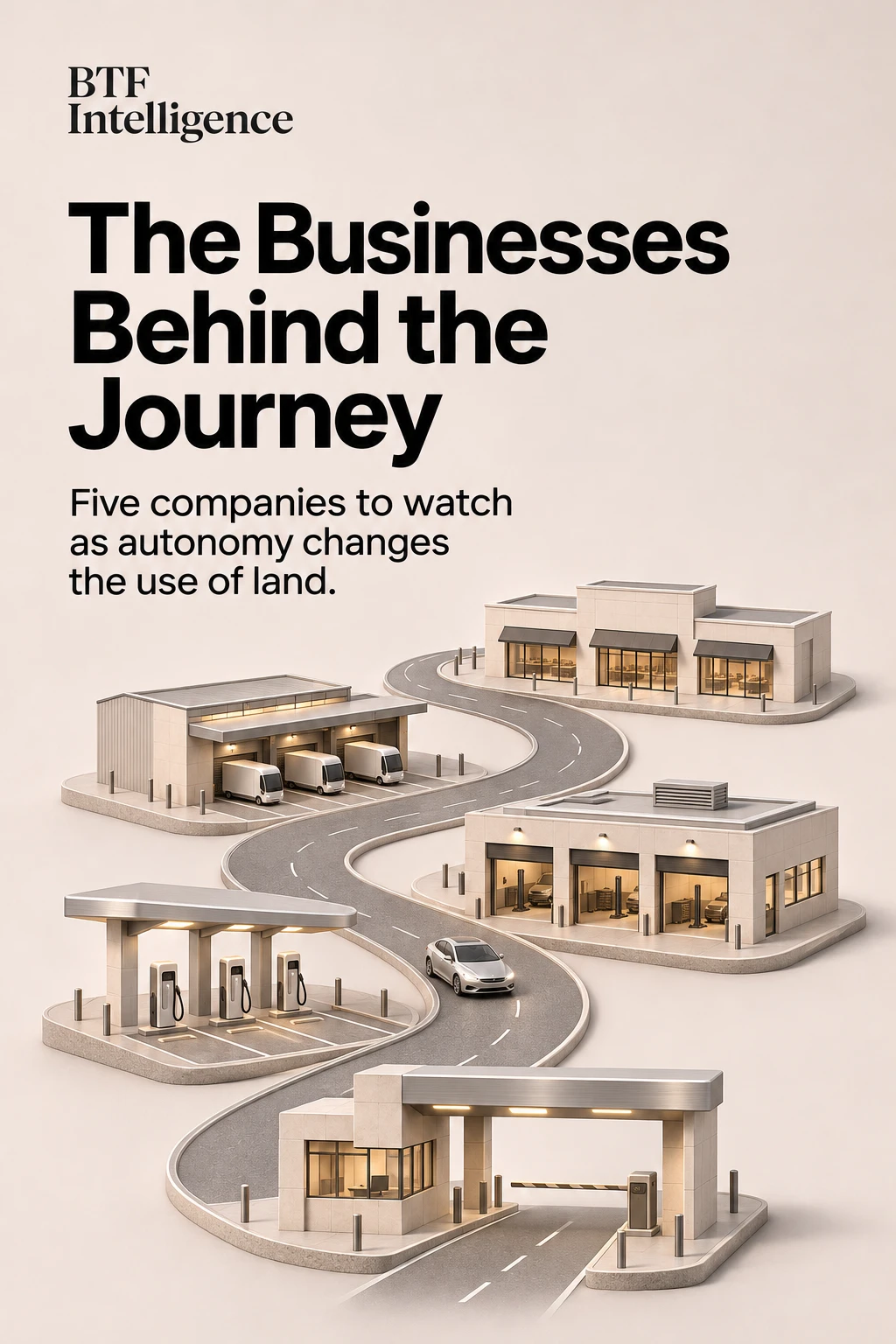
The Businesses Behind the Journey
Five companies to watch as autonomy changes the use of land
Summary
EVgo should lead the next research effort into autonomy's property consequences, followed by Prologis. This ranks research attention, not stocks or expected returns. EVgo separately reports a dedicated autonomous-vehicle charging footprint. Prologis tests the central property mechanism: assembling useful land, deliverable power and a customer agreement that can support the investment. Kimco Realty, ABM Industries and Verra Mobility complete the five-company watchlist, each revealing another place where value can be created, retained or lost between the passenger's journey and a property's next use.
EVgo's evidence is direct but uncomfortable for a simple growth story. Its September-quarter operating table showed 120 dedicated AV stalls, down from 140 a year earlier, even as its broader network expanded. The unanswered question is whether a smaller footprint served demand more effectively or reflected lost business. Aggregate throughput does not settle that question. Its November 9 release also described LS Power's nonbinding acquisition proposal. A November 23 review of issuer news and filing indexes located no later resolution. This is the latest disclosed position found, not confirmation of private negotiations or a completed transaction.
Prologis has documented fleet-charging capabilities in its logistics business, including hubs and charging at customer depots. Their relevance to autonomous passenger fleets must still become an operating case with a credible customer and recoverable capital costs. Public-agency material describing specific withdrawn projects reinforces the need to distinguish announcements from delivery. ABM provides a different comparison: an undated company case study reports commissioning over 100 charging units, representing more than 200 ports, for an unnamed autonomous ride-hailing provider across three cities. That strengthens direct deployment evidence, but undisclosed contract economics prevent a conclusion about materiality or attractive returns.
Kimco connects the inquiry to shopping-center redevelopment. Its reported $142.3 million sale of The Milton, a 253-unit apartment building at Pentagon Centre, demonstrates an executed mixed-use transaction rather than an autonomy benefit. A parking reduction creates value only through feasible development and workable tenant access. Verra supplies the caution about bargaining power: its October results described customer-contract pressures and a termination effective January 30, 2027. A necessary administrative service can face less favorable economics when concentrated customers negotiate or internalize work. More transactions do not automatically mean more provider earnings.
The series closes with dependencies rather than a timetable. Healthy destinations must need less parking before released land becomes meaningful. Households must actually relinquish vehicles before residential storage needs change. Fleet facilities must sustain the cost and reliability behind those decisions. Public benefits must survive the maintenance, access and financing obligations accepted to deliver them. Suppliers finally need repeat paid work that leaves cash after the required capital and operating responsibilities. These processes can overlap, and ordinary redevelopment can succeed without autonomy causing it.
The evidence to watch is therefore specific: a financeable phase, a household not replacing a car, measured improvements in fleet turnaround, a workable recurring public account and a renewed commercial relationship with adequate returns. Contrary observations would weaken the corresponding link without disproving every other benefit. None of the five companies is presented as owning Sunrise or holding its contracts. Their investment cases also require valuations of existing businesses. The opportunity becomes credible when a provider makes a useful part of the place work repeatedly and retains enough of the payment to justify what it invested.
This report reflects Dalton Skach’s views as of November 23, 2026. As of November 23, 2026, Dalton Skach owns shares in Tesla and SpaceX and holds no positions in Kimco Realty, Prologis, ABM Industries, EVgo or Verra Mobility. This is general research, not personalized investment advice or a recommendation to buy, sell or hold a security. Terms of Use.
Sources
November 23, 2026: Public summary published. The complete edition remains private.
- Kimco Realty, Second Quarter 2026 Results
- Kimco Realty, Third Quarter 2026 Results
- Prologis, Third Quarter 2026 Results
- Prologis, 2024–25 Global Impact and Sustainability Report
- South Coast AQMD, Technology Committee agenda packet
- ABM, Fiscal Third Quarter 2026 Results, SEC Exhibit 99.1
- ABM, EV Charging solutions
- EVgo, Third Quarter 2026 Results
- EVgo, Form 10-Q for quarter ended September 30, 2026
- EVgo, Fleet Solutions announcement
- Verra Mobility, Third Quarter 2026 Financial Results
- BTF, The Land Beneath the Parking Lot
- ABM, Autonomous EV Fleet Charging Infrastructure Case Study
- EVgo, News Releases index
- EVgo, SEC Filings index
The full report is coming soon.
The complete report will be available to members when published.
Become a member