Summary
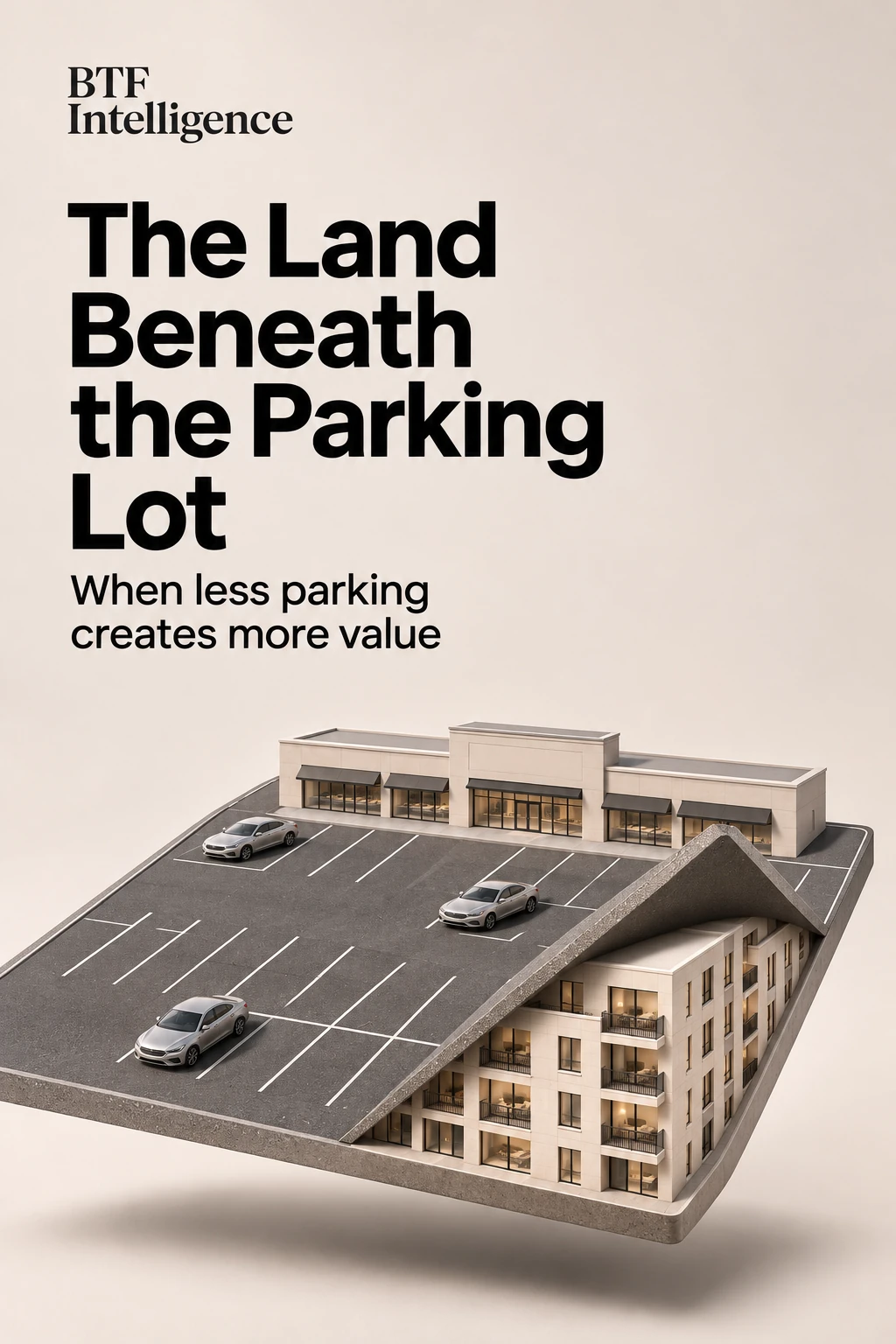
Autonomous transport's first substantial real-estate opportunity may come from making selected redevelopment projects less expensive, rather than making parking disappear everywhere. A shopping center that can serve customers with fewer parked vehicles may be able to put some of its land to another use. But that opportunity has value only when the owner controls the necessary rights, there is demand for the replacement buildings, and the project can be financed. The strongest candidates may be operating properties where one manageable development phase becomes feasible before households give up their cars altogether.
Sunrise Mall in Citrus Heights, California, provides a place to examine those conditions. A November 2021 city presentation recorded 6,400 parking spaces, a historical inventory rather than a current occupancy survey. The city's redevelopment framework already envisioned mixed uses, and subsequent sports-center proposals illustrate the additional work needed to secure property, financing and approvals. Sunrise is not established here as an autonomy-led redevelopment. Its usefulness is that it lets us separate an opportunity already being pursued from the additional change autonomous transport might enable.
The missing link is behavior. A robotaxi ride that replaces a conventional taxi does not necessarily free a parking space. One that replaces a private-car visit can, but the impact depends on visit duration, the busiest periods, and whether enough space can be consolidated into a usable parcel. Waymo's historical shopping-center partnership at Ahwatukee Foothills Towne Center establishes that autonomous shopping trips can occur. It does not establish a measured parking reduction. Concentrated departures also create a different requirement: enough pickup capacity to move people safely and conveniently.
Parking replacement is where the economics become tangible. Pentagon Centre's project documentation describes a garage that enabled redevelopment while preserving parking for existing retailers. A defensible reduction in replacement parking could improve that kind of project's economics. The report's explicitly illustrative apartment model uses a broad WGI construction benchmark to show how reducing parking can turn a negative land residual positive. Sensitivity tests show how lower income, higher required investment yields, construction overruns and delay can overwhelm the modeled savings. These calculations explain a mechanism; they are not a Sunrise valuation or a forecast of local construction costs.
The benefit does not automatically reach everyone equally. Less costly development can make additional housing feasible without guaranteeing lower rents in a particular building. Existing businesses must survive construction, and people who cannot use the new transport service still need reliable access. At Sunrise, the March financing framework described a potential General Fund backstop, while July publicity emphasized project revenues as the intended repayment source. Definitive documents must establish the final exposure. The relevant comparison is with the best project feasible under present transport conditions, so ordinary redevelopment gains are not misattributed to autonomy.
The evidence to watch is therefore specific: falling peak parking demand alongside healthy customer activity; travel data showing which private-car visits are displaced; workable pickup arrangements during busy periods; tenant, lender and planning acceptance; and a financed project that demonstrably improves because less parking is needed. Until those links are established, Sunrise supplies a compelling redevelopment question rather than proof of an autonomy windfall. The opportunity belongs to owners who can turn a verified change in access into a useful, economically durable next use for the land.
This report reflects Dalton Skach’s views as of November 23, 2026. As of November 23, 2026, Dalton Skach owns shares in Tesla and SpaceX and holds no positions in Kimco Realty, Prologis, ABM Industries, EVgo or Verra Mobility. This is general research, not personalized investment advice or a recommendation to buy, sell or hold a security. Terms of Use.
Sources
November 23, 2026: Published with the complete report.
- City of Citrus Heights, Sunrise Tomorrow City Council presentation, November 10, 2021, PDF page 3, “Existing Conditions.” Historical figures: 95 acres, 1.4 million square feet of existing building area, 6,400 parking spaces. The city commonly rounds the wider site to 100 acres; the DEIR registry lists 95.8 acres. These are not interchangeable survey measurements.
- City of Citrus Heights, Sunrise Tomorrow Specific Plan background, accessed November 22, 2026. Records adoption on November 10, 2021; describes mixed uses, private ownership and implementation by owners. Some later city publicity says 2022; the adoption-specific source is used here. Permitted development is not a construction commitment.
- City of Citrus Heights, Sunrise Sports Center Takes Major Step Forward with Property Agreement, July 29, 2026. Purchase agreement and proposed financing description; project and financing still subject to review and approval in that announcement. Not proof of a closed acquisition, issued bonds or construction commencement.
- Sara Beth Williams, Citrus Heights Sentinel, Future of independent toy store in Sunrise Mall uncertain, November 7, 2026, section “What’s happening with the rest of Sunrise Mall?” Used for dated reporting that the majority-property purchase remained pending and the uncertainty facing the independent toy store. No claim of an independently verified present title chain.
- Waymo, Growing Waymo’s Partnerships in Metro Phoenix, July 25, 2018. Pilot announcement involving DDR and Ahwatukee Foothills Towne Center. Historical company statement, not evidence of current service coverage at Sunrise or of removed parking.
- SITE Centers, 2020 Corporate Responsibility and Sustainability Report, printed page 35, “Waymo.” Company-reported more than 2,000 rides from the partnership; not a parking-occupancy study.
- City of Citrus Heights, Sunrise Tomorrow project overview, accessed November 22, 2026. Describes the proposed 4,000-seat arena and sports complex. Event-departure discussion is BTF analysis, not an operational forecast or a measured queue at this site.
- Neda Mirzaeian, Soo-Haeng Cho and Sean Qian, Can Autonomous Vehicles Solve the Commuter Parking Problem?, Management Science, published online February 18, 2026. Abstract reviewed. Game-theoretic commuter model; supports the possibility of increased vehicle miles/hours when parking relocates. Not empirical proof of shopping-center effects. No percentage forecast from the paper is transferred to this report.
- City of Citrus Heights, Sunrise Tomorrow Specific Plan FAQ, accessed November 22, 2026. Questions on progress and the April 2025 amendment denial. City reports that anchor closures lifted longstanding private restrictions. Underlying private instruments have not been independently reviewed. The FAQ contains inconsistent descriptions of interim uses as open versus under construction; those status claims are excluded.
- Pentagon Centre Urban Design Guidelines, May 3, 2024 submission, hosted by Arlington County, PDF page 11, “Physical Conditions & Constraints.” Records the 2016 garage enabling Blocks A and C redevelopment while retaining required retailer parking; discusses tunnel and access constraints. Used as historical project documentation, not a statement of current final approvals.
- City of Citrus Heights, Sunrise Tomorrow Multi-Modal Transit Center and Frontage Access Improvements, accessed November 22, 2026. Funding sought for final engineering, transit-center right-of-way acquisition and construction.
- WGI, WGI Earns Two 2026 Zweig Group Marketing Excellence Awards, October 13, 2026, section “The 2026 Parking Structure Cost Outlook Is Here.” WGI states a national median of $33,300 per parking-structure space. Used as a dated broad benchmark only. The complete 2026 cost workbook and project-specific scope exclusions were not obtained; the report does not present this as an all-in or marginal construction quote.
- U.S. Access Board, Guide to the ADA Accessibility Standards: Passenger Loading Zones, accessed November 22, 2026. General accessibility guidance for designated passenger loading zones. No finding about a particular Sunrise design's legal compliance is made.
- City of Citrus Heights, Sunrise Tomorrow Specific Plan, adopted November 10, 2021, printed pages 94–95, section 4.2.3, DS-30 and Table 4.1; physical PDF page 48 in the downloaded combined file; also printed pages 286–287 (physical page 198), infrastructure financing and Table 8.2. The latter has a roughly $83m narrative figure versus $86,113,100 table total and mid-2020 cost inputs with scope exclusions. Neither is used as a current budget. Historical minimum/maximum structure and project parking-plan requirements verified in text and rendered page. This is not a determination of the rules applicable to a 2026 application.
- University of Washington Transportation Center, Curb Allocation Change Project, December 4, 2019. University summary of the Seattle study on three Boren Avenue N block faces, December 2018–January 2019. Loading-zone expansion and geofencing improved compliance and reduced dwell time; roadway speed effects were not significant and average loading-zone occupancy remained under 20%. Historical human-driven ride-hail evidence, not an autonomous-vehicle trial.
- Mustapha Harb, Joan Walker, Jai Malik and Giovanni Circella, Real-World Simulations of Life with an Autonomous Vehicle Suggest Increased Mobility and Vehicle Travel, UC Institute of Transportation Studies policy brief, November 2021, DOI 10.7922/G2K35RZ5, PDF pages 2–3. Forty-three Sacramento-region households received chauffeurs for one or two weeks; observed VMT rose 60%, with more than half of the increase from zero-household-passenger trips. Short simulated private-ownership experiment, not a robotaxi fleet evaluation or a long-run forecast. Brief reviewed via the publisher’s PDF.
- City of Citrus Heights, March 11, 2026 City Council agenda packet, Item 9 staff report, pages 4–6 of 10; physical PDF page 65 contains the financing/backstop discussion. Describes the proposed Economic Development and Participation Agreement, further approvals, up to $60m city financing matched with TMS equity, first-priority deed of trust and a General Fund backstop in default. The agenda packet is a proposed framework, not an executed bond document. Read alongside the later July announcement; neither establishes definitive financing terms.
- Kimco Realty, Second Quarter 2026 Results, August 4, 2026, “Transactional Activities.” Reports sale of The Milton, 253 units at Pentagon Centre, for $142.3m at approximately 4.9% cap rate; Kimco pro-rata proceeds $78.2m. Company-reported transaction, not an appraisal of Sunrise or a measure of autonomy's contribution.
- Daniel Baldwin Hess and Jeffrey Rehler, Minus Minimums: Development Response to the Removal of Minimum Parking Requirements in Buffalo (NY), Journal of the American Planning Association 87(3), 2021, pp. 396–408, DOI 10.1080/01944363.2020.1864225. Author-university abstract reviewed: 36 major developments in the first two years after reform; 47% below former minimums, mixed-use parking 53% below prior requirements, aggregate single-use parking above prior requirements. Historical observational evidence; not a universal causal effect or autonomy study.
- Carolina Reid, Terner Center for Housing Innovation, The Costs of Affordable Housing Production: Insights from California's 9% Low-Income Housing Tax Credit Program, March 2020, Table 3, PDF page 21; interpretation on page 22. Structured-parking coefficient $35,945 per residential unit in the multivariate model. Not a per-stall estimate or guaranteed avoidable cost.
- UCLA, Low-income renters pay a high, and hidden, price for city parking requirements, June 8, 2017, reporting research by C.J. Gabbe and Gregory Pierce using the 2011 American Housing Survey. Supports discussion of parking bundled into housing rents. Historical associations are not current Sacramento pricing or guaranteed savings from unbundling.
- California Public Utilities Commission, AV Program Quarterly Reporting, page updated November 17, 2026, accessed November 22, 2026. Reporting definitions, available reports, redactions and corrections reviewed. Individual quarterly datasets were not analyzed for this report; no fleet-performance or Sunrise-attribution statistic is claimed.
Read the complete report.
The complete first report in this series is free to read.
Read the report free