What NASA’s Moon Awards Change for SpaceX and Blue Origin
By Dalton Skach · 3 min read
A satellite deployment and a rover delivery give investors two different ways to judge the lunar business. One tests whether a transport service works. The other puts a price on getting a customer’s equipment onto the surface.
NASA announced both on November 7. For SpaceX and Blue Origin, the question is how much those assignments should change a forecast for repeat lunar work.
What NASA has actually bought
SpaceX’s Starship communications deployment is scheduled for 2028 under an existing lunar logistics contract. The release gives no price for that task order. Blue Origin’s PROMISE delivery expands a May task order and carries a $94 million base award plus a $140 million performance option. Both companies also qualify to compete in CLPS 2, a ten-year program with a shared $10 billion ceiling.1
A mission can establish more than revenue
For SpaceX, a successful deployment could give NASA evidence that Starship can deliver a communications payload beyond Earth orbit. That would be useful when the agency evaluates another mission. It would still leave investors needing a price, the cost of performing the work, and evidence that customers will buy the service again.
For Blue Origin, the performance option is larger than the base award. Together they total $234 million, with roughly 60% conditional on the option. Treating the whole amount as assured business would erase the distinction NASA made in the contract structure.2
PROMISE is also a substantial payload integration task. NASA plans to adapt Curiosity’s duplicate test vehicle and other Mars rover hardware, power it with a radioisotope generator, and launch in late 2028 for an 18-month primary mission. Blue Origin’s Mark 1 lander will carry it to the lunar South Pole.3
Reusing hardware may shorten the rover’s development path. It does not tell an investor when the combined rover, lander and launch system will be ready. I would want to see integration and testing milestones before becoming more confident in the delivery schedule.
The next order matters
The commercial test comes after a successful demonstration: can the supplier fly again without rebuilding its business around each mission? A repeat order can reveal what a customer will pay for an established capability. Repeat delivery can reveal whether the supplier’s costs improve.
The announcements also name Falcon 9 and New Glenn among launch vehicles for other missions, and Honeybee Robotics for miniCAST energy storage. NASA does not break out those suppliers’ economics in the release.4 More roles create more possible routes to revenue, but counting the roles alone cannot establish their value.
The investor takeaway
I would add the named missions to a delivery forecast, keep the PROMISE option conditional, and leave the CLPS 2 ceiling out of company revenue estimates. The package strengthens the evidence that NASA wants to buy lunar logistics. It leaves the question of profitable, repeatable delivery open.
The evidence that would change my view is a follow-on order with disclosed economics, backed by a demonstrated ability to repeat the service. Until then, the most useful question for either company is: what does the next mission cost after this one has taught you how to do it?
This article reflects Dalton Skach’s views as of November 8, 2026. It provides general research and does not offer personalized investment advice or recommend buying, selling, or holding a security. As of November 8, 2026, Dalton holds shares in SpaceX and does not hold shares in Blue Origin. Editorial Standards & Disclosures · Terms of Use
Sources and calculations
- NASA, release 26-095, November 7, 2026. “Moon Base cargo landers,” “Nuclear-powered Moon rover,” and “Launch, transportation awards.” Event and announcement date: November 7. CLPS 2 eligibility does not allocate the ceiling to any company. ↩
- NASA, “Nuclear-powered Moon rover.” BTF calculation: $94 million + $140 million = $234 million; $140 million ÷ $234 million = 59.8%. The option is performance-based. Award values are not a statement of recognized revenue or profit. ↩
- NASA, PROMISE mission page, “From Mars to the Moon” and “Equipped to Explore,” accessed November 8, 2026. Hardware, power source, launch target and mission duration. Mark 1 assignment: November 7 release, “Nuclear-powered Moon rover.” ↩
- NASA, “Launch, transportation awards” and “Lunar architecture, infrastructure.” Falcon 9, New Glenn and Honeybee roles. Individual supplier revenue and margin are not provided in this release. ↩
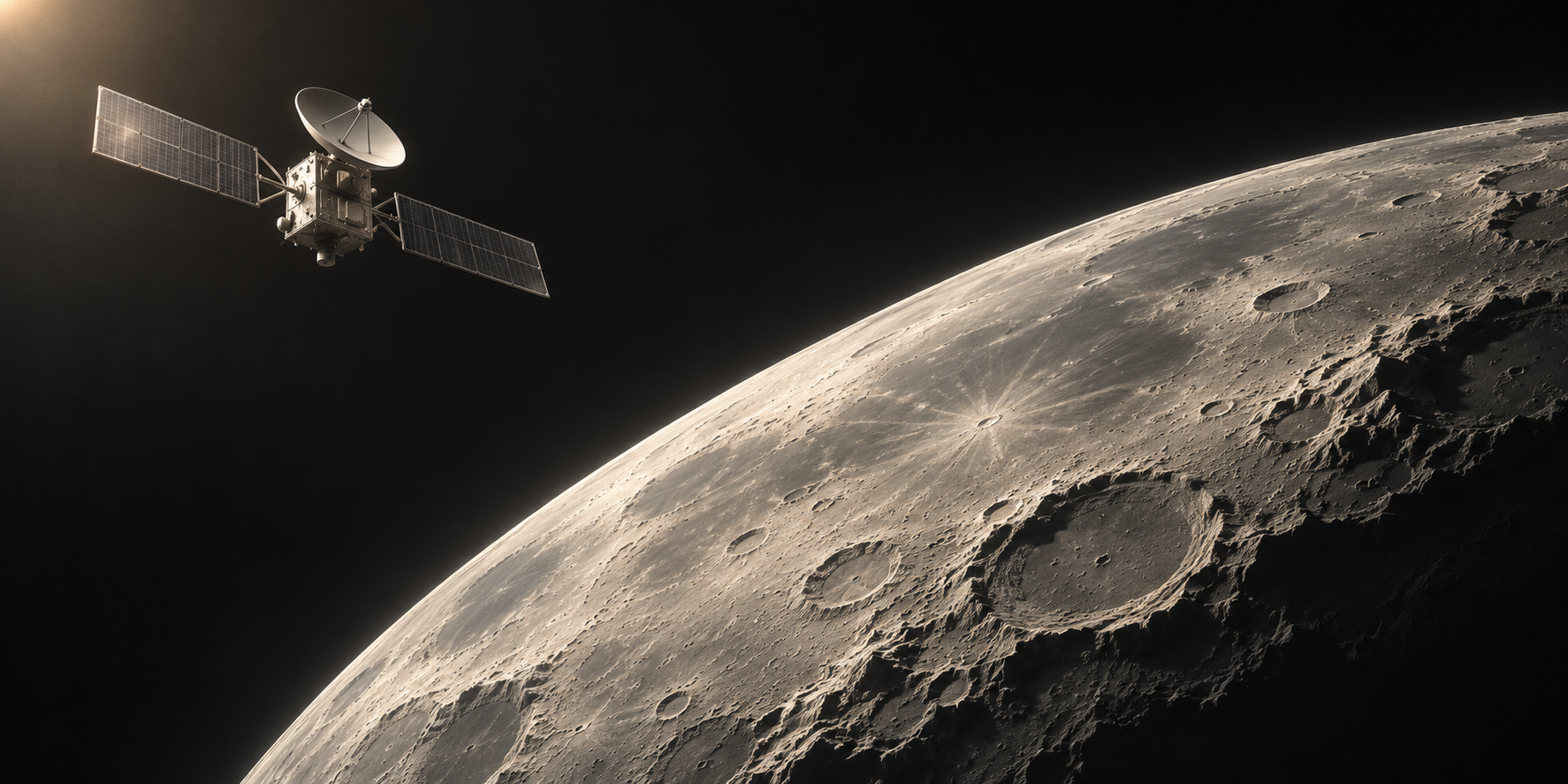
Hero: original AI-generated photographic illustration of a conceptual satellite and lunar terrain. It does not depict an actual mission. Body illustrations: original AI-generated sculpted models, approved November 8, 2026. The models are conceptual, not exact vehicle designs. The second visual is an analytical framework, not a forecast of mission success.