Who Wins NASA’s $10 Billion Moon Business?
By Dalton Skach · 6 min read
Before astronauts can live on the Moon, somebody has to deliver their equipment. NASA is opening a larger market for that work. Blue Origin has an early advantage in assigned cargo missions, while SpaceX can benefit even when another company supplies the lander.
NASA’s November 7 announcement created a ten-year lunar delivery framework with a shared $10 billion ceiling and eight eligible suppliers. It also assigned specific missions through other contracts. The investor question is which companies can turn those opportunities into repeat, profitable deliveries.1
My expectation is that the work will be divided. Between Blue Origin and SpaceX, Blue Origin has the clearer near-term cargo award momentum. SpaceX has an additional route through launch services, alongside the larger opportunity it is developing with Starship. Neither deserves to have the entire $10 billion added to its revenue forecast.
What the $10 billion actually buys
The Commercial Lunar Payload Services program, or CLPS, lets NASA buy transportation for scientific instruments and equipment. A supplier may manage the spacecraft, arrange its launch and deliver the cargo. Think of NASA hiring a delivery company rather than building every truck itself.
Under CLPS 2, the new framework, eligibility is an invitation to compete for individual assignments called task orders. Intuitive Machines describes a shared $10 billion ceiling over approximately ten years, potentially rising to $15 billion if NASA exercises a five-year extension. Neither number promises an equal share to the participants, nor guarantees that NASA will spend the full amount.2
The field includes Blue Origin, SpaceX, Firefly Aerospace, Intuitive Machines, ispace-U.S., Lockheed Martin Space, Northrop Grumman Space Systems and Voyager Technologies. NASA is buying access to several capabilities, giving it alternatives when schedules or mission requirements change.3
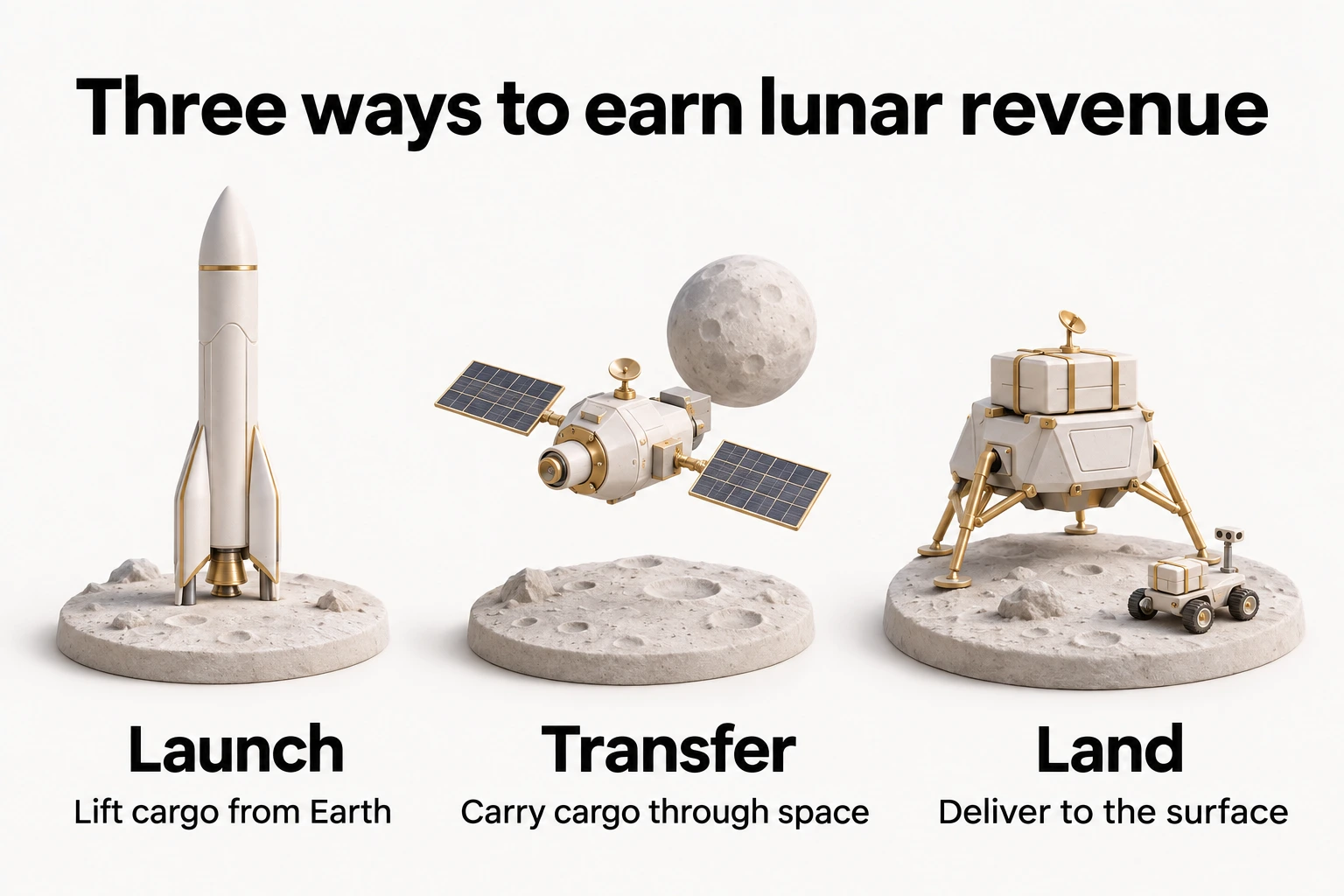
It also helps to separate three jobs: launching from Earth, transporting cargo through space, and landing it on the Moon. A company can earn money on one stage without winning the entire delivery. Those stages may be bundled into one customer contract, so their values should not automatically be added together.
Blue Origin has orders to build around
Blue Origin’s immediate advantage is a sequence of named customers and deliveries. In May, NASA awarded it $188 million, plus $280.4 million in performance-dependent options, to deliver two lunar terrain vehicles. Those are rovers intended to support operations on the surface.4
The November package adds the PROMISE rover delivery using Blue Origin’s Mark 1 lander: a $94 million base award and a $140 million performance option. The combined potential value is $234 million, with about 60% dependent on the option. NASA is targeting a late-2028 launch.5
That sequence matters commercially. Several assignments can help a company retain its engineering team, plan production and apply lessons from one vehicle to the next. Successful delivery would give NASA a stronger reason to buy again. It does not yet establish a profit margin.
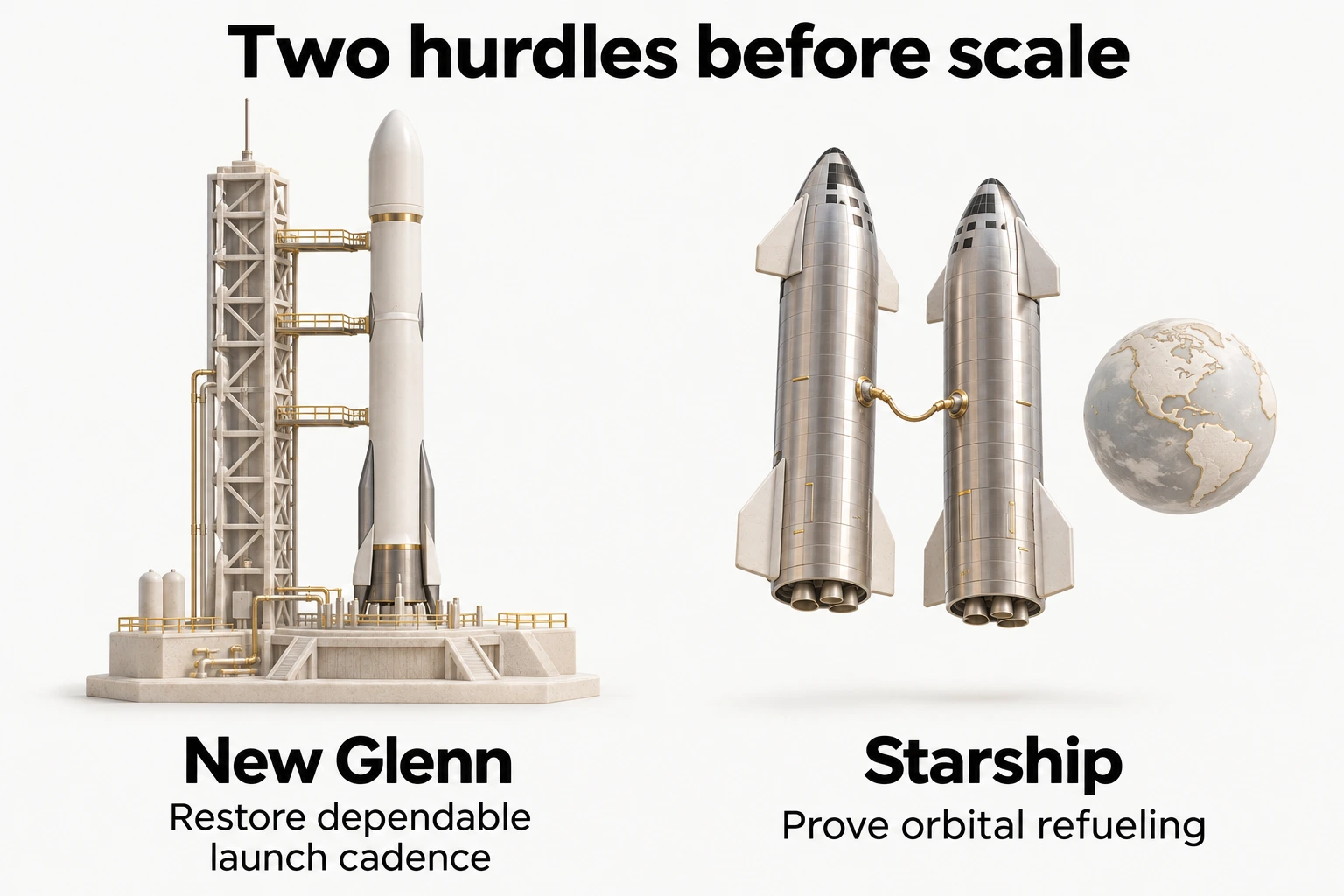
The qualification is execution. In an October 16 update, Blue Origin said its LC-36A launch complex was being restored after an earlier anomaly. Its planned production and launch expansion describes capacity it intends to build, rather than a demonstrated high flight rate.6 I would favor Blue Origin’s order momentum without assuming it has already solved the launch and landing schedule.
SpaceX can earn money before Starship lands
SpaceX’s opportunity has two parts. NASA names Falcon 9 among the rockets for the newly awarded transportation missions. Separately, it selected Starship to deploy communications satellites in the Earth-Moon region in 2028, under an existing lunar logistics contract. The release does not disclose a price for that Starship assignment.7
For a SpaceX investor, the first route is especially useful: another contractor’s lunar order can still create demand for a SpaceX launch. That is why market share in landers alone would understate SpaceX’s possible participation.
Starship offers a different investment proposition. If SpaceX can spread development and flight costs across repeated, substantial deliveries, it could build a valuable transport business. But a satellite deployment assignment is not proof that its lunar landing system works or that its eventual cost per delivery will beat competitors.
NASA’s October 23 architecture update still makes orbital refueling central to Starship’s crewed lunar plan. Tanker spacecraft must collect extremely cold propellant in a depot, which then fuels the lander. The relevant evidence is an integrated demonstration of that process, followed by an uncrewed lunar demonstration, rather than rocket size alone.8
Who is most likely to win?
I expect several suppliers to win different missions. Blue Origin looks well positioned for further rover and infrastructure deliveries if it executes its existing assignments. SpaceX can participate through launch purchases and could become more competitive for demanding lunar transport as Starship demonstrates its capabilities. This is my assessment of the evidence, not a published consensus forecast or a NASA ranking.
Firefly is a serious competitor. Its November 7 announcement points to Blue Ghost’s successful March 2025 landing and completion of its mission objectives, followed by four additional CLPS missions. It is developing a larger lander.9 For payloads that fit its demonstrated capabilities, that experience is a concrete reason to expect more opportunities.
Intuitive Machines says it has received six earlier CLPS task orders, including two this year.10 Existing relationships and mission experience make it another credible contender. The evidence does not justify assigning most future dollars to the two best-known companies before NASA specifies the missions, prices and delivery requirements.
The separate race to land astronauts also remains open. NASA’s October update says neither provider is assigned a specific Artemis lunar landing mission; readiness will determine the first selection. Blue Origin’s accelerated crewed design defers propellant transfer in favor of transfer stages. That changes its technical challenge, but does not make its cargo awards a decision on who lands astronauts first.11
The investor takeaway
I would expect a shared market, with Blue Origin’s existing cargo orders giving it an early commercial advantage and SpaceX able to benefit through both launches and Starship development. I would keep future task orders, performance options and demonstrated delivery revenue separate in any valuation.
The evidence that would strengthen that view is dependable New Glenn operations, successful rover deliveries, Starship refueling and lunar demonstrations, and follow-on orders at prices that cover the suppliers’ costs. Delays, unsuccessful missions or awards shifting toward experienced smaller lander providers would weaken the case for either company capturing a large share. Winning the right to bid is the beginning of this business.
This article reflects Dalton Skach’s views as of November 9, 2026. It provides general research and does not offer personalized investment advice or recommend buying, selling, or holding a security. As of November 9, 2026, Dalton owns shares in SpaceX and has no financial interests in Blue Origin, Firefly Aerospace, Intuitive Machines, ispace, Lockheed Martin, Northrop Grumman or Voyager Technologies. Editorial Standards & Disclosures · Terms of Use
Sources and calculations
- NASA, release 26-095, November 7, 2026, “Moon Base cargo landers.” Event date: November 7. Article date: November 9. ↩
- Intuitive Machines, November 9, 2026, CLPS 2 scope and contract structure. The optional extension to $15 billion is the company’s description; NASA’s November 7 release states the ten-year, $10 billion framework. No extension is treated as exercised here. ↩
- NASA, November 7, “Moon Base cargo landers” and “Launch, transportation awards.” Supplier list and distinct transportation roles. Commercial implications are BTF analysis. ↩
- NASA, release 26-046, May 26, updated May 27, 2026, rover delivery task orders. These are earlier CLPS 1.0 assignments, not allocations from the new ceiling. ↩
- NASA, November 7, “Nuclear-powered Moon rover.” Calculation: $94 million + $140 million = $234 million; $140 million ÷ $234 million = 59.83%. These are contract amounts, not recognized revenue or profit. ↩
- Blue Origin, October 16, 2026, “Expanding launch capacity” and “Manufacturing for a growing flight schedule.” Company account of restoration and planned expansion; not a current launch-date confirmation. ↩
- NASA, November 7, “Launch, transportation awards.” The approximately $1.3 billion of transportation orders is separate from CLPS 2 and is not assigned wholly to either company. ↩
- NASA, October 23, 2026, “Starship lander concept of operations.” Crewed architecture is evidence of development requirements, not a specification for every CLPS mission. ↩
- Firefly Aerospace, November 7, 2026, page 1, CLPS 2 vendor announcement. Flight history, subsequent orders and larger-lander plans are attributed to the company. ↩
- Intuitive Machines, November 9, previous task-order awards. An award count is not a count of completed missions. ↩
- NASA, October 23, “Blue Moon lander concept of operations” and “Returning American astronauts to the Moon.” ↩
News lead: Lucas Nolan, Breitbart, November 9, 2026, citing the New York Post. The supplied article correctly distinguishes the ceiling from committed spending. This analysis checks the underlying announcement and company statements. No market-implied probabilities or contract-share estimates are asserted.
Artwork: original AI-generated conceptual photography for the hero and thumbnail, and two original sculpted-model illustrations. None depicts an actual mission, completed lunar base, exact vehicle design or engineering interface. The second illustration selects two development priorities rather than presenting a complete readiness checklist. Research accessed November 9, 2026.