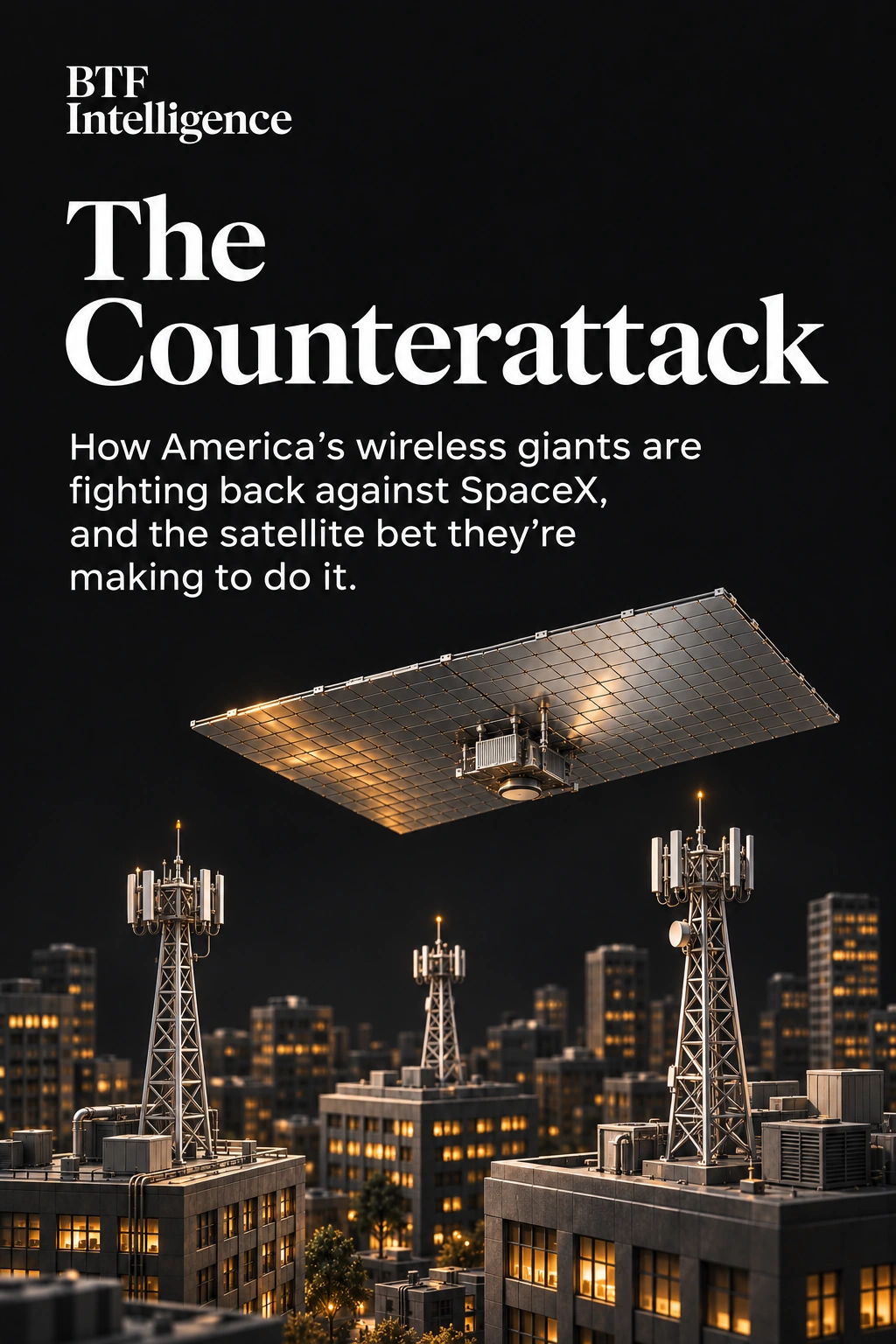
The Counterattack
How America’s wireless giants are fighting back against SpaceX, and the satellite bet they’re making to do it
Summary
America's largest wireless carriers are not waiting for SpaceX to finish its network. They are trying to keep satellite connectivity under their control: an added capability purchased from competing suppliers, while the carriers retain the customer and the monthly bill. My judgment is that this is a credible defense, but its satellite component depends on alternatives to SpaceX becoming dependable commercial services.
The response has several parts. AT&T, Verizon and T-Mobile have refused SpaceX the terrestrial network access that could accelerate its entry. They have also formed a joint venture intended to support satellite coverage through pooled spectrum and multiple suppliers. These are related business interests, but they are not the same evidentiary claim. Publicly documented cooperation on satellite supply does not establish an agreement among the carriers to refuse SpaceX network access.
AST SpaceMobile is central to the alternative. AT&T and AST reported a test in which an ordinary phone moved between terrestrial and satellite coverage without losing its connection. That is meaningful evidence of technical progress. It is not proof of continuous nationwide service, sufficient capacity or attractive commercial economics. The report identifies launch availability and constellation deployment as critical constraints. A demonstrated connection must become a service customers can repeatedly use.
Amazon offers another potential counterweight through its announced Globalstar acquisition and relationship with Apple. But regulatory approval is different from closing a transaction, and a planned next-generation phone constellation is different from an operating one. The carriers gain bargaining power only if competing suppliers can deliver useful service on a relevant timetable.
Their stronger defenses are already on Earth: dense networks, handset financing, customer service and combinations of mobile and home internet. Those relationships can make switching inconvenient. They do not eliminate the risk that a new competitor weakens pricing power or raises the cost of retaining customers. The carriers can protect market share and still earn less from it.
The key evidence is therefore operational: AST's launches and commercial availability, Amazon's deployment milestones, the joint venture's supplier agreements, and any change in the carriers' refusal to sell SpaceX terrestrial access. The full report examines how the technical, regulatory and customer defenses interact, and why the carriers' answer to SpaceX still depends partly on satellite companies that need SpaceX's rockets.
This summary reflects the report published November 12, 2026. As confirmed November 8, 2026, Dalton owns shares in Tesla and SpaceX. Editorial Standards and Disclosures · Terms of Use
Sources
November 12, 2026: public summary added. The complete report is unchanged.
- AT&T: satellite joint venture announcement
- AT&T: reported October 21 satellite handoff demonstration
- AST SpaceMobile: November 9 deployment and launch update
- Amazon: announced Globalstar acquisition and Apple agreement
- FCC: Globalstar transaction approval
- Verizon: third-quarter 2026 earnings transcript
- AT&T: third-quarter 2026 earnings transcript
- T-Mobile: third-quarter 2026 earnings transcript
Read the complete report.
The preview is free. Become a member to read the complete report, with quarterly or annual access to the member research archive and new member reports during your subscription.
Become a member to read